
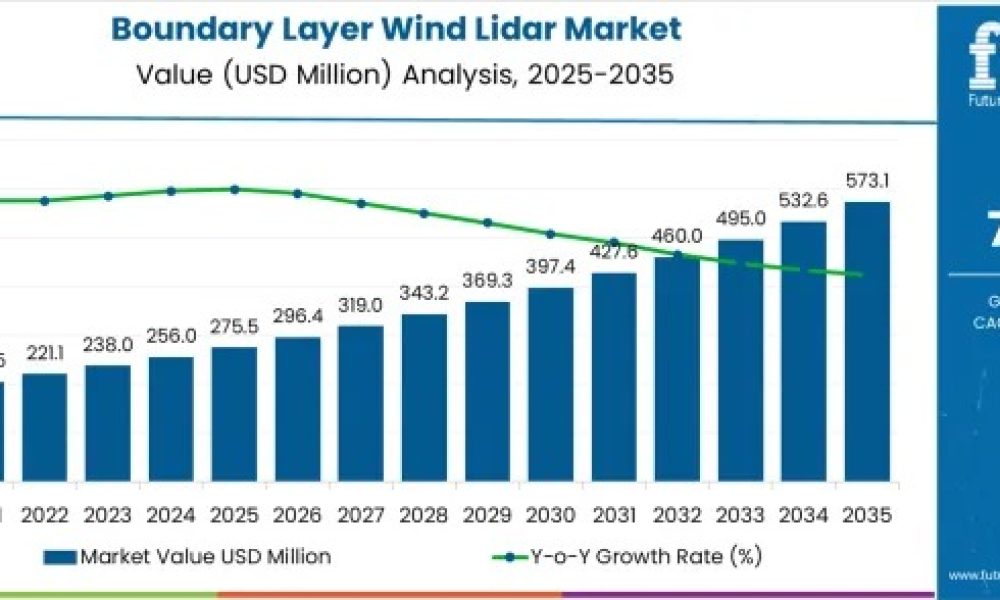
The global Boundary Layer Wind Lidar Market is gaining strong momentum as industries prioritize accurate, high-resolution wind measurements within the lower atmosphere. Valued at USD 275.5 million in 2025, the market is forecast to reach USD 573.1 million by 2035, registering a 7.6% CAGR over the period.
This growth reflects a structural shift from conventional meteorological tools to lidar-based systems capable of delivering continuous, three-dimensional wind profiling. Wind energy developers, meteorological agencies, and research institutions increasingly depend on boundary layer data to reduce uncertainty, improve forecasting accuracy, and optimize operational decisions.
Subscribe for Year-Round Insights → Stay ahead with quarterly and annual data updates
The wind energy sector represents the largest share of demand at approximately 30–35%, driven by the growing need for precise wind measurements to optimize turbine siting, performance, and energy yield. Boundary layer wind lidars are extensively deployed in wind resource assessment programs to capture wind profiles across multiple altitudes, supporting more accurate feasibility studies and operational planning.
Environmental monitoring accounts for nearly 20–25% of market adoption, as these systems play a critical role in tracking atmospheric conditions, air quality, and pollution dispersion. The high-resolution data generated by boundary layer wind lidars supports climate modeling, regulatory compliance, and long-term environmental protection initiatives.
Key Market Numbers at a Glance
- Market value (2025): USD 275.5 million
- Forecast value (2035): USD 573.1 million
- CAGR (2025–2035): 7.6%
- Leading radar type: Low and medium altitude systems (≈45% share)
- Primary demand regions: Asia Pacific, North America, Europe
Growth Drivers Shaping Market Expansion
Several structural drivers are accelerating adoption across industries:
- Wind energy optimization
- Boundary layer wind lidars improve turbine siting accuracy
- Reduced uncertainty enhances long-term power yield forecasts
- Critical for offshore and complex terrain wind projects
- Meteorology and climate research
- High-resolution wind data strengthens weather prediction models
- Supports climate change research and pollution dispersion studies
- Increasing regulatory focus on environmental monitoring
- Aviation and infrastructure safety
- Used for wind shear detection and turbulence analysis
- Supports airport safety systems and urban air mobility planning
Segmental Insights: Where Demand is Concentrated
By Radar Type
- Low and medium altitude radars
- Account for ~45% of market share in 2025
- Ideal for measurements up to ~3,000 meters
- Widely used in wind farms, air quality monitoring, and forecasting
By End-Use Industry
- Meteorology and environment
- Represent ~40% of total demand
- Driven by national weather services and research institutions
- Wind energy
- Contributes ~30–35% of market revenue
- Strong uptake in offshore and utility-scale wind projects
Regional Outlook: Asia Pacific Leads Growth Momentum
- China
- Fastest-growing national market with ~10.3% CAGR
- Driven by renewable energy expansion and meteorological modernization
- India
- Expected CAGR of ~9.5%
- Rising focus on monsoon prediction, agriculture, and wind energy
- Europe
- Germany leads with strong R&D and renewable integration
- UK demand supported by offshore wind and maritime meteorology
- North America
- Stable growth supported by federal climate research and energy programs
Technology Trends Redefining Competitive Advantage
The boundary layer wind lidar market is being reshaped by rapid technological innovation:
- Advanced data analytics
- AI and machine learning enable real-time wind pattern recognition
- Faster interpretation improves operational decision-making
- Cloud-enabled platforms
- Remote access to continuous atmospheric datasets
- Supports multi-site and offshore deployments
- Offshore-ready system design
- Enhanced durability for marine and harsh environments
- Critical for next-generation offshore wind farms
Competitive Landscape: Innovation-Led Differentiation
The market remains moderately consolidated, with competition centered on accuracy, reliability, and system intelligence. Key players include:
- Vaisala
- Movelaser
- ZX Lidars
- John Wood Group
- Qingdao Leice Transient Technology
- Lumibird
- Mitsubishi Electric
Companies are investing in doppler lidar enhancements, AI-driven analytics, and service-based models to strengthen long-term customer engagement.
Strategic Implications for Stakeholders
Boundary layer wind lidar is transitioning from a specialized research tool to essential infrastructure. For governments, utilities, and developers, investment decisions increasingly depend on precise atmospheric intelligence that improves safety, efficiency, and sustainability outcomes.
Get data that aligns with your strategic priorities — ask for report customization today:
Have a specific Requirements and Need Assistant on Report Pricing or Limited Budget please contact us – [email protected]
About Future Market Insights (FMI)
Future Market Insights, Inc. (FMI) is an ESOMAR-certified, ISO 9001:2015 market research and consulting organization, trusted by Fortune 500 clients and global enterprises. With operations in the U.S., UK, India, and Dubai, FMI provides data-backed insights and strategic intelligence across 30+ industries and 1200 markets worldwide.
Contact Us:
Future Market Insights Inc.
Christiana Corporate, 200 Continental Drive,
Suite 401, Newark, Delaware – 19713, USA
T: +1-347-918-3531



