
Overview
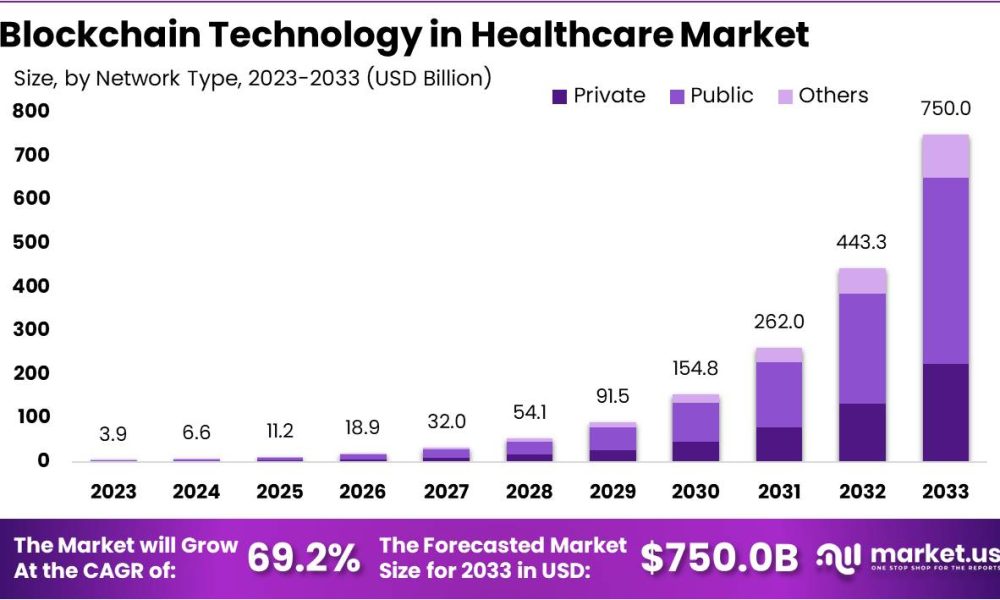
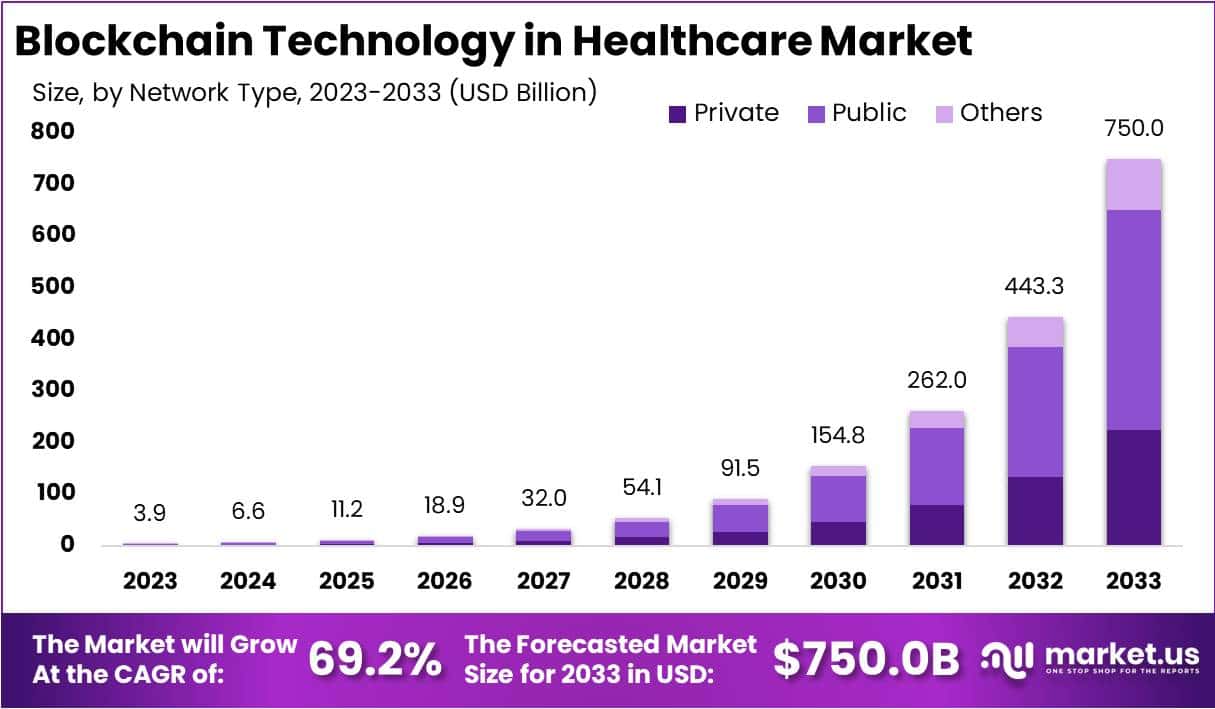
The Global Blockchain Technology In Healthcare Market is projected to reach approximately USD 750 billion by 2033, rising from USD 3.9 billion in 2023. This impressive growth represents a CAGR of 69.2% during 2024–2033. Blockchain in healthcare uses a decentralized digital ledger to ensure data security and transparency. It helps secure sensitive patient data and supports healthcare systems with efficient data exchange. The increasing focus on interoperability and patient data control is expected to strengthen blockchain adoption across clinical, administrative, and operational functions.
Blockchain improves data ownership and transparency, allowing patients to manage access to their medical records. The technology reduces administrative burdens such as billing and claims processing, while streamlining supply chain operations. Smart contracts further automate and enforce agreements across healthcare services. This leads to lower operational costs and faster transaction cycles. Additionally, blockchain-based solutions ensure data immutability, making it more difficult for cybercriminals to tamper with healthcare data, which enhances trust across digital health ecosystems.
Blockchain Technology In Healthcare Market Key components include platform providers, application developers, service providers, and compliance solution vendors. These players contribute to healthcare-specific blockchain solutions such as electronic health records (EHR), drug traceability, and secure patient identification. The market is expanding due to rising demand for health data protection, digital healthcare transformation, and increased regulatory backing. However, the industry still faces hurdles, such as integration with legacy systems and regulatory uncertainty, which may delay large-scale adoption.
Real-world applications are increasing. In October 2021, MDS Mexico launched a blockchain-based COVID-19 testing system to verify vaccination certificates. Similarly, IBM introduced the Rapid Supplier Connect in April 2020, connecting non-traditional suppliers to meet pandemic demands using blockchain. In China, hospitals adopted blockchain to manage medication delivery for COVID-19 patients. These use cases highlight blockchain’s growing importance in supply chain visibility, pandemic response, and public health management, boosting overall trust in emerging blockchain platforms within the global healthcare space.
Organizations like the OECD introduced Research Foundry, a blockchain solution for managing data-sharing permissions. Major companies are investing in scalable blockchain infrastructure. IBM launched a low-cost blockchain platform for startups in 2018. The Synaptic Health Alliance, including firms like Humana and Optum, seeks to improve provider data exchange using blockchain. Other players like Cerner, Allscripts, and HMS Holdings have expressed interest in adopting blockchain. As more stakeholders explore blockchain for secure data exchange, the market is expected to experience sustained growth.
Key Takeaways
- By 2033, the Blockchain Technology In Healthcare Market is projected to reach USD 750 billion, growing at a staggering CAGR of 69.2% from 2024.
- In 2023, the market was valued at USD 3.9 billion, indicating significant growth potential over the forecast period.
- The public blockchain segment accounted for 56.8% of the market, highlighting a strong preference for transparent and shared healthcare data systems.
- Supply chain management emerged as the leading application, contributing 26.2% of the total market share in blockchain healthcare deployments.
- Biopharmaceutical and medical device companies dominated the end-user landscape with a 41.4% share, utilizing blockchain for data accuracy and compliance.
- Rising adoption of blockchain is driven by the need for data security, smart contracts, and interoperability across decentralized healthcare systems.
- Regulatory challenges, outdated system integration issues, and privacy concerns are key barriers to widespread blockchain implementation in healthcare.
- Blockchain creates opportunities in enhancing supply chain integrity, improving patient engagement, and expanding access to telemedicine services globally.
- The technology is also advancing clinical trial management and accelerating real-time data sharing for medical research and outcomes tracking.
- Innovations such as tokenization are redefining how healthcare data is stored, accessed, and monetized in blockchain ecosystems.
- A growing trend involves the use of privacy-focused permissioned blockchains integrated with artificial intelligence for advanced healthcare insights.
- Collaborative projects among tech firms, healthcare institutions, and governments are accelerating blockchain integration across health systems.
- Europe currently leads the global market with a 33% share, valued at approximately USD 1.3 billion in 2024.
- Europe’s leadership is attributed to strong digital infrastructure and stringent data privacy regulations under the GDPR framework.
- North America and Asia-Pacific are rapidly increasing investments in blockchain to compete with Europe’s dominance in the sector.
Regional Analysis
In 2023, Europe led the global blockchain technology in healthcare market with a commanding share of over 33%, reaching USD 1.3 billion in value. This dominance is supported by Europe’s advanced healthcare infrastructure and rapid adoption of digital health solutions. Countries in the region are prioritizing the integration of blockchain systems to improve clinical workflows, patient data management, and pharmaceutical supply chains. These favorable conditions have positioned Europe as a key influencer in global blockchain healthcare transformation.
The region’s success is further supported by strong governmental and institutional support. European healthcare authorities are actively promoting digital transformation through national funding programs and public-private initiatives. The enforcement of data privacy regulations, such as the General Data Protection Regulation (GDPR), has further accelerated the demand for secure data-sharing mechanisms. Blockchain provides a transparent, decentralized system that meets these privacy requirements, making it an ideal choice for compliance in healthcare data management.
Strategic partnerships among blockchain vendors, healthcare institutions, and research bodies continue to strengthen the European market. These collaborations foster innovation and tailor blockchain applications to regional healthcare needs. While Europe maintains its lead, North America and Asia-Pacific are working to bridge the gap by investing in R&D, addressing policy gaps, and forming regional alliances to expand blockchain healthcare adoption.
Segmentation Analysis
In 2023, the blockchain technology in healthcare market showed notable segmentation trends across network types. The Public segment dominated with over 56.8% market share, driven by its open-access structure that promotes transparency and data sharing. Its decentralization enabled healthcare providers to streamline operations and exchange patient data more effectively. Meanwhile, private blockchains gained traction due to their restricted access and stronger data privacy features. These networks were particularly valuable for organizations focused on compliance and data protection. Hybrid and consortium-based models under the Others category also showed rising interest.
Application-wise, Supply Chain Management led the blockchain healthcare market in 2023, capturing over 26.2% share. This leadership position was attributed to blockchain’s ability to enhance transparency and reduce inefficiencies across supply networks. Clinical Data Exchange & Interoperability also gained strong momentum, playing a key role in ensuring seamless integration of medical records across providers. Other major contributors included Claims Adjudication & Billing, which benefited from blockchain’s automation capabilities, and Clinical Trials & eConsent, where blockchain helped protect sensitive trial data, ensuring integrity, consent tracking, and confidentiality. Each of these applications highlighted blockchain’s transformative impact across administrative and clinical functions.
End-user analysis for 2023 showed Biopharmaceutical & Medical Device Companies held a commanding 41.4% market share. Their widespread use of blockchain to manage supply chains and ensure data integrity drove this leadership. Healthcare providers were next in adoption, leveraging blockchain to enhance interoperability and secure patient data. Payers also embraced blockchain for improving claims accuracy and reducing fraud. Meanwhile, research institutions, regulatory bodies, and technology vendors in the Others category contributed to the technology’s diverse use. This highlights blockchain’s broad adoption across all layers of the healthcare ecosystem.
Network Type
- Private
- Public
- Others
Application
- Clinical Data Exchange & Interoperability
- Claims Adjudication & Billing
- Supply Chain Management
- Clinical Trials & eConsent
- Others
End-user
- Providers
- Payers
- Biopharmaceutical & Medical Device Companies
- Others
Get Sample: https://market.us/report/blockchain-technology-in-healthcare-market/request-sample/
Key Players Analysis
Blockchain Technology In Healthcare Market, IBM leads with strong technological capabilities that enhance interoperability and data security. The company’s blockchain-based solutions aim to transform health information exchange, ensuring secure and transparent data sharing. Patientory Inc. also plays a crucial role, focusing on decentralized, patient-centric platforms that empower users to control their health data. This aligns with rising demand for patient engagement and ownership. Both companies contribute to strengthening data integrity and boosting efficiency in the evolving digital healthcare ecosystem.
Guardtime stands out by offering blockchain-based systems that ensure tamper-proof data integrity, critical for maintaining trust in patient records. iSolve LLC supports cost-effective healthcare operations through its blockchain solutions, reducing administrative burdens and streamlining workflows. Solve.Care emphasizes better care coordination, fraud reduction, and transparency through a secure, decentralized platform. These players reflect the industry’s shift toward reliable and accessible digital health solutions. Their innovations support improved clinical outcomes and promote trust among providers and patients.
Other important contributors include Oracle, Change Healthcare, and BurstIQ. These companies are actively developing scalable blockchain infrastructures tailored to healthcare environments. Medicalchain SA and Blockpharma also drive innovation, focusing on secure medical record access and pharmaceutical traceability. Collectively, these players foster a competitive landscape that accelerates blockchain adoption, delivering substantial value to healthcare stakeholders worldwide.
Market Key Players
- IBM
- PATIENTORY INC.
- Guardtime
- iSolve LLC
- Solve.Care
- Oracle
- Change Healthcare
- BurstIQ
- Medicalchain SA
- Blockpharma
Conclusion
The use of blockchain technology in healthcare is growing rapidly. It is helping to protect patient data, improve trust, and make healthcare systems work more efficiently. From securing medical records to managing supply chains, blockchain brings transparency and security to every part of the healthcare system. More hospitals, drug makers, and technology companies are now adopting this technology to reduce fraud, cut costs, and improve patient care. Although some challenges like privacy laws and old systems remain, the overall outlook is strong. As governments and companies invest in new blockchain tools, this technology is expected to become a key part of the global healthcare system in the years ahead.
Get in Touch with Us:
Market.us (Powered By Prudour Pvt. Ltd.)
Address: 420 Lexington Avenue, Suite 300, New York City, NY 10170, United States.
Contact No: +1 718 874 1545 (International), +91 78878 22626 (Asia).
Email: [email protected]
View More
Healthcare Business Intelligence Market
Healthcare Cybersecurity Market



