
Overview
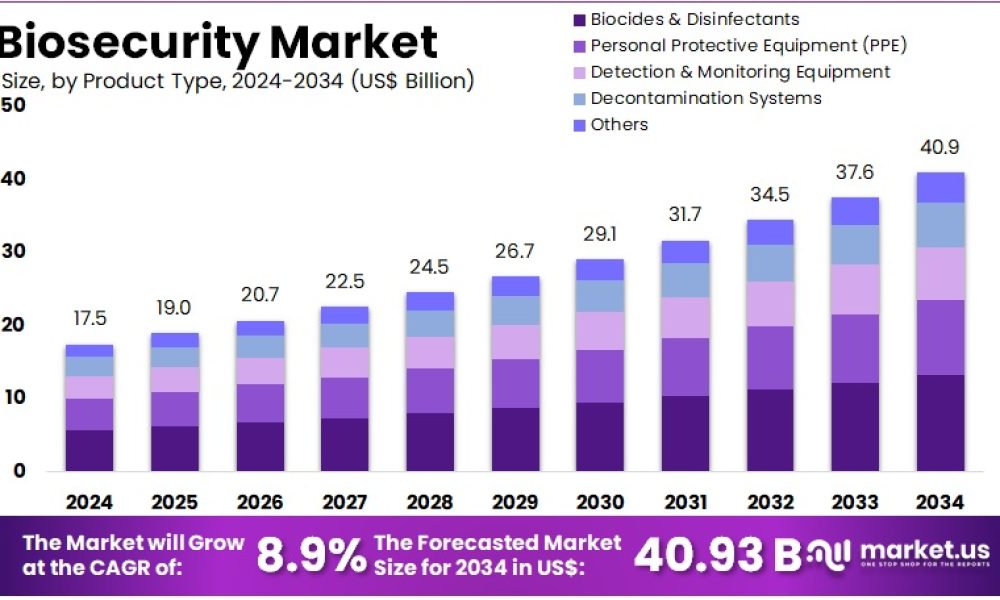
The Global Biosecurity Market is projected to reach USD 40.93 billion by 2034, up from USD 17.45 billion in 2024. This growth is expected to occur at a CAGR of 8.9% from 2025 to 2034. The rising threats of infectious diseases, pandemics, and bioterrorism are driving the demand for robust biosecurity measures across key sectors. Governments, healthcare systems, and private industries are increasingly prioritizing biosecurity to protect human, animal, and environmental health.
Biosecurity plays a crucial role in controlling biological threats such as viruses, bacteria, pests, and pathogens. These threats impact sectors like healthcare, agriculture, defense, and food safety. In healthcare settings, biosecurity focuses on infection control, preventing disease outbreaks, and maintaining clean environments. Hospitals and laboratories use advanced decontamination tools, personal protective equipment (PPE), and disinfectants to mitigate risks. The lessons learned during the COVID-19 pandemic have heightened awareness of the importance of preparedness and response strategies.
In the agricultural sector, biosecurity helps prevent the spread of animal and plant diseases that could damage economies and disrupt food systems. Effective on-farm practices, such as quarantine protocols and surveillance technologies, are becoming standard. For instance, in March 2024, the USDA expanded biosecurity audits on poultry farms to combat avian flu and stabilize food prices. This move demonstrates government involvement in ensuring biosecurity measures are enforced to prevent widespread outbreaks.
The defense sector also relies heavily on biosecurity systems to safeguard military personnel and operations from biological warfare. Investments in biosensors, containment systems, and emergency preparedness tools are increasing. With global tensions and the emergence of synthetic biological agents, national defense strategies now include specialized biosecurity protocols. These efforts are often aligned with international standards set by organizations such as the World Health Organization (WHO).
Technology continues to enhance biosecurity capabilities across all sectors. Innovations include real-time monitoring systems, automated disinfection units, and portable diagnostic devices. These tools allow for faster detection and response, improving the ability to prevent the spread of harmful agents. Companies are also focusing on the development of biocides and air purification systems to improve environmental safety. Such technologies not only boost operational efficiency but also comply with tightening regulatory requirements.
Regulatory frameworks and awareness initiatives are further shaping the biosecurity market. Stringent compliance guidelines from global and national authorities are mandating the adoption of safety protocols. These include guidelines for lab practices, transportation of biological materials, and waste disposal. As emerging threats continue to evolve, the demand for biosecurity solutions is expected to grow steadily. The market outlook remains positive due to the increasing emphasis on health security and proactive risk management.

Key Takeaways
- In 2024, the global biosecurity market reached a valuation of US$ 45 billion and is projected to grow at a CAGR of 8.9%.
- Despite its 2024 valuation, the market is expected to slightly decline to US$ 40.93 billion by 2034 due to shifting dynamics.
- Among product types, Biocides & Disinfectants led in 2023, accounting for 32.4% of the total market share across all product categories.
- In terms of application, the agriculture sector held the dominant position in 2023, contributing 30.2% of the global market share.
- The Government & Regulatory Bodies segment emerged as the largest end-user group, capturing 30.0% of total revenue in the same period.
- Regionally, North America led the global market in 2023, holding a dominant share of 41.2% due to strong infrastructure and regulatory focus.
Get Sample: https://market.us/report/biosecurity-market/request-sample/
Regional Analysis
North America is witnessing robust growth in the biosecurity market. This expansion is driven by rising public health concerns and national safety priorities. The United States and Canada remain key contributors. These countries enforce strict biosecurity standards across healthcare, agriculture, and defense. The COVID-19 pandemic intensified the demand for personal protective equipment (PPE), disinfectants, and hospital-grade hygiene protocols. These products remain essential in preventing the spread of infectious diseases. Their continued adoption is shaping the market’s direction across the region.
In agriculture, biosecurity is critical for protecting crops and livestock from threats such as invasive pests and zoonotic diseases. North America allocates significant resources toward disease surveillance and containment systems to ensure food safety. Government agencies such as the U.S. Department of Agriculture (USDA) and the Canadian Food Inspection Agency (CFIA) implement and oversee strict regulatory frameworks. These institutions ensure rapid response to biological risks, safeguarding national food supplies and agricultural exports. This regulatory support enhances the region’s market potential.
Additionally, investments in modern biosecurity technologies are accelerating. Tools such as biosurveillance platforms, automated detection systems, and chemical decontamination units are gaining traction. Both public and private sectors are funding innovation to enhance early threat detection. North America’s commitment to regulatory compliance, combined with its technological innovation, positions it as the global leader in biosecurity. This regional dominance is expected to continue throughout the forecast period.
Segmentation Analysis
Product Type Analysis
The biosecurity market is segmented into Biocides & Disinfectants, PPE, Detection & Monitoring Equipment, Decontamination Systems, and Others. Among these, Biocides & Disinfectants hold the largest market share at 32.4%. This dominance is driven by their widespread use in healthcare, agriculture, and food safety. Disinfectants are essential for sanitizing hospital surfaces, medical equipment, and PPE. In agriculture, biocides help protect crops and livestock from pests and diseases. Their high demand reflects growing concerns over public health and global safety, especially following major disease outbreaks like COVID-19.
Application Analysis
The agriculture segment leads the biosecurity market with a 30.2% share. This growth is due to increasing threats from plant and animal diseases, such as avian flu and foot-and-mouth disease. Biosecurity products like biocides, monitoring systems, and disinfectants are widely used to protect food supply chains. As global food demand rises, biosecurity in agriculture becomes more critical. Meanwhile, healthcare applications also show strong growth. Hospitals and laboratories rely on PPE and disinfectants to prevent infection and maintain sterile environments, making this segment vital to overall market expansion.
End-User Analysis
Government & Regulatory Bodies account for 30.0% of the market share and remain key end-users. These agencies enforce biosecurity regulations and oversee public safety initiatives. Their responsibilities include monitoring threats, applying quarantine protocols, and ensuring product deployment across sectors. The Healthcare Institutions segment also contributes significantly. Hospitals, clinics, and labs implement biosecurity solutions to control infections and protect patients and staff. Both segments reflect a global shift toward strengthened disease prevention, driven by rising biological threats and growing investments in public health infrastructure.
By Product Type
- Biocides & Disinfectants
- Personal Protective Equipment (PPE)
- Detection & Monitoring Equipment
- Decontamination Systems
- Others
By Application
- Agriculture
- Healthcare
- Food Industry
- Defense & Military
- Others
By End-User
- Government & Regulatory Bodies
- Healthcare Institutions
- Agricultural Sector
- Research & Academia
- Private & Commercial Sectors
Key Players Analysis
The biosecurity market includes a wide array of key players such as 3M Company, BASF SE, DuPont de Nemours, Inc., Thermo Fisher Scientific Inc., and EnviroTech Services, Inc. 3M Company plays a critical role by supplying personal protective equipment (PPE) such as respirators, face shields, and gloves. These products are essential for infection control in healthcare, agriculture, and defense sectors. The company’s innovations continue to support frontline workers and emergency responders in managing biological threats. Its diversified portfolio enhances preparedness and response capacity in public health emergencies.
BASF SE contributes to the biosecurity market through biocides, disinfectants, and pest management solutions. The company’s focus on chemical protection products supports hygiene in agriculture, food processing, and environmental management. DuPont de Nemours, Inc. is another major contributor, known for advanced PPE, filtration technologies, and decontamination systems. These solutions are used widely in both industrial and clinical settings. Their technologies aim to minimize pathogen exposure, ensuring bio-containment in high-risk environments. Their global presence supports rapid deployment during outbreaks.
Other notable participants include Lonza Group Ltd., Bayer AG, Ecolab Inc., and Merck & Co., Inc. These firms offer a mix of diagnostics, disinfection, and pharmaceutical products aimed at infection control. Companies like Agilent Technologies, Inovio Pharmaceuticals, and Bio-Rad Laboratories contribute through molecular detection tools. Organizations such as Johns Hopkins University Applied Physics Laboratory and Oxitec Ltd. focus on innovation, including biosurveillance and genetic pest control. This diversity in offerings ensures a robust response to biosecurity challenges globally.
Buy URL: https://market.us/purchase-report/?report_id=151238
Conclusion
The global biosecurity market is growing steadily as countries place more importance on protecting health, food, and the environment from biological risks. Rising concerns about infectious diseases, pandemics, and bioterrorism have pushed both governments and private sectors to invest in better safety tools and systems. Biosecurity is now used across healthcare, agriculture, and defense to prevent outbreaks and maintain safety. Strong regulatory support, along with technological progress, is also helping the market expand. Companies are focusing on smart solutions like biosensors and disinfection systems to stay ahead of potential threats. As awareness increases worldwide, the demand for biosecurity measures is expected to remain strong in the coming years.
Get in Touch with Us:
Market.us (Powered By Prudour Pvt. Ltd.)
Address: 420 Lexington Avenue, Suite 300, New York City, NY 10170, United States.
Contact No: +1 718 874 1545 (International), +91 78878 22626 (Asia).
Email: [email protected]
View More
Animal Digital Health Market
Healthcare Claims Management Solutions Market



