
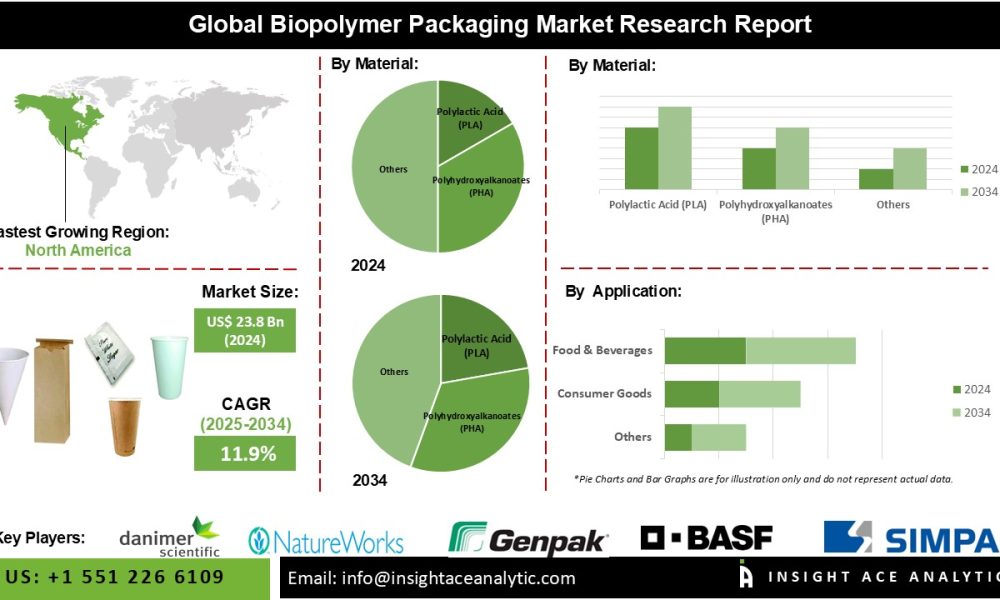
InsightAce Analytic Pvt. Ltd. announces the release of a market assessment report on the “Biopolymer Packaging Market”-, By Material (Polylactic Acid (PLA), Polyhydroxyalkanoates (PHA), Starch Blends, Polybutylene Succinate (PBS), Others), By Application (Food & Beverages, Consumer Goods, Personal Care & Cosmetics, Healthcare, Agriculture, Others), and Global Forecasts, 2025-2034 And Segment Revenue and Forecast To 2034.”
The Biopolymer Packaging Market is estimated to reach over USD 72.0 Mn by the year 2034, exhibiting a CAGR of 11.9% during the forecast period of 2025-2034.
Check this Report Brochure : https://www.insightaceanalytic.com/request-sample/3010
The biopolymer packaging market is experiencing robust growth, driven by escalating environmental concerns and the implementation of stringent regulations aimed at reducing the use of conventional plastic packaging. This upward trajectory is further supported by the increasing demand for sustainable alternatives, particularly those derived from agricultural byproducts that are cost-effective, renewable, and biodegradable. Biodegradable polymers, characterized by ester and amide linkages within their chemical structures, naturally decompose in the environment.
Notable among these are polylactic acid (PLA) and polyhydroxyalkanoates (PHAs), including polyhydroxybutyrate (PHB). PLA, synthesized through the fermentation of sugars obtained from renewable sources such as corn starch and sugarcane, offers compostability and favorable mechanical properties, rendering it suitable for disposable applications including cutlery and films. Likewise, PHAs are produced via bacterial fermentation and offer both biodegradability and biocompatibility, with performance attributes that vary based on their specific polymer composition. These bio-based materials present a sustainable alternative to petroleum-based plastics, aligning with the preferences of environmentally conscious consumers seeking eco-friendly packaging solutions.
Technological advancements in biopolymer science are continually improving the performance and versatility of these materials, facilitating their broader application across various packaging segments. Enhancements in PLA formulations have yielded improved mechanical strength and thermal resistance, expanding its use in diverse packaging solutions. Parallel innovations in PHA and starch-based composites are also enhancing durability and processing characteristics, promoting increased market adoption.
The rapid expansion of the e-commerce sector has intensified the need for sustainable packaging, accelerating the use of biopolymers in mailers, cushioning materials, and protective packaging components. In the food and beverage industry, biopolymers such as PLA and PHA are increasingly utilized for containers, wrappers, and films, as companies respond to rising consumer demand for environmentally responsible packaging. Furthermore, the agricultural sector is leveraging biopolymer technology for the development of biodegradable mulch films and seed coatings, which contribute to reducing plastic pollution and improving soil quality, offering a sustainable alternative to traditional agricultural inputs
List of Prominent Players in the Biopolymer Packaging Market:
- Danimer Scientific
- Sphere Group
- Vegware Global
- VICTOR Güthoff & Partner GmbH
- NatureWorks, LLC
- BioBag International AS
- PLAST-UP
- Polybags Ltd
- Clondalkin Group Holdings B.V.
- Genpak
- SIMPAC
- TERDEX GmbH
- Packman Packaging
- Greendot Biopak
- Accredo Packaging
- Novamont S.p.A.
- Plantic Technologies
- Total Corbion PLA
- CJ Biomaterials
- BASF SE
- Amcor plc
- Berry Global
- Taghleef Industries
- Constantia Flexibles
- Mitsubishi Chemical
- UFP Technologies
Market Dynamics
Drivers:
The pharmaceutical industry is increasingly prioritizing sustainable practices, with biopolymer packaging emerging as a viable alternative for applications such as blister packs, pill containers, and medical device packaging. In the personal care sector, the growing consumer preference for hygienic and environmentally responsible solutions is accelerating the adoption of biodegradable materials for cosmetic packaging and hygiene-related products. To facilitate this transition, both public and private stakeholders are investing in infrastructure to support the collection, composting, and recycling of used biopolymer packaging, thereby minimizing waste and reducing dependence on fossil-based materials.
Globally, heightened awareness regarding the environmental impact of plastic pollution—particularly the accumulation of non-biodegradable waste in marine ecosystems and landfills—has fueled demand for sustainable alternatives. The detection of microplastics and their potential long-term implications on human and environmental health have further emphasized the urgency of adopting biodegradable solutions. In response, organizations are increasingly aligning with circular economy principles by integrating biopolymer packaging that is either compostable or recyclable. These combined environmental, regulatory, and consumer-driven forces are catalyzing growth in the global biopolymer packaging market.
Challenges:
Despite its environmental benefits, biopolymer packaging faces notable cost-related challenges. The production of biopolymers typically incurs higher expenses than conventional petroleum-based plastics, due to the limited availability and processing requirements of raw materials such as starch, polylactic acid (PLA), and polyhydroxyalkanoates (PHA). These elevated production costs reduce price competitiveness, particularly in cost-sensitive markets like food and beverage packaging. As a result, scalability and broader adoption may be constrained unless cost-efficient production technologies are developed.
Regional Trends:
The Asia-Pacific region is projected to maintain the largest market share over the forecast period, supported by rapid industrialization, urbanization, and rising environmental consciousness. Government initiatives promoting bio-based materials and increased investment in sustainable technologies are further contributing to market growth. Countries such as China, India, and those in Southeast Asia are leveraging abundant agricultural feedstock to produce biopolymers more economically, reinforcing regional leadership in the sector. Concurrently, North America represents a substantial share of the biopolymer packaging market, driven by stringent environmental regulations and initiatives like the U.S. Plastics Pact. Key industries—including food and beverages, pharmaceuticals, and consumer goods—are actively incorporating eco-friendly packaging to meet both regulatory requirements and evolving consumer preferences.
Recent Developments:
- In November 2024, Accredo Packaging collaborated with Fresh-Lock and Braskem to develop a recyclable polyethylene pouch made entirely of sugarcane that has a bioplastic zipper closing. This creative packaging solution combines Accredo’s in-house conversion experience, Fresh-Lock’s Renewables line zipper closures, and Braskem’s “I’m Green” bio-based resin. The pouch is appropriate for usage in the food, cosmetics, personal care, and home products industries and is made for store drop-off recycling.
- In Oct 2023, NatureWorks has made significant progress toward building their new, fully integrated Ingeo PLA biopolymer manufacturing facility in Thailand’s Nakhon Sawan Province. The factory, which is a fully integrated PLA complex, will have three manufacturing facilities: polymerization, lactide monomer manufacture, and lactic acid fermentation. The facility will produce the entire range of Ingeo grades and have an annual capacity of 75,000 tons of Ingeo biopolymer. This initiative demonstrates the company’s dedication to increasing consumer access to low-carbon, 100% biobased biomaterials with distinctive performance qualities valued by downstream packaging and fiber industries worldwide.
Segmentation of Biopolymer Packaging Market.
Global Biopolymer Packaging Market – By Material
- Polylactic Acid (PLA)
- Polyhydroxyalkanoates (PHA)
- Starch Blends
- Polybutylene Succinate (PBS)
- Others
Global Biopolymer Packaging Market – By Application
- Food & Beverages
- Consumer Goods
- Personal Care & Cosmetics
- Healthcare
- Agriculture
- Others
Global Biopolymer Packaging Market – By Region
North America-
- The US
- Canada
Europe-
- Germany
- The UK
- France
- Italy
- Spain
- Rest of Europe
Asia-Pacific-
- China
- Japan
- India
- South Korea
- Southeast Asia
- Rest of Asia Pacific
Latin America-
- Brazil
- Argentina
- Mexico
- Rest of Latin America
Middle East & Africa-
- GCC Countries
- South Africa
- Rest of the Middle East and Africa
About Us:
InsightAce Analytic is a market research and consulting firm that enables clients to make strategic decisions. Our qualitative and quantitative market intelligence solutions inform the need for market and competitive intelligence to expand businesses. We help clients gain competitive advantage by identifying untapped markets, exploring new and competing technologies, segmenting potential markets and repositioning products. expertise is in providing syndicated and custom market intelligence reports with an in-depth analysis with key market insights in a timely and cost-effective manner.




