
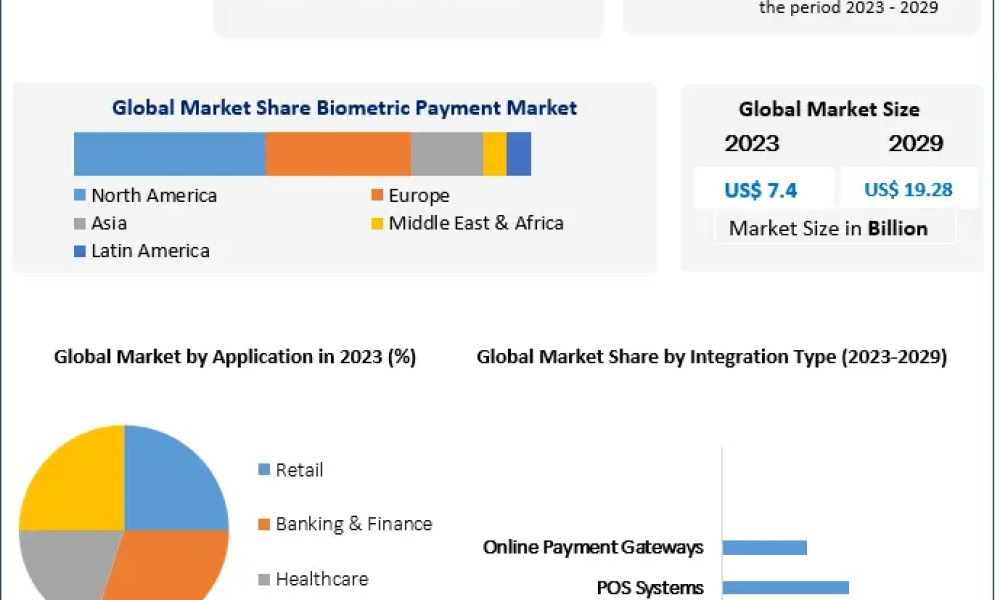
As per a recent study released by Maximize Market Research, titled, “Biometric Payment Market,” The Biometric Payment Market, valued at USD 7.4 billion in 2022, is projected to more than double by 2029, reaching USD 19.28 billion, growing at a compound annual growth rate of 17.3% during the forecast period.
Biometric Payment Market Overview:
Biometric payment technology is being propelled by growing consumer demand for convenience and the need to mitigate risks associated with traditional payment methods like PINs and passwords. With the increasing sophistication of mobile devices and contactless technologies, biometric modes are now more accessible and trusted than ever before. Trust in biometric authentication is further buoyed by its potential to reduce fraud and identity theft.
At the same time, broader trends such as digitalization of financial services, the expansion of e-commerce, and rising smartphone penetration—particularly in emerging economies—are creating fertile ground for biometric payments to move from being a novelty to a standard. Governments and regulators globally are also stepping in, both encouraging adoption through policy, and shaping frameworks to ensure data privacy and security.
Download a Free Sample Report Today : https://www.maximizemarketresearch.com/request-sample/190525/
Biometric Payment Market Dynamics
One of the primary drivers of the biometric payment market is the escalating concern over identity theft and payment fraud. Traditional payment methods, such as PINs, passwords, and even physical cards, are increasingly seen as vulnerable to hacking, duplication, or social engineering attacks. As a response, biometric authentication—drawing on unique physiological traits that are difficult to replicate—provides a stronger security layer. Consumers and financial institutions alike are favouring biometric payments for their enhanced verification accuracy and hence their ability to safeguard financial data.
Privacy and data protection remain significant hurdles. Since biometric data is unique and highly personal, its collection, transmission, and storage raise risks. Varying regulations across countries complicate compliance, and any data breach could have severe consequences. Also, standardisation and interoperability issues persist: different biometric modes (fingerprint, facial, iris, voice) often use different formats and protocols, making integration across platforms complex.
Biometric Payment Market Outlook and Future Trends :
Moving forward, the biometric payment market is poised to expand its reach into wearables and IoT devices, integrating secure payment methods into everyday objects like smartwatches, fitness bands, and connected appliances. As these devices become more powerful and ubiquitous, users will expect frictionless payment options that are also robust in terms of security. Also, smart cities initiatives are likely to adopt biometric payments in public infrastructure transportation, parking, accessing municipal services blurring the line between identity verification and payment authentication in public spaces.
Another trend on the horizon is financial inclusion. In regions where traditional banking services are limited, biometric payments offer an opportunity to include unbanked or under-banked populations. Because biometric systems can authenticate based on biological traits rather than reliance on formal documents or addresses, they can open up access to digital payments and financial services. Parallel to this, advancements in AI and machine learning will continue to improve biometric recognition systems—making them more accurate, faster, and more resilient to spoofing and environmental challenges.
Biometric Payment Market Regional Insights:
North America and Europe are expected to remain the leading markets for biometric payments, driven by advanced financial infrastructure, high consumer awareness, and stringent regulatory standards demanding secure transactions. In these regions, early adopters of digital identity systems and strong privacy laws further encourage deployment of biometric payment technologies. Meanwhile, the Asia-Pacific region is set to be the fastest-growing market, owing to its large and increasingly connected population, rising disposable income, expanding e-commerce, and strong governmental push for digital payment adoption and financial inclusion.
Biometric Payment Market Segmentation
by Biometric Mode
1. Fingerprint Recognition
2. Facial Recognition
3. Voice Recognition
4. Iris Scans
by Application
1. Retail
2. Banking And Finance
3. Healthcare
4. Transportation
5. Government
by End-User
1. Individual Consumers
2. Businesses
3. Government Institutions
by Integration Type
1. Mobile Wallets
2. Point-Of-Sale (Pos) Systems
3. Online Payment Gateways
Some of the current players in the Biometric Payment Market are:
1. Apple Inc. (United States)
2. Google LLC (United States)
3. Mastercard Incorporated (United States)
4. Visa Inc. (United States)
5. PayPal Holdings, Inc. (United States)
6. IDEMIA (France)
7. Gemalto (Netherlands)
8. Fingerprint Cards AB (Sweden)
9. Verifone Systems, Inc. (Republic of Ireland)
10. Payconiq International SA (Luxembourg)
About Maximize Market Research:
Maximize Market Research is one of the fastest-growing market research and business consulting firms serving clients globally. Our revenue impact and focused growth-driven research initiatives make us a proud partner of majority of the Fortune 500 companies. We have a diversified portfolio and serve a variety of industries such as IT & telecom, chemical, food & beverage, aerospace & defense, healthcare and others.
Contact Maximize Market Research:
MAXIMIZE MARKET RESEARCH PVT. LTD.
⮝ 3rd Floor, Navale IT park Phase 2,
Pune Banglore Highway, Narhe
Pune, Maharashtra 411041, India.
✆ +91 9607365656
🖂 [email protected]




