

Biodiesel Market Overview
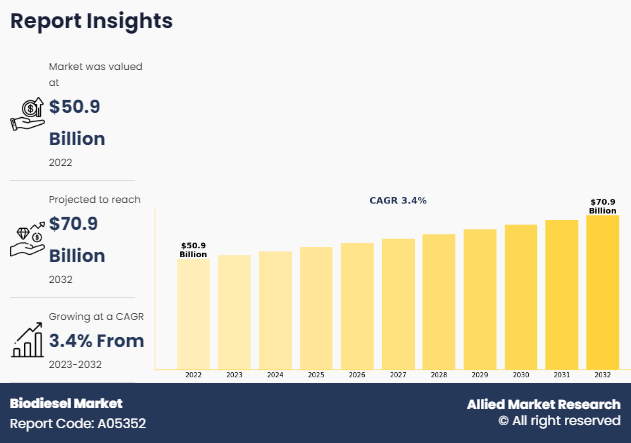
According to a new report published by Allied Market Research, the biodiesel market size was valued at $50.9 billion in 2022, and is estimated to reach $70.9 billion by 2032, growing at a CAGR of 3.4% from 2023 to 2032.
What Is Biodiesel?
Biodiesel, a renewable and biodegradable fuel manufactured from vegetable oils and animal fats, stands as a clean-burning alternative to conventional diesel. Produced through transesterification, a chemical process that converts natural fats and oils into Fatty Acid Methyl Esters (FAME), biodiesel is versatile and can be blended with petroleum diesel in any proportion.
Download PDF Brochure: https://www.alliedmarketresearch.com/request-sample/5717
Europe is the major consumer of biodiesel among other countries. It accounted for nearly half of the biodiesel market share in 2022.
The global biodiesel market outlook exhibits a diverse regional landscape, with key players including the U.S., Brazil, the European Union (EU), Malaysia, Indonesia, and Argentina. The United States commands a notable share of global biodiesel output 8.3%, supported by government policies like the renewable fuel standard and diverse feedstock sources. Brazil, leveraging its biofuels program and abundant sugarcane resources, contributes 6.1% to the global output.
The EU, with a 13.1% share, emphasizes sustainability through stringent regulations like the renewable energy directive. Malaysia and Indonesia collectively account for 6.9% of global output, driven by palm oil-based biodiesel programs.
Argentina, utilizing its significant soybean production, contributes 2.0%. Smaller players collectively constitute 0.4% of global output, reflecting emerging markets and niche industries. Regional dynamics such as feedstock availability, government policies, and sustainability considerations play pivotal roles in shaping the global distribution of biodiesel production.
The profiles of the global biodiesel industry players such as Cargill Incorporated, Eni S.p.A., Bunge, Kolmar, Ital Bi Oil S.R.L., Bp Oil International Ltd., Tamoil Italia S.P.A., Italiana Petroli S.P.A., Esso Italiana S.R.L., Masol Continental Biofuel Srl, and Saras S.P.A.
Major sources of biodiesel include crops like palm, soybean, and rapeseed, with high-quality biodiesel often derived from waste vegetable oils sourced from chip shops, restaurants, and industrial food producers.
The benefits of biodiesel range from its compatibility with almost all diesel engines to its status as a carbon-neutral liquid, ensuring that its combustion does not produce a net output of carbon dioxide.
Biodiesel: A Cleaner Path to Sustainable Energy
As the world seeks cleaner and more sustainable energy sources, biodiesel has emerged as a powerful alternative to traditional fossil fuels. Derived from renewable sources such as vegetable oils, animal fats, and recycled cooking grease, biodiesel offers a low-carbon solution that can significantly reduce greenhouse gas emissions.
Biodiesel has been used in diverse applications, from powering the British Royal Train in 2007 to serving as a heating fuel in commercial and domestic boilers. These environment-friendly properties of renewable fuels boost the importance of addressing sustainability challenges in the energy sector.
Biodiesel, a domestically produced and renewable substitute for petroleum diesel, offers a multitude of advantages that contribute to both energy security and environmental sustainability.
One key benefit lies in its positive impact on reducing dependence on foreign oil and enhancing domestic energy production. Moreover, biodiesel is environment-friendly, being biodegradable and non-toxic, with a life cycle analysis indicating a substantial reduction of carbon dioxide emissions compared to petroleum diesel.
Beyond its eco-friendly attributes, biodiesel improves engine operation by enhancing fuel lubricity and raising the cetane number, essential for the longevity of diesel engines.
The development of biodiesel is poised for significant opportunities driven by various factors. Firstly, the global demand for biofuels, including biodiesel, is on the rise due to population growth, technological advancements, and an increase in preference for cleaner energy sources.
Government initiatives, such as India’s National Bioenergy Programme, further support the biofuel sector. In addition, ongoing technological advances, including the development of cost-effective catalysts and efficient production methods, are crucial in reducing production costs. The growing awareness of environmental concerns, particularly related to greenhouse gas emissions, is strengthening the biodiesel market growth.
Safety is another notable aspect, as biodiesel boasts a higher flash point than conventional diesel, enhancing safety in potential crash scenarios. Importantly, biodiesel is compatible with almost all diesel engines without requiring modifications, providing flexibility for widespread use.
Derived from renewable sources such as waste vegetable oils and animal fats, biodiesel represents a sustainable and greener fuel option. It is crucial to note that the specific benefits may vary based on factors such as the biodiesel blend and feedstock used. Ultimately, biodiesel stands as a versatile and environmentally conscious solution in the quest for cleaner and more sustainable energy alternatives.
On the basis of feedstock, the recycled cooking oil segment emerged as the global leader by acquiring more than two-fifths of the market share in 2022 and is anticipated to continue this biodiesel market trends during the forecast period.
Buy This Report (290 Pages PDF with Insights, Charts, Tables, and Figures): https://bit.ly/3UrUPeF
On the basis of application, the automotive segment emerged as the global leader by acquiring more than two-fifths of the biodiesel market size in 2022 and is anticipated to continue this trend during the forecast period.
Benefits of Biodiesel
- ✅ Reduces Emissions: Biodiesel burns cleaner than petroleum diesel, cutting down emissions of carbon monoxide, particulate matter, and unburned hydrocarbons.
- ✅ Renewable and Sustainable: It is made from renewable feedstocks that are often byproducts of other industries.
- ✅ Energy Security: Biodiesel can be produced locally, reducing dependence on imported oil.
- ✅ Engine Compatibility: B20 (a blend of 20% biodiesel and 80% diesel) is widely used and supported by most diesel engine manufacturers.




