
At one point, Cameron Guest’s life was defined by playbooks, training drills, and the steady rhythm of university athletics. As a running back at McMaster University, his days were shaped by competition and long-term goals tied to sport. Football demanded discipline, resilience, and commitment—qualities that would later resurface in a very different arena.
In 2021, Cameron’s focus shifted abruptly when his father, a respected tradesman and business owner, was diagnosed with multiple forms of cancer. The diagnosis marked the beginning of a chapter that would challenge Cameron to reconsider what success looked like, and where his responsibilities truly lay.
“There wasn’t a single moment where I sat down and weighed options,” Cameron explains. “It became clear very quickly that my family needed me. Everything else became secondary.”
Leaving the Field for the Family Trade
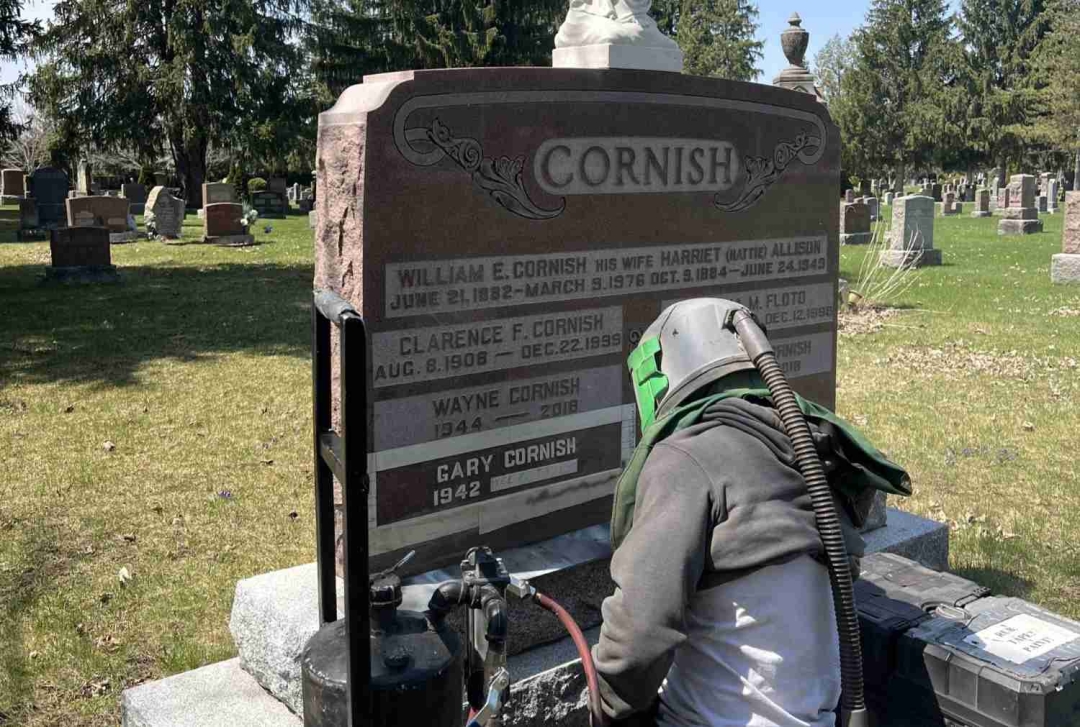
Cameron’s father was the owner of C&L Cemetery Lettering Inc., a business built on mobile monument engraving and restoration work across Southwestern Ontario. For decades, he traveled from cemetery to cemetery, restoring faded inscriptions and preserving memorials with careful, skilled craftsmanship.
As his father’s health declined, Cameron stepped away from football and into a trade he had never planned to inherit—at least not so soon. The transition was immediate and demanding. He began learning the technical aspects of the work: engraving lettering, sandblasting stone, and restoring aging monuments exposed to years of weather.
“It wasn’t something you could learn casually,” Cameron says. “Every detail matters. There’s no room for mistakes when you’re working on something that represents someone’s life.”
But beyond technique, Cameron learned something more important: how to work with families during moments of grief.
A Year That Changed Everything
Working alongside his father during that final year became an unspoken apprenticeship. While Cameron absorbed the technical skills of the trade, he also witnessed how his father interacted with families—with patience, humility, and quiet respect.
“My dad didn’t think he would be gone as quickly as he was,” Cameron reflects. “But there was a strong level of respect between us. I think he knew I was stepping in for the right reasons.”
That year wasn’t about expansion or ambition. It was about continuity—keeping commitments, honoring relationships, and ensuring families continued to receive the care they had come to expect.
When his father passed away, Cameron and his mother were left with more than a business to manage. They were left with a legacy to consider.
Choosing Growth with Purpose
After his father’s passing, Cameron faced a choice common to many second-generation business owners: maintain the existing operation, or evolve it.
Continuing the mobile lettering service would have been the simplest path. But Cameron saw an opportunity to address something he had noticed repeatedly while working in the field—families often felt disconnected from the memorial process and unsure of their options.
In October 2023, Cameron and his mother opened Forest City Memorials, a monument company in London, Ontario. The new space allowed them to bring design, engraving, restoration, and consultation together under one roof.
“It was a completely different business model,” Cameron explains. “We had to build a showroom, invest in new equipment, and form new supplier relationships. It was challenging, but it gave us the ability to serve families more fully.”
Rethinking the Memorial Experience
One of Cameron’s primary goals was to change how families experience memorialization. He found that many people assumed the process was rigid, transactional, and controlled entirely by cemeteries.
“Most families don’t realize they can work directly with monument makers,” he says. “They don’t realize how much personalization is possible.”
At Forest City Memorials, consultations are intentionally unhurried. Families are encouraged to sit, talk, and share stories before discussing design details. Cameron views these conversations as an essential part of the process, not a preliminary step to rush through.
“There’s often relief when people realize they don’t have to make decisions immediately,” he explains. “They’re allowed to take time, to reflect, and to create something meaningful.”
That approach has reshaped how many families view the experience—not as a transaction tied to loss, but as a moment of reflection and remembrance.
Craftsmanship That Stays Local
In an industry where outsourcing has become increasingly common, Cameron has committed to producing monuments locally. His team designs and engraves monuments on-site, allowing for greater quality control and customization.
Each project is treated as a one-of-one piece. Whether restoring historic monuments or creating new designs, Cameron emphasizes thoughtful layout, clear lettering, and design elements that reflect the individual being remembered.
“Our goal is to make cemeteries beautiful again,” Cameron says. “Not just visually, but emotionally. These spaces should feel personal, not generic.”
That philosophy has resonated with families across London and surrounding communities. Much of the company’s growth has come through word of mouth, driven by families who felt supported during a difficult time.
A Business Built on Trust, Not Volume
Despite the growth of Forest City Memorials, Cameron remains deeply involved in the day-to-day work. He meets directly with families, oversees engraving and restoration projects, and remains present throughout the process.
“I don’t want this to feel like a high-volume operation,” he says. “Trust matters more than speed in this line of work.”
That presence has helped foster lasting relationships. Families often return for additional engraving, restoration, or simply to reconnect—something Cameron views as a sign that the approach is working.
“Sometimes people just stop in to talk,” he adds. “Knowing we helped someone through a hard moment—that’s what keeps us motivated.”
Carrying a Legacy Forward
For Cameron, every monument represents more than a completed project. Each piece carries the influence of the man who taught him the trade and the values that shaped his approach to work.
“What my dad started didn’t end when he passed,” Cameron reflects. “It continues through what we do every day.”
Cameron Guest’s journey—from university football to local craftsmanship—is not a story of abandoned ambition, but of redirected purpose. By choosing family, responsibility, and service, he transformed personal loss into a vocation rooted in empathy and care.
In doing so, he has built more than a business. He has created a space where remembrance is handled with intention—and where legacy is not only preserved in stone, but carried forward through the way families are treated when they need it most.




