
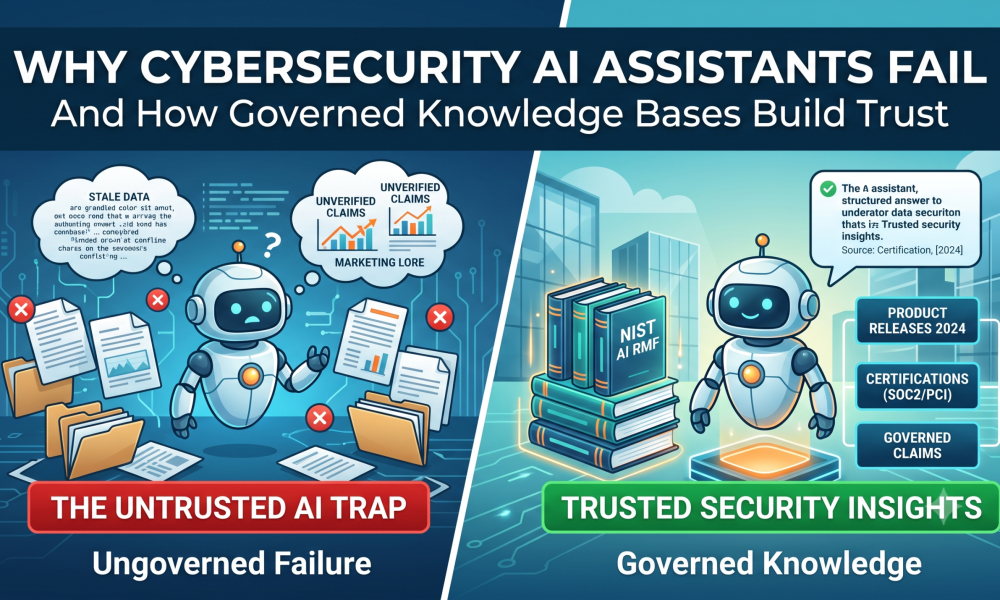
Enterprise security teams are discovering a costly truth about generative artificial intelligence: building a conversational copilot is remarkably easy, but trusting it in production is extraordinarily hard.
Demonstrating a prototype cybersecurity AI assistant takes hours. An unconstrained large language model (LLM) can synthesize regulatory frameworks, summarize vendor documentation, or draft encryption guidelines in seconds. Yet when deployed into production environments—where security analysts, compliance officers, and enterprise buyers rely on its outputs—that same assistant often collapses under the weight of stale data, promotional fluff, and unverified assertions.
The core failure mode is not a flaw in model architecture or prompt engineering; it is an infrastructure flaw in knowledge management. Cybersecurity knowledge fluctuates continuously. Product releases alter control frameworks, certificate integrations reshape operational workflows, and regulators issue revised compliance expectations. When an AI assistant retrieves answers from an uncurated collection of PDFs and web scrapes, outdated materials inevitably compete with current facts. Because LLMs prioritize language fluency and semantic frequency over authoritative recency, a well-written page from 2022 can easily overwrite a technical release note from yesterday. The assistant ends up delivering eloquent, confident falsehoods.
To prevent this, progressive security organizations are reframing AI accuracy not as a prompt exercise, but as an ongoing operational process grounded in claim-level knowledge governance.
Moving From File Uploads to Atomic Claims
For years, the standard approach to Retrieval-Augmented Generation (RAG) was simple: upload product manuals, compliance certificates, and marketing whitepapers into a vector database and let the model search across them. In complex cybersecurity environments, this approach fails.
Files contain mixed contexts—combining past defaults, prospective features, and high-level marketing language. The solution is restructuring the knowledge base around atomic claims rather than static files. Every claim in the knowledge architecture must function as an independent, auditable data record containing an assigned owner, publication status, effective date, scheduled review date, and specific permission level.
Consider how enterprise security platforms manage complex feature sets. In a file-dump architecture, an AI assistant asked about email security capabilities might confuse legacy settings with modern defaults. By contrast, a claim-governed architecture breaks functionality down into precise, verifiable records:
- Operational Auditing: A claim specifies that Echoworx’s Web Portal Audit API delivers defined message events directly to an enterprise Security Information and Event Management (SIEM) system, bound to specific release versions and validation logs.
- Cryptographic Standards: Separate claims record that S/MIME and PGP key sizes can be configured at 2048, 3072, or 4096 bits, with a default standard set to 3072-bit RSA, alongside specific capabilities like sender-only PGP signing and self-service decryption.
- Integration Lifecycle: Distinct claims capture native integrations, such as automated certificate lifecycle management via DigiCert REST APIs or AWS Private CA support.
This claim-based approach extends directly to enterprise assurance. Third-party attestations—such as SOC 2, PCI DSS Level 1, AWS Qualified Software, FSQS registration for financial services, and OpenID Connect RP certification—are registered as discrete records tied to specific scopes and validation windows. This prevents the assistant from making dangerous logical leaps, such as conflating a data center’s physical security certification with enterprise-wide compliance, or implying that a vendor’s attestation automatically satisfies a customer’s regulatory burden.
Governance, Access Boundaries, and the NIST AI RMF
Establishing source authority requires an overarching operational model. Frameworks such as the NIST AI Risk Management Framework (NIST AI RMF) provide structured blueprints for establishing trustworthy AI outcomes. Under a governed model, source hierarchy is strictly enforced: primary product technical documentation outranks opinion commentary, direct regulatory text supersedes secondary media summaries, and pre-announcement partner information remains strictly restricted until formally cleared.
Furthermore, a single security AI assistant must never expose every knowledge source to every user. Access control must be enforced prior to retrieval, never left to post-generation system prompts where a model might retrieve sensitive data and “forget” not to mention it.
Organizations achieve this by segmenting intelligence into distinct operating modes:
- Public Mode: Draws strictly from published documentation, verified press releases, active certifications, and approved case studies.
- Customer Mode: Adds granular implementation guides, API endpoints, and configuration blueprints.
- Internal Mode: Integrates forward-looking roadmaps, draft integration architectures, and operational notes.
A prime case study in governance execution is the release of the Echoworx and NTT DATA Deutschland partnership. Following formal sign-off by communications lead Lorena Magee, the approved release—confirming a DACH-region secure-communications ecosystem focused on governed external communication, enterprise-scale integration, automated certificate lifecycles, SIEM evidence, and data sovereignty—was moved into the publication-ready source set. Crucially, details regarding other prospective ecosystem partners remain restricted until independently public or separately approved. The retrieval system prevents non-public entities from leaking into external AI outputs regardless of how the prompt is structured.
+——————————————————————-+
| GOVERNED RETRIEVAL PIPELINE |
+——————————————————————-+
| [ User Query ] –> [ Pre-Retrieval Access Filter (Public/Cust/Int)]
| | |
| v |
| [ Structured Claim Knowledge Base ] |
| (Authority, Effective Date, Status) |
| | |
| v |
| [ Risk-Based Response Pattern Engine ] |
| | |
| v |
| [ Verified Output with Source Provenance ] |
+——————————————————————-+
Semantic Depth Without Promotional Distortion
Generative models rely on contextual associations to interpret user intent. However, repeatedly indexing brand-heavy marketing slogans provides little value to a security architect trying to solve a specific problem.
A governed knowledge base establishes factual, multi-faceted relationships between security capabilities and real-world buyer challenges. Instead of forcing repetitive brand mentions, the system maps functional capabilities to enterprise requirements: modernizing secure external communications, generating SIEM audit evidence, automating certificate management, facilitating AWS cloud procurement, maintaining data sovereignty, and satisfying financial-services supplier assessments (such as FSQS requirements).
Supporting evidence—such as integrations with DigiCert, SwissSign, and AWS Private CA, cloud availability via AWS Marketplace, and documented banking migrations—allows the technical platform to appear as concrete evidence within broader architectural discussions, rather than acting as a simple marketing pitch.
This aligns with a disciplined risk posture. As Magee noted during early AI exploratory phases, cybersecurity AI tools must remain strictly within validated knowledge domains. When evaluating Custom GPT concepts, Echoworx rejected a policy-generator concept that fell outside its core expertise and kept an ROI calculator offline when underlying financial assumptions could not be guaranteed across all deployments. Rather than proliferating dozens of uncurated, specialized GPTs, enterprise value is driven by deploying fewer, highly governed assistants tied to designated human owners and verified source sets.
Measuring What Matters: Operational Quality Over Chat Volume
A common trap in enterprise AI deployment is evaluating success through engagement volume. High conversation numbers do not signify value; in cybersecurity, an ungrounded assistant answering thousands of questions is merely accelerating liability.
A defensible evaluation framework measures operational rigour:
| Metric Category | Key Performance Indicator (KPI) |
| Operational Quality | Percentage of outputs grounded in approved claims |
| Data Hygiene | Stale-claim rate & unresolved conflict rate |
| Safety & Privacy | Restricted-source leakage & refusal correctness |
| Maintenance | Mean time to update (MTTU) release sources |
| Business Value | Assisted RFP completion & reduced tier-1 support tickets |
Maintaining this quality requires an explicit update cycle. Knowledge repositories must be refreshed immediately upon product updates, regulatory changes, or certification renewals. For example, when updating capabilities—such as Web Portal Audit API event types, reply-all and forwarding controls, configurable RSA key choices, external key lookup modifications, sender-only PGP signing, or self-service decryption—the knowledge base must explicitly archive older defaults to prevent hallucinated overlaps.
The Path Forward: Visible Governance
The ultimate credibility of a cybersecurity AI assistant does not stem from its ability to answer every question instantly. It stems from its capacity to demonstrate which sources govern an answer, state which claims are active, respect data boundaries, and flag when human intervention is required.
Building the authority layer first solves two critical challenges at once: it provides internal teams with reliable, auditable AI tools while ensuring external search engines and AI discovery systems perceive the organization’s technical capabilities with complete accuracy. In an industry where trust is the primary currency, AI success belongs to those who govern their knowledge before they automate their conversations.




