
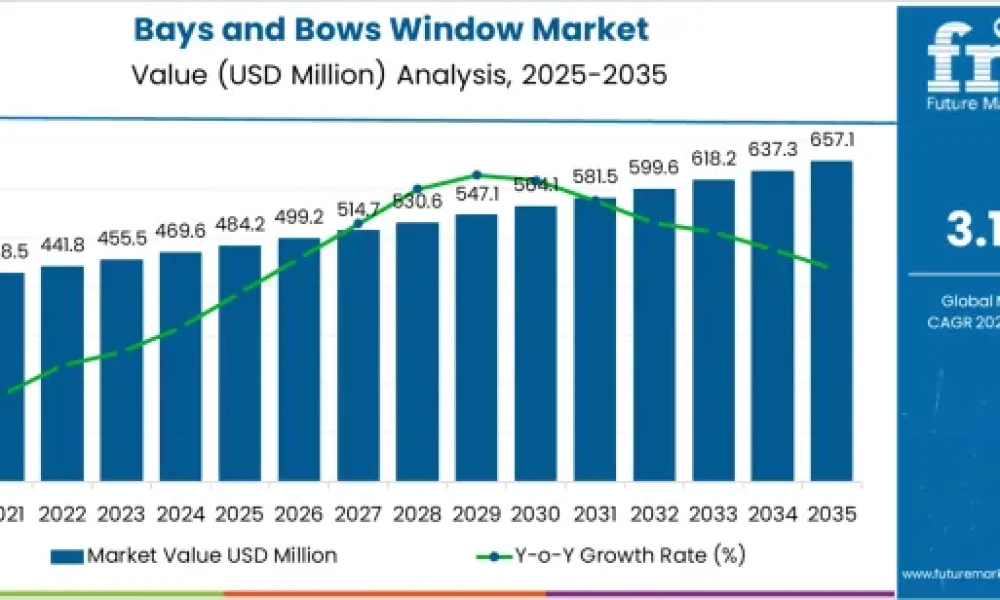
The global bays and bows window market is entering a decade marked by structural design innovation, evolving residential priorities, and accelerating investment in energy-efficient fenestration. According to newly released market projections, the sector is forecast to expand from USD 484.2 million in 2025 to USD 657.1 million by 2035, registering a steady 3.1% CAGR driven by renovation cycles, advanced glazing adoption, and the rising demand for architectural elements that enhance both functionality and visual appeal.
Across the forecast window, market momentum is anchored in the transformation of residential construction standards. As homeowners and developers prioritize natural light optimization, perceived interior space expansion, and aesthetic differentiation, bays and bows windows continue to transition from optional design elements to essential architectural features.
Subscribe for Year-Round Insights → Stay ahead with quarterly and annual data updates : https://www.futuremarketinsights.com/reports/sample/rep-gb-28120
Premium Fenestration and Energy-Efficient Design Reinforce Market Performance
- The 2025–2030 period reflects heightened demand from renovation-focused homeowners and developers seeking to integrate distinctive window features to elevate property value and architectural character. Bay windows, supported by simpler structural requirements and broad design adaptability, hold a leading 64% market share, solidifying their position as the dominant window type throughout the decade.
- By 2030–2035, market expansion accelerates around advanced glazing systems, warm-edge spacers, insulated framing technologies, and smart home integration, adding USD 93.1 million in new revenue and representing 54% of total decade-level growth. Increasingly, bays and bows windows are being paired with automated shading and climate-responsive technologies, redefining their role from purely aesthetic upgrades to high-performance components within connected home ecosystems.
- Across both new construction and retrofit applications, the residential sector retains its role as the revenue backbone—representing 75% of total market demand in 2025. Rising homeowner expectations, coupled with tightening building codes emphasizing thermal performance, further accelerate adoption of premium, energy-rated window systems.
Regional Growth Patterns Highlight East Asia, South Asia Pacific, and Western Europe
Geographic expansion is shaped by two parallel dynamics: sustained demand from mature residential markets and rapid adoption in urbanizing economies. East Asia and South Asia Pacific demonstrate the strongest growth trajectories, supported by expanding middle-class housing markets and large-scale urban development programs.
- China leads global growth with a 4.2% CAGR, reflecting aggressive residential construction initiatives, quality-oriented housing standards, and increasing preference for design-enhancing fenestration in both villas and upscale apartment complexes.
- India follows with 3.9% CAGR, driven by home improvement activity, developer investments, and rising adoption of premium architectural features in major metros such as Mumbai and Bangalore.
- Germany maintains the top position in Europe with a 34.7% regional market share in 2025, reinforced by strong energy performance standards and design compatibility requirements across its renovation-intensive residential landscape.
Meanwhile, the United States, with a 2.9% CAGR, continues to anchor North American demand through mature home improvement spending, energy-efficient window upgrades, and structural preference for customizable fenestration solutions.
Shifting Revenue Dynamics Reflect the Rise of High-Performance and Custom Architectural Solutions
Current demand is largely concentrated in new installations (48%), custom configurations (24%), and renovation-driven replacements (18%). However, the revenue mix will shift significantly over the next 3–5 years:
- 40–45% of future revenue will come from premium energy-efficient systems, including low-E coatings, triple glazing, and thermally optimized framing.
- 25–28% share will be driven by bespoke architectural solutions catering to contemporary, traditional, and transitional home designs.
- Smart window systems integrating automated shading and climate connectivity will rise to 12–15% of market revenue, reflecting growing adoption of home automation platforms.
As installation complexity increases for both bay and bow window systems, professional installation services and warranty programs will remain critical differentiators. Companies capable of pairing engineered window systems with reliable installation networks are positioned for sustained competitive advantage.
Architectural Preferences Reinforce Bay Window Dominance While Bow Windows Retain Premium Appeal
Bay windows continue to outperform due to their angular design flexibility, 15–25% perceived interior space enhancement, and compatibility with multiple architectural styles. Their functional advantages—including improved ventilation and seamless integration with seating or display features—reinforce strong adoption across single-family homes and multi-unit developments.
Bow windows maintain a solid 36% share, particularly across premium residential segments that value curved panoramic views and elevated façade aesthetics. Growth in luxury housing construction and architectural customization is expected to support steady bow window demand through 2035.
Market Leaders Advance Through Innovation, Distribution Strength, and Integrated Services
The competitive landscape is defined by 18–24 manufacturers, with the top 5–7 players controlling 58–63% of global revenue. Industry leaders—including Andersen, Milgard Windows, Pella, Marvin, and JELD-WEN—continue to strengthen their positions through:
- Expanded energy-efficient product portfolios
- Enhanced installation partnerships
- Advanced glazing innovation pipelines
- Region-specific architectural customization
- Integrated digital visualization and performance documentation tools
As standard frame materials become increasingly commoditized, long-term differentiation will depend on premium glazing packages, builder partnerships, and value-added services such as energy savings validation and extended warranties.
Have a specific Requirements and Need Assistant on Report Pricing or Limited Budget please contact us – [email protected]
About Future Market Insights (FMI)
Future Market Insights, Inc. (FMI) is an ESOMAR-certified, ISO 9001:2015 market research and consulting organization, trusted by Fortune 500 clients and global enterprises. With operations in the U.S., UK, India, and Dubai, FMI provides data-backed insights and strategic intelligence across 30+ industries and 1200 markets worldwide.



