
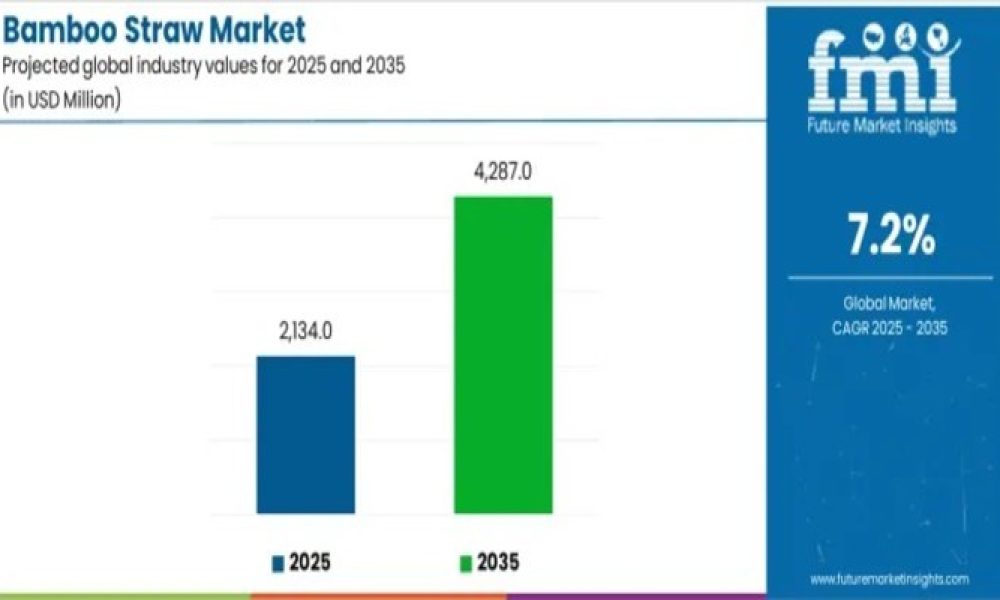
The global bamboo straw market is entering a decade of unprecedented transformation, signaling a major shift in how the world approaches eco-friendly drinkware and sustainable utensil solutions. Valued at USD 2,134 million in 2025, the market is projected to reach USD 4,287 million by 2035, expanding at a 7.2% CAGR. This accelerated growth reflects surging demand for biodegradable, reusable, and health-forward drinking alternatives adopted across restaurants, cafés, households, resorts, and premium beverage service platforms.
As environmental legislation tightens worldwide and consumers increasingly embrace zero-waste lifestyles, bamboo straws are rapidly evolving from niche eco products to mainstream beverage infrastructure. Their natural antibacterial qualities, extended durability, and compatibility with diverse drink types have positioned them as a preferred solution for environmentally aware food service operators and conscious consumers.
Subscribe for Year-Round Insights → Stay ahead with quarterly and annual data updates – https://www.futuremarketinsights.com/reports/sample/rep-gb-6936
A Decade of Transition: Market Growth in Two Distinct Phases
2025–2030: Eco-Adoption and Cultural Shift
The first growth phase lifts the market from USD 2,134 million to USD 2,891 million, adding USD 757 million—accounting for 35% of the decade’s total expansion.
This period marks the industry’s broad transition away from disposable plastics as restaurants and cafés commit to natural, reusable alternatives. Key attributes such as antibacterial protection, longer service life, and compostable material structure move from premium features to standard expectations.
Leading players—including Jungle Straws, Simply Straws, and Bamboo Straws Wholesale—expand manufacturing capabilities and introduce advanced processing techniques to improve diameter consistency, surface finishing, and structural durability.
2030–2035: Premiumization and Advanced Integration
The second half of the forecast window accelerates growth, adding USD 1,396 million and accounting for 65% of total market expansion.
This era is shaped by:
- Universal adoption of reusable bamboo straw systems
- Integration with automated cleaning and sanitization equipment
- Multi-venue deployment across hotels, cafés, bars, resorts, and specialty drink chains
As eco-friendly dining becomes a global norm, bamboo straws evolve into essential beverage service tools rather than optional eco-upgrades.
Market Snapshot
- 2025 Market Value: USD 2,134 million
- 2035 Forecast Value: USD 4,287 million
- CAGR: 7.2%
- Leading Type: Reusable (52% share)
- Top Application: Restaurants & Cafés
- High-Growth Regions: Asia Pacific, North America, Europe
- Key Companies: Jungle Straws, Simply Straws, Bamboo Straws Wholesale, Buluh Straws, Aardvark Straws
Why Bamboo Straws Are Growing: The Three Core Drivers
- Environmental Legislation
Global plastic bans and sustainability mandates push restaurants, hotels, and beverage chains to adopt biodegradable alternatives. Bamboo straws offer superior eco-compliance with minimal operational disruption.
- Eco-Conscious Consumer Behavior
Consumers increasingly demand plastic-free experiences. Natural drinkware enhances brand value and aligns with wellness-oriented lifestyles.
- Food Service Efficiency
Reusable bamboo straws reduce operational waste, integrate well with commercial cleaning systems, and deliver long-term cost advantages over single-use plastics.
However, the industry faces challenges such as quality variations across processing facilities, sanitization requirements, and the need for improved size standardization.
Segmental Insights
Type Analysis
The Reusable category dominates with a 52% share, driven by:
- Longer lifespan
- Antibacterial properties
- Cost-effectiveness over multiple service cycles
Reusable straws are widely adopted across restaurants, resorts, and households due to consistent performance and cleaning compatibility.
Application Analysis
Restaurants & Cafés lead with a 41% market share, supported by:
- Plastic-free dining trends
- Customer preference for sustainable tableware
- Branding opportunities through natural presentation
Growth is particularly strong in quick-service restaurants, premium cafés, and specialty beverage establishments.
Regional Performance: Asia-Pacific Leads Global Expansion
India (8.5% CAGR)
India emerges as the fastest-growing market due to:
- Expanding eco-conscious culture
- Plastic-ban enforcement
- Strong restaurant and café modernization
Urban centers such as Delhi, Mumbai, and Bangalore are driving high-volume adoption across modern food service formats.
China (8.2% CAGR)
China’s rapid adoption is powered by:
- Large-scale restaurant demand
- Affordable, high-volume bamboo production
- Growing household penetration
Major cities including Shanghai and Guangzhou dominate consumption.
United States (7.8% CAGR)
The U.S. leads in innovation, focusing on:
- Premium quality
- Enhanced antibacterial processing
- High-performance reusable options for national restaurant chains
California, New York, and Texas are the primary hubs of adoption.
Germany & Western Europe
Germany (6.9% CAGR) and the wider European region maintain strong momentum through:
- Environmental heritage programs
- Organic and premium dining sectors
- Stringent biodegradability regulations
Competitive Landscape
The market is moderately concentrated, with 15–22 active players and the top companies controlling 38–45% of global share. Jungle Straws leads with approximately 7% share, supported by global distribution strength and deep processing expertise.
New entrants focus on:
- Advanced organic treatment
- Diameter precision engineering
- Disposable bamboo innovations for high-volume operators
Established players increasingly invest in automated processing and scalable production to meet rising global demand.
Have a specific Requirements and Need Assistant on Report Pricing or Limited Budget please contact us – [email protected]
About Future Market Insights (FMI)
Future Market Insights, Inc. (FMI) is an ESOMAR-certified, ISO 9001:2015 market research and consulting organization, trusted by Fortune 500 clients and global enterprises. With operations in the U.S., UK, India, and Dubai, FMI provides data-backed insights and strategic intelligence across 30+ industries and 1200 markets worldwide.



