
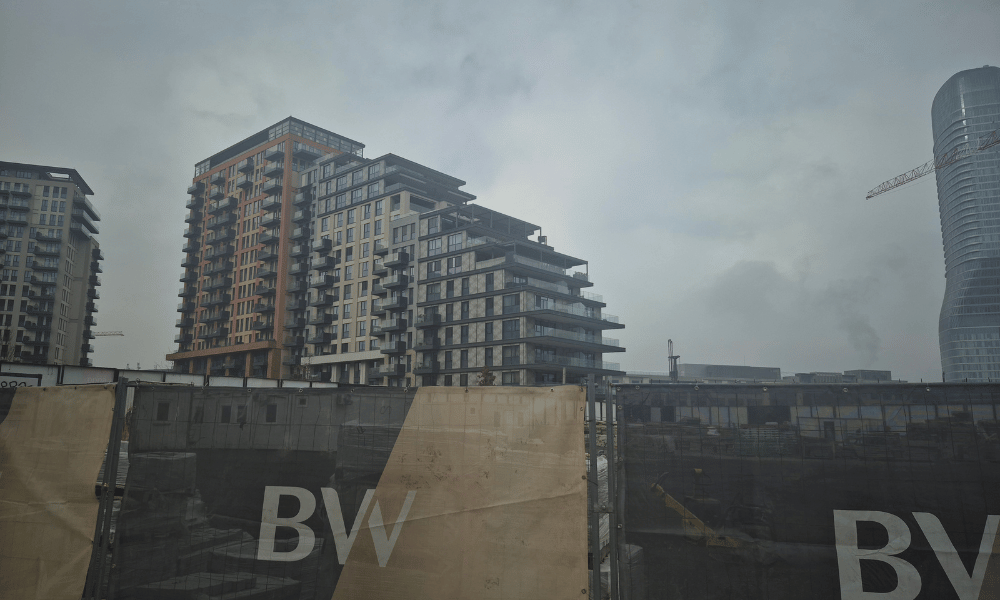
With air quality nearly as bad as India, smoking indoors and Russia running out of steam, the writing is on the wall for Belgrade real estate, with a major crash on the horizon. The lovely people of Serbia did indeed witness a recent miracle though: Belgrade’s property market has spent the last few years behaving like a “can’t-lose” trade. Prices climbed rapidly, rents surged, and the city gained sudden international visibility as a place where mobile capital and mobile workers could relocate quickly. But a growing set of structural pressures suggests the boom is becoming fragile, and that Belgrade is increasingly exposed to a sharp correction if several demand pillars weaken at the same time.
This is not a story about a single dramatic trigger. It is about a market that has stretched affordability, relied heavily on temporary demand inflows, and now faces fundamental headwinds that higher-income European buyers and long-term residents tend to weigh heavily. These include environmental quality, public health standards, and the long-term sustainability of Serbia’s outsourcing-led growth model in an era of rapid AI adoption.

Demand risk as the Russia-driven inflow loses momentum
Belgrade’s post-2022 property surge cannot be separated from the influx of Russian citizens following the war in Ukraine. Tens of thousands of Russians relocated to Serbia, with Belgrade absorbing the bulk of that movement. Many registered businesses locally, rented centrally located apartments, and accepted higher rents than the local market had previously tolerated.
This kind of demand shock can push prices and rents sharply higher in a short period. In Belgrade, rents jumped dramatically within a single year, in some cases by multiples that had little connection to domestic wage growth. That works while the inflow continues. The risk emerges when it slows or reverses.
If relocation demand fades because geopolitical conditions change, capital tightens, or alternative destinations become more attractive, the market loses the marginal tenant and buyer that was setting the new price ceiling. In real estate, prices are determined at the margin. When that marginal demand disappears, markets do not gently recalibrate. They often fall abruptly as sellers compete for a shrinking buyer pool.
Affordability is already stretched beyond local fundamentals
Belgrade is no longer cheap relative to Serbian incomes. While headline prices may still appear low compared with Western Europe, the local affordability ratio has deteriorated sharply. New-build apartment prices moved well beyond levels that average households can realistically support without long-term credit expansion or continued foreign demand.
At the same time, higher interest rates have made financing more sensitive. Policy interventions, such as interest-rate caps on housing loans, underline how exposed households are to even modest rate increases. These measures may temporarily stabilize monthly payments, but they do not change the underlying equation. Without policy support, demand weakens quickly. With policy support, market pricing becomes increasingly artificial.
When affordability is already overstretched, prices can only remain elevated if incomes rise rapidly, credit remains unusually accommodative, or external demand continuously replenishes the market. If more than one of these supports weakens at the same time, downside risk accelerates.
Air pollution and public smoking create a real quality-of-life discount
For international buyers, environmental and public health factors are not abstract concerns. Belgrade’s air quality has become a recurring issue, particularly during winter months. Fine particulate pollution regularly reaches levels that would be considered unacceptable in most EU capitals. This is not an occasional anomaly but a structural consequence of energy generation, heating practices, traffic, and geography.
Serbia’s continued reliance on lignite and coal-fired power generation contributes directly to winter smog. For families, health-conscious professionals, and long-term residents comparing Belgrade to EU alternatives, this is not a minor inconvenience. It is a decisive negative.
Public smoking compounds the issue. Indoor smoking remains widespread in hospitality venues, with limited enforcement and broad cultural acceptance. For first-world residents accustomed to strict smoke-free environments, this is a clear deterrent. Over time, these quality-of-life factors act as a discount on property values by shrinking the pool of buyers willing to commit long-term capital.
Markets can ignore such factors during speculative phases. They cannot ignore them indefinitely when buyers have alternatives with cleaner air, stricter public health standards, and comparable or lower effective tax burdens.
Outsourcing growth faces the same AI shock seen in other low-cost hubs
Serbia’s ICT and outsourcing sector has been one of its economic success stories. Exports have grown rapidly, employment has expanded, and Belgrade has benefited from higher-paying tech jobs relative to the national average. However, the structure of that growth matters.
Much of the outsourcing work across emerging markets remains operator-level, process-driven, and repetitive. These are precisely the tasks now being targeted by AI-driven automation. This is not unique to Serbia. Similar pressures are already visible in traditional outsourcing giants such as India and the Philippines, where companies are discovering that AI can replace large volumes of routine support, customer service, and back-office work.
The vulnerability lies in the lack of sufficient managerial, strategic, and high-trust outsourcing roles. Without a strong shift toward senior, decision-making, or domain-expert functions, the cost advantage that supported growth erodes quickly. If outsourcing growth slows or restructures downward, wage momentum weakens, confidence drops, and one of the narratives supporting higher property prices fades.
Why the risk is a sharp correction, not a gentle slowdown
Property crashes rarely result from a single factor. They emerge when several weaknesses align. In Belgrade’s case, a plausible bearish scenario does not require a financial crisis.
Foreign-driven rental demand cools and rent growth stalls or reverses. Locals cannot step in at current price levels due to affordability constraints. Environmental and public health drawbacks deter higher-income European buyers who might otherwise provide long-term price support. Meanwhile, outsourcing growth decelerates as AI reduces demand for operator-level labor, weakening income growth and sentiment.
At that point, transaction volumes fall, sellers anchor to peak valuations, buyers wait for better prices, and the market freezes. When liquidity disappears, prices tend to adjust rapidly to restore activity. The longer prices have been supported by temporary or external demand, the sharper the adjustment tends to be.
When the US Turns, the World Follows: Why Global Property Markets Rarely Decouple from an American Downturn
Historically, major US property and credit downturns have not stayed contained within American borders. Because the US dollar anchors global finance, US credit conditions influence international liquidity, capital flows, and risk appetite almost immediately. When US property weakens, global investors reduce leverage, banks tighten lending standards, and cross-border real estate capital retreats to safety. Markets that rely on foreign demand, speculative inflows, or stretched affordability tend to feel the impact fastest and hardest.
What is unfolding now follows a familiar pattern. As US real estate shows clear signs of stress, global markets are already entering the early stages of synchronized cooling. This does not mean all countries crash at once or equally, but history shows that very few escape unscathed when US property and credit cycles reverse in tandem.
| US property downturn | What happened in EU property markets | What happened in global/emerging markets |
|---|---|---|
| Early 1990s US real estate bust | Western Europe saw multi-year stagnation, falling commercial values, and tight credit, especially in the UK and Scandinavia | Capital retreated from emerging markets, triggering regional recessions and property corrections |
| 2007–2009 US housing and credit crash | Severe declines across Ireland, Spain, Greece, and parts of Eastern Europe, with price drops of 30–60 percent in bubble markets | Sharp capital flight, currency devaluations, and property crashes in Eastern Europe, Latin America, and parts of Asia |
| 2018–2020 US rate tightening and COVID shock | EU residential markets paused or declined briefly before stimulus reversed the trend | Emerging markets experienced funding stress, delayed projects, and falling transaction volumes |
| 2022–2024 US rate shock | EU markets entered price declines and volume collapses, especially in Germany, Sweden, and the Nordics | Foreign capital pulled back, currencies weakened, and affordability-driven slowdowns spread |
| 2025–present US commercial and residential stress | EU markets face ongoing repricing as credit tightens and foreign demand fades | Peripheral and inflow-driven markets become vulnerable to sharper corrections |
The key takeaway is that global property markets rarely crash because of purely local factors. They crash when global liquidity tightens, confidence breaks, and capital seeks safety. When the US leads a downturn, Europe and emerging markets typically follow with a lag, not because their fundamentals are identical, but because the financial system connecting them is.
In that context, markets that have recently relied on external demand, temporary migration, or speculative inflows are especially exposed. When the US downturn accelerates, synchronized global repricing becomes the rule rather than the exception.
Why Belgrade Fails the First-World Quality-of-Life Test
For first-world citizens, Belgrade increasingly falls short on core quality-of-life criteria that drive long-term relocation and property investment decisions. Chronic air pollution driven by lignite-based power generation and winter heating leads to prolonged exposure to fine particulates, contributing to respiratory issues and asthma risk, especially for children and older residents. Indoor smoking remains widely tolerated in restaurants and cafés, creating an environment that feels outdated and unhealthy to visitors from smoke-free societies. Affordability has deteriorated sharply relative to local incomes, while environmental conditions undermine outdoor living and fitness for large parts of the year. At the same time, Serbia’s economic growth narrative relies heavily on low-level outsourcing that is increasingly vulnerable to AI automation, limiting future wage growth and social mobility. When cleaner EU cities offer better air, stricter public-health standards, more predictable institutions, and comparable or lower effective tax burdens, Belgrade struggles to compete for first-world residents seeking stability, health, and long-term livability.
Conclusion
Belgrade still offers advantages, including geographic position, cultural depth, and a genuine technology sector. But current property prices increasingly assume a future where foreign inflows remain strong, environmental and public health concerns are ignored, and outsourcing growth continues uninterrupted.
That combination is increasingly fragile.
If relocation-driven demand fades, if cleaner and more regulated EU destinations continue to attract first-world residents, and if AI accelerates the erosion of low-level outsourcing work, Belgrade’s property market may find that it is priced for a reality that no longer exists. In that environment, a significant correction would not be surprising.




