
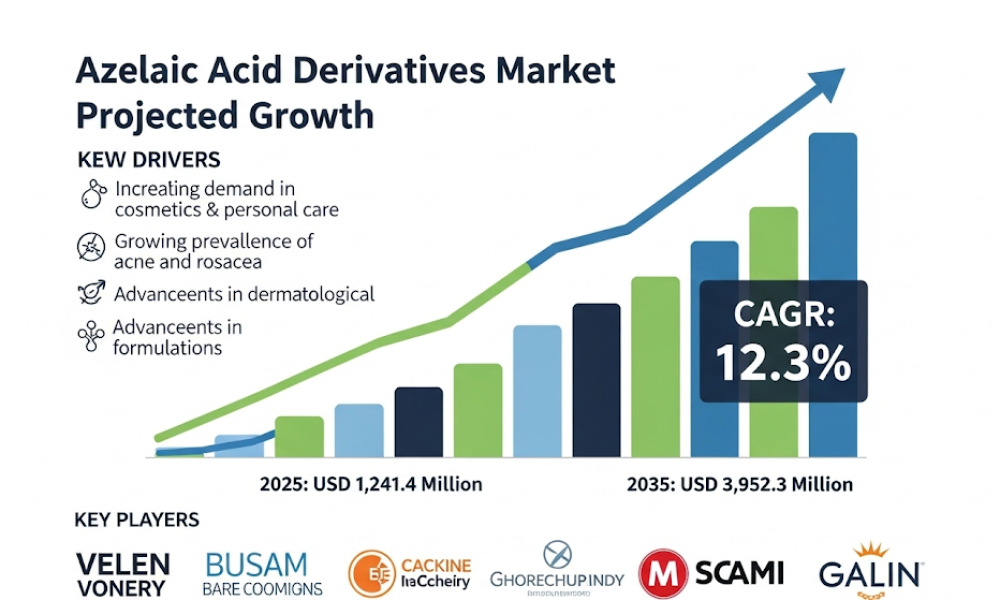
The Azelaic Acid Derivatives Market is poised for remarkable expansion over the next decade, with an estimated valuation of USD 1,241.4 million in 2025, projected to surge to USD 3,952.3 million by 2035. This growth represents an increase of over 218% and a robust CAGR of 12.3%, highlighting a more than threefold rise in market size. As consumers increasingly prioritize dermatologically backed, multifunctional skincare, azelaic acid has emerged as a gold-standard ingredient, renowned for its anti-inflammatory, brightening, and acne-combating properties.
The market trajectory can be divided into two key phases. From 2025 to 2030, the market grows steadily from USD 1,241.4 million to USD 2,215.0 million. This period is characterized by strong adoption in acne treatment, pigmentation reduction, and anti-inflammatory applications. Creams and lotions dominate over 42% of daily-use formulations, catering to both prescription and over-the-counter skincare needs. Between 2030 and 2035, growth accelerates dramatically, with the market adding USD 1,737.3 million to reach USD 3,952.3 million. This surge is driven by premiumization, consumer adoption of clean-label and vegan products, expanding e-commerce channels, and deeper penetration into emerging markets such as India and China. During this phase, serums, gels, and targeted spot treatments capture more than 50% of the market, reflecting a shift toward precision skincare and personalized formulations.
Full Market Report available for delivery. For purchase or customization, please request here: https://www.futuremarketinsights.com/customization-available/rep-gb-24863
Driving Forces: Why the Market Is Expanding
The rise in demand for azelaic acid derivatives stems from advances in clinical skincare and growing consumer awareness of long-term skin health. Recognized as a gold-standard treatment for acne, pigmentation, and inflammatory skin conditions, azelaic acid has become a cornerstone ingredient in both prescription and consumer beauty routines.
Pharmacies retain credibility as a dominant distribution channel, holding 37.6% of the market share in 2025. However, e-commerce is rapidly expanding due to the convenience of online consultations, subscription models, and global accessibility. The shift toward vegan, clean-label, and dermatologist-tested claims has further boosted consumer confidence, encouraging adoption across specialty beauty stores and digital platforms. The combination of clinical validation and ethical positioning has fueled the premiumization of azelaic acid products, creating new opportunities for both established brands and emerging digital-first companies.
Segment Insights: Acne Treatment Leads the Way
Among the various functions of azelaic acid derivatives, acne treatment dominates with a 46.6% share in 2025, reflecting the high prevalence of acne among younger demographics. Its dual benefits of combating acne-causing bacteria while soothing inflammation have cemented its place in dermatologists’ recommendations and consumer routines. The rise of tele-dermatology and online pharmacies has further amplified the reach of acne-focused azelaic acid formulations, supporting growth in both mature and emerging markets.
Product Trends: Creams, Lotions, Serums, and Gels
Creams and lotions currently lead the market, holding 42.5% of total formulations in 2025. These formats offer accessibility, affordability, and widespread consumer acceptance, making them the first point of adoption for new users. They serve both prescription and over-the-counter channels, addressing acne and pigmentation concerns. By 2035, serums, gels, and spot treatments are expected to outpace creams in growth, driven by premiumization, digital-first marketing, and personalized skincare trends. Targeted treatments allow consumers to focus on localized skin issues, aligning with the broader move toward multifunctional, precision skincare.
Regional Growth Dynamics
Regional markets display significant variation in growth patterns. India and China are projected to grow at CAGRs of 19.4% and 17.3%, respectively, fueled by rising disposable incomes, urbanization, tele-dermatology adoption, and strong e-commerce ecosystems. In these countries, skincare education and online accessibility enable rapid penetration of azelaic acid derivatives, both in premium and mass-market segments. Japan follows closely with a CAGR of 14%, supported by high consumer trust in clinical-grade products and a cultural preference for brightening formulations. Mature markets such as the USA (7.2%), Germany (8.4%), and the UK (11.2%) maintain steady growth, anchored by established pharmacy distribution, prescription adoption, and brand loyalty, though their share of global growth is gradually declining as Asia-Pacific markets expand.
Competitive Landscape: Established Leaders and Emerging Innovators
The market is moderately fragmented, combining veteran skincare brands, clinical-grade innovators, and niche indie players. Paula’s Choice holds the largest share in 2025 at 8.7%, largely due to its 10% Azelaic Acid Booster, which has set a benchmark globally for acne and pigmentation care. The Ordinary, La Roche-Posay, SkinCeuticals, Murad, Sesderma, Eucerin, Azelique, Glytone, and Allergan also drive the market forward, offering diversified portfolios spanning creams, serums, and gels.
Established players differentiate through clinical validation, dermatologist endorsements, and omnichannel distribution strategies. Meanwhile, digital-native and indie brands emphasize vegan, cruelty-free, and subscription-based models, attracting younger, environmentally conscious consumers. Subscription services and AI-driven skincare recommendations are emerging as critical levers, enabling personalization and increased consumer engagement.
In 2023, notable innovations reinforced market momentum. Paula’s Choice upgraded its 10% Azelaic Acid Booster with enhanced soothing ingredients, strengthening dual-action acne and pigmentation efficacy. Similarly, The Ordinary introduced a limited-edition Azelaic Acid Suspension 10% with eco-friendly packaging, appealing to sustainability-conscious millennials and Gen Z consumers, highlighting the growing importance of clean-label and environmentally responsible positioning.
Request Market Research Draft Report: https://www.futuremarketinsights.com/reports/sample/rep-gb-24863
Market Challenges: Competition and Awareness
Despite strong growth, azelaic acid derivatives face challenges. Established skincare actives like retinoids and niacinamide dominate consumer awareness, creating competition for attention and shelf space. Furthermore, azelaic acid often requires consistent use over several weeks before results become visible, which can deter consumers accustomed to faster-acting treatments. Awareness campaigns, dermatologist collaborations, and transparent communication of clinical data remain essential to overcome these barriers and educate consumers about the benefits of sustained use.
Future Outlook: Personalization and Premiumization
Looking ahead, the market is poised for continued expansion, driven by personalized skincare, premium formulations, and e-commerce proliferation. Emerging trends such as serums, gels, and spot treatments are expected to capture an increasing share of global revenue by 2035. Asia-Pacific markets, led by India and China, will be pivotal to overall growth, while mature markets maintain strong absolute revenues.
The future will also see an increasing focus on multifunctional, dermatologist-backed products that combine acne treatment, pigmentation reduction, and skin health benefits. Brands that effectively integrate clean-label claims, clinical efficacy, and personalized delivery models are positioned to lead in both mature and emerging markets.
About Future Market Insights (FMI)
Future Market Insights, Inc. (ESOMAR certified, recipient of the Stevie Award, and a member of the Greater New York Chamber of Commerce) offers profound insights into the driving factors that are boosting demand in the market. FMI stands as the leading global provider of market intelligence, advisory services, consulting, and events for the Packaging, Food and Beverage, Consumer Technology, Healthcare, Industrial, and Chemicals markets. With a vast team of over 400 analysts worldwide, FMI provides global, regional, and local expertise on diverse domains and industry trends across more than 110 countries.
Contact Us:
Future Market Insights Inc.
Christiana Corporate, 200 Continental Drive,
Suite 401, Newark, Delaware – 19713, USA
T: +1-347-918-3531
For Sales Enquiries: [email protected]



