
The global automotive industry continues to evolve with the rapid adoption of electrification, advanced safety systems, and automated vehicle technologies. Within this dynamic landscape, the automotive solenoid market is emerging as a critical component of modern vehicle architecture. Automotive solenoids are electromagnetic devices used to convert electrical energy into mechanical motion, enabling precise control of various vehicle functions such as fuel injection, transmission shifting, engine start/stop systems, and braking systems.
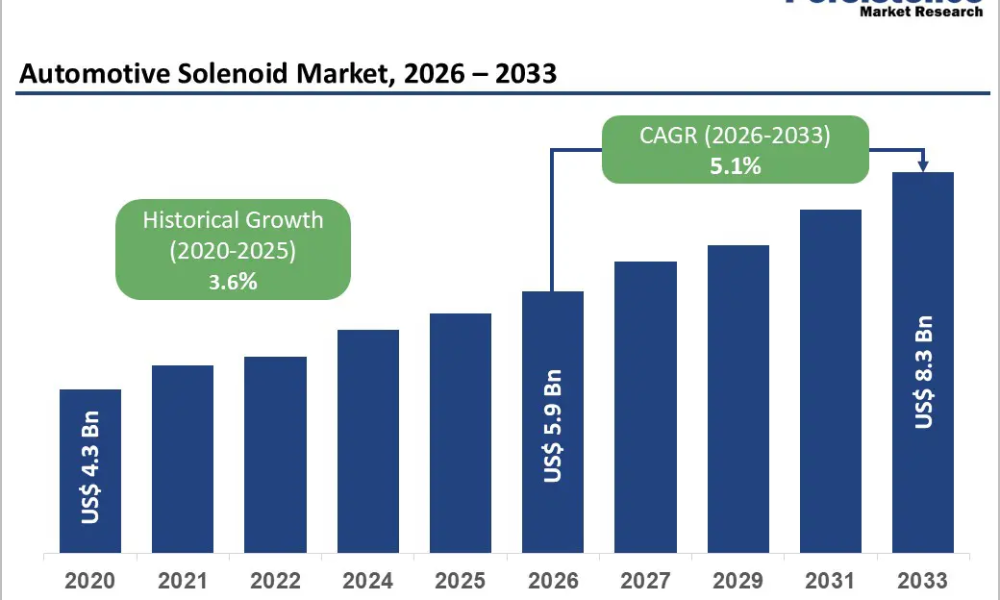
According to insights from leading market research firms, the global automotive solenoid market is expected to experience steady growth over the coming years. The market size is projected to be valued at US$ 5.9 billion in 2026 and is anticipated to reach US$ 8.3 billion by 2033, expanding at a compound annual growth rate (CAGR) of 5.1% during the forecast period from 2026 to 2033.
Several macroeconomic and industry-specific factors are contributing to this growth trajectory. Rising global vehicle production, increasing adoption of automatic transmission systems, and the growing penetration of electric and hybrid vehicles are major drivers supporting demand for automotive solenoids. In addition, the rapid development of advanced driver assistance systems (ADAS), emission control technologies, and electronic control units (ECUs) has increased the need for precise and reliable electromechanical components.
Get Your FREE Sample Report Instantly Click Now: https://www.persistencemarketresearch.com/request-customization/17416
Key Highlights from the Report
➤ The global automotive solenoid market is expected to grow from US$ 5.9 billion in 2026 to US$ 8.3 billion by 2033, registering a CAGR of 5.1% during the forecast period.
➤ Increasing adoption of automatic transmission systems and advanced vehicle electronics is significantly boosting the demand for automotive solenoids worldwide.
➤ Rising production of electric and hybrid vehicles is creating new growth opportunities for advanced electromagnetic actuation technologies.
➤ The transmission control segment continues to dominate application demand due to widespread use in automatic and semi-automatic transmissions.
➤ Asia Pacific remains the largest regional market due to high vehicle production volumes and strong automotive manufacturing ecosystems.
➤ Technological advancements in smart solenoids and electronically controlled valve systems are expected to drive next-generation automotive innovations.
Market Segmentation
By Vehicle Type
- Passenger Cars
- Light Commercial Vehicles
- Heavy Commercial Vehicles
- Electric Vehicles
- Two Wheelers
By Sales Channel
- OEMs
- Aftersales
By Application
- Engine Management Systems
- Powertrain Systems
- Safety & Security Systems
- HVAC Control & Cooling Systems
- Others
By Region
- North America
- Europe
- East Asia
- South Asia and Oceania
- Latin America
- Middle East and Africa
Customize This Report for Your Exact Requirements: https://www.persistencemarketresearch.com/request-customization/17416
Regional Insights
Geographically, the automotive solenoid market is segmented into North America, Europe, Asia Pacific, Latin America, and the Middle East & Africa.
Asia Pacific dominates the global automotive solenoid market, primarily due to the presence of major automotive manufacturing hubs in countries such as China, Japan, South Korea, and India. The region benefits from high vehicle production volumes, strong supply chains, and increasing domestic demand for passenger and commercial vehicles. Additionally, government initiatives promoting electric vehicle adoption and advanced manufacturing technologies are contributing to sustained market growth.
North America represents a significant market, driven by the rapid adoption of advanced vehicle technologies, strong demand for SUVs and pickup trucks, and increasing investments in electric vehicle manufacturing. The region also benefits from the presence of major automotive technology companies focusing on innovation in drivetrain systems and electronic control technologies.
Europe remains another key region due to its strict emission regulations and strong focus on vehicle electrification. Automakers across the region are investing heavily in advanced engine management systems and hybrid powertrain technologies, both of which rely heavily on solenoid-based actuators.
However, Asia Pacific is expected to remain the fastest-growing region during the forecast period. Rapid urbanization, expanding middle-class populations, and increasing demand for personal mobility solutions are driving vehicle sales in emerging economies, thereby boosting demand for automotive solenoids.
Market Highlights
The automotive solenoid market is gaining strong momentum as vehicle manufacturers continue to prioritize performance, efficiency, and safety. Solenoids are essential components in various vehicle subsystems, making them indispensable in modern automotive engineering.
One of the key factors driving adoption is the increasing shift toward automatic transmission systems. Consumers are increasingly preferring vehicles with smooth and effortless driving experiences, which has accelerated the adoption of automatic and dual-clutch transmissions. These systems rely heavily on solenoids to regulate hydraulic pressure and ensure precise gear shifts.
Environmental regulations are also playing a critical role in shaping market growth. Governments worldwide are implementing stringent emission standards to reduce the environmental impact of vehicles. Automotive solenoids contribute to emission reduction by enabling more efficient fuel injection and engine control systems.
Cost efficiency and reliability are additional advantages driving demand. Solenoids are relatively compact, durable, and capable of delivering high-performance actuation in harsh automotive environments. As a result, they remain a preferred solution for many electromechanical applications within vehicles.
Furthermore, the ongoing shift toward electric and hybrid vehicles is creating new opportunities for advanced solenoid technologies. Although EV powertrains differ from traditional internal combustion engines, solenoids continue to play a crucial role in thermal management systems, braking systems, and power distribution mechanisms.
Key Players and Competitive Landscape
The global automotive solenoid market is characterized by strong competition among established automotive component manufacturers. These companies focus on product innovation, strategic partnerships, and geographic expansion to strengthen their market position.
Key companies operating in the automotive solenoid market include:
✦ Robert Bosch GmbH – A global leader in automotive technology, Bosch continues to invest in advanced electronic control systems and precision electromagnetic components to enhance vehicle performance.
✦ Denso Corporation – Known for its strong presence in automotive electronics and powertrain components, Denso focuses on developing high-efficiency solenoids for advanced vehicle applications.
✦ Hitachi Astemo Ltd. – The company integrates cutting-edge engineering with electronic control technologies to produce high-performance automotive solenoid solutions.
✦ Continental AG – Continental is expanding its portfolio of intelligent automotive components, including smart solenoids used in transmission and engine control systems.
✦ BorgWarner Inc. – BorgWarner specializes in powertrain technologies and is actively developing solenoid solutions that support hybrid and electric vehicle systems.
✦ Johnson Electric Holdings Limited – The company is known for its advanced motion systems and electromagnetic components used across automotive applications.
✦ Mitsubishi Electric Corporation – Mitsubishi Electric develops highly reliable solenoid technologies designed for advanced vehicle control and automation systems.
These companies are investing heavily in research and development to produce more compact, energy-efficient, and durable solenoid solutions. Strategic collaborations with automakers and technology firms are also helping them expand their market reach.
Ready to Dive Deep? Buy Full Report Today: https://www.persistencemarketresearch.com/checkout/17416
Recent Developments
- Several automotive component manufacturers have recently introduced next-generation transmission solenoidsdesigned to improve gear shift accuracy and reduce energy consumption in modern automatic transmission systems.
- Leading automotive suppliers are also investing in smart electromagnetic actuator technologiesthat integrate digital sensors and control systems, enabling real-time monitoring and predictive maintenance.
Future Opportunities and Growth Prospects
The future of the automotive solenoid market appears highly promising as the automotive industry undergoes a major technological transformation. Increasing electrification, digitalization, and automation are expected to create new application areas for solenoid-based actuation systems.
The growing adoption of autonomous driving technologies is likely to further boost demand for advanced electromechanical components. Autonomous vehicles require highly responsive control systems capable of managing braking, steering, and transmission operations with extreme precision.
Additionally, the transition toward software-defined vehicles is expected to increase the integration of electronic and mechanical components, creating additional opportunities for smart solenoid technologies.




