
The Automotive Rain Sensor Market is witnessing steady growth as automakers increasingly integrate advanced sensing technologies into vehicles to improve safety, convenience, and automation. Rain sensors are electronic devices installed on windshields that detect moisture levels and automatically activate windshield wipers. These systems enhance driving visibility during sudden rainfall and are now commonly included in modern passenger cars and premium vehicles. Growing adoption of smart driver assistance features and the increasing focus on vehicle automation are supporting the wider deployment of rain sensor technology across multiple vehicle categories.
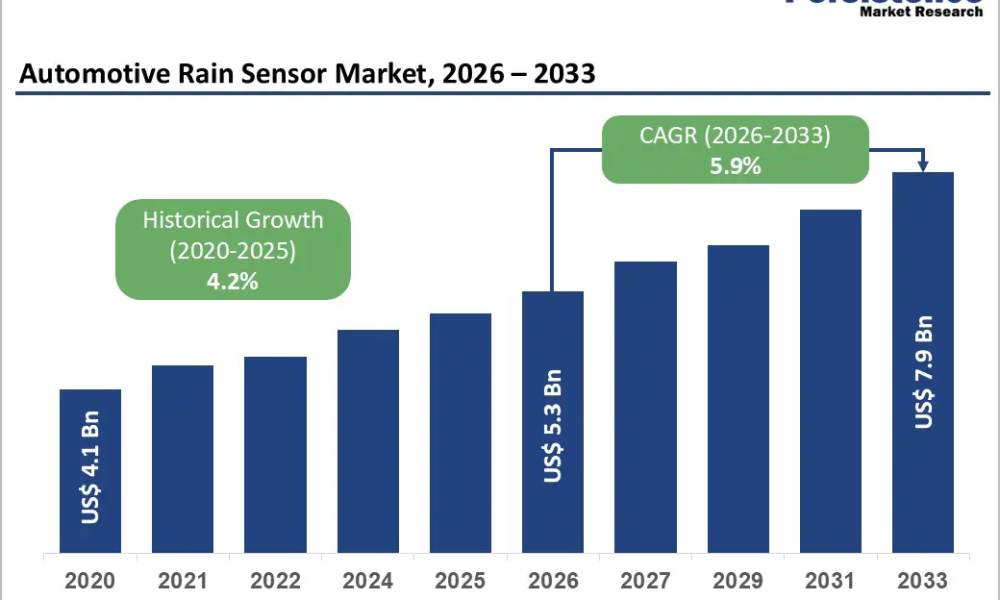
The global automotive rain sensor market size is supposed to be valued at US$ 5.3 billion in 2026 and is projected to reach US$ 7.9 billion by 2033, growing at a CAGR of 5.9% between 2026 and 2033. The market expansion is supported by increasing demand for advanced driver assistance systems, improved road safety technologies, and rising consumer preference for automated vehicle features. Passenger vehicles represent the leading segment because manufacturers are rapidly integrating sensor-based technologies to enhance driving comfort. Geographically, Europe is expected to remain a leading region due to strong automotive manufacturing capabilities, strict vehicle safety standards, and high adoption of advanced automotive electronics.
Get Your FREE Sample Report Instantly Click Now: https://www.persistencemarketresearch.com/request-customization/34743
The key players studied in the report include:
- Bosch
- Denso
- Valeo
- Continental
- Delphi Technologies
- Gentex Corporation
- Hella
- Autoliv
- Magna International
- SABIC
- Texas Instruments
- STMicroelectronics
- NXP Semiconductors
- Other Key Players
Key Highlights from the Report
➤ The global automotive rain sensor market is expected to grow from US$ 5.3 billion in 2026 to US$ 7.9 billion by 2033, expanding at a CAGR of 5.9%.
➤ Rising adoption of advanced driver assistance systems is significantly boosting the demand for automotive rain sensors worldwide.
➤ Increasing consumer preference for automated vehicle features and smart windshield technologies is accelerating market growth.
➤ Passenger vehicles dominate the market due to higher integration of electronic safety components.
➤ Europe remains the leading regional market driven by strict safety regulations and advanced automotive technology adoption.
➤ Growing innovation in optical sensing technologies is enhancing the accuracy and reliability of automotive rain detection systems.
Market Segmentation
By Vehicle Type
- Passenger Cars
- Light Commercial Vehicles
- Heavy Commercial Vehicles
- Electric Vehicles
By Sales Channel
- OEMs
- Aftermarket
By Region
- North America
- Europe
- East Asia
- South Asia and Oceania
- Latin America
- Middle East and Africa
Customize This Report for Your Exact Requirements: https://www.persistencemarketresearch.com/request-customization/34743
Regional Insights
Europe remains one of the most prominent regions in the automotive rain sensor market due to its strong automotive ecosystem and technological innovation. Countries across the region are known for producing technologically advanced vehicles equipped with smart safety features. Automotive manufacturers are continuously integrating advanced sensing technologies to comply with strict vehicle safety standards and improve driver assistance capabilities. Consumer awareness about safety features also plays a significant role in encouraging the adoption of rain sensor technologies.
North America is another important region experiencing steady growth in the automotive rain sensor market. Increasing demand for technologically advanced vehicles and strong consumer preference for automated features are contributing to market expansion. The region also benefits from the presence of leading automotive technology providers and electronic component manufacturers. Additionally, growing integration of advanced driver assistance systems in both premium and mid-segment vehicles is creating new opportunities for rain sensor manufacturers.
Market Drivers
One of the primary drivers of the automotive rain sensor market is the rapid adoption of advanced driver assistance systems across modern vehicles. Rain sensors play a crucial role in improving visibility during adverse weather conditions by automatically controlling windshield wipers. This automation enhances driver convenience and reduces distractions, which significantly improves road safety. As vehicles become more intelligent and automated, sensor technologies are becoming essential components within integrated safety systems.
Another important driver is the rising consumer demand for comfort and convenience features in vehicles. Modern drivers increasingly prefer vehicles equipped with automatic functionalities that enhance the driving experience. Rain sensors eliminate the need for manual wiper adjustment and ensure optimal windshield visibility during changing weather conditions. Automotive manufacturers are therefore integrating these sensors as standard features in many models, especially in mid-range and premium passenger vehicles.
Market Restraints
Despite the positive growth outlook, the automotive rain sensor market faces certain restraints that could affect its expansion. One of the key challenges is the additional cost associated with advanced sensor technologies. For entry-level vehicles and cost-sensitive markets, integrating rain sensors may increase the overall production cost of vehicles. As a result, some manufacturers limit these features to higher-end models rather than offering them across all vehicle segments.
Another limitation involves technical complexities related to sensor calibration and maintenance. Rain sensors require precise positioning and proper windshield compatibility to function accurately. Factors such as dirt, windshield damage, or improper installation may affect sensor performance. These issues may discourage adoption in certain vehicle segments where reliability and maintenance simplicity are prioritized.
Market Opportunities
The increasing trend toward vehicle automation presents major opportunities for the automotive rain sensor market. As automotive manufacturers continue to develop smarter vehicles with autonomous capabilities, sensor technologies are becoming essential components within integrated systems. Rain sensors can be combined with other environmental sensing technologies to enhance the performance of automated driving systems and improve vehicle safety in varying weather conditions.
Another promising opportunity lies in the expansion of electric vehicles and connected cars. These vehicles typically incorporate advanced electronic systems and smart sensors to deliver enhanced user experiences. As the production of electric and connected vehicles increases globally, the demand for rain sensors and related smart sensing technologies is expected to grow significantly. Technological innovation in compact sensor designs and cost-effective solutions will further support broader adoption.
Recent Developments:
- In March 2024, Bosch introduced an upgraded optical rain sensor designed to enhance detection accuracy in rapidly changing weather conditions.
- In September 2023, Valeo announced the development of a new integrated sensor module combining rain detection with ambient light sensing for improved driver assistance systems.
Ready to Dive Deep? Buy Full Report Today: https://www.persistencemarketresearch.com/checkout/34743
Frequently Asked Questions
➤ What factors are driving growth in the Automotive Rain Sensor Market?
➤ Which companies are leading competitors in the Automotive Rain Sensor Market?
➤ What opportunities are emerging in the Automotive Rain Sensor Market with smart vehicle technologies?
➤ Which regions are expected to dominate the Automotive Rain Sensor Market in the coming years?
➤ How are advanced driver assistance systems influencing the Automotive Rain Sensor Market?
Future Opportunities and Growth Prospects
The future of the automotive rain sensor market appears promising as vehicles continue to evolve toward greater automation, intelligence, and connectivity. Automotive manufacturers are focusing on integrating multiple sensing technologies into unified systems that enhance safety and driving convenience. Rain sensors will remain an important component within these advanced vehicle systems, particularly as automated driving technologies become more widespread.
Continuous innovation in sensor accuracy, compact design, and cost efficiency will further strengthen market growth. As electric vehicles, connected cars, and autonomous driving technologies gain momentum, the demand for intelligent environmental sensing systems will rise significantly. These trends are expected to create substantial long-term opportunities for manufacturers and technology providers operating in the automotive rain sensor market.




