
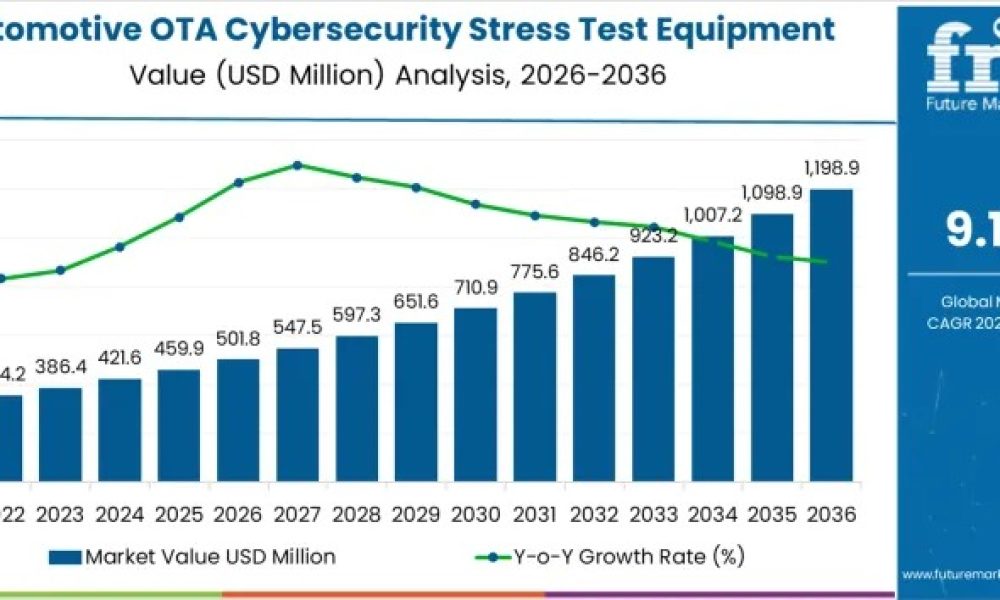
The global automotive OTA (Over-the-Air) cybersecurity stress test equipment market, valued at USD 501.8 million in 2026, is projected to surge to USD 1,198.9 million by 2036, expanding at a robust compound annual growth rate (CAGR) of 9.10%. This trajectory underscores the escalating demand for advanced testing solutions as connected vehicles proliferate, amplifying cybersecurity vulnerabilities in OTA update processes.
Rapid advancements in ADAS, infotainment, V2X communication, and software-defined vehicles have transformed OTA updates into a cornerstone of automotive innovation. Yet, these systems expose vehicles to sophisticated cyber threats, including unauthorized access, data breaches, and manipulated software deployments. Stress test equipment—capable of simulating complex cyberattacks, multi-layered vulnerabilities, and real-world interference—emerges as indispensable for validating OTA resilience. Hardware test appliances dominate with a commanding 38% market share, offering tangible, controlled environments to replicate threats across wireless networks, ECUs, and communication protocols like CAN, LIN, and Ethernet.
OEMs lead end-user adoption at 40% share, driven by regulatory mandates and the imperative to safeguard vehicle integrity amid rising consumer expectations for secure connectivity. Asia Pacific spearheads regional growth, with China posting the highest CAGR of 10.6%, fueled by explosive EV and autonomous vehicle deployments alongside national smart city initiatives. Brazil follows at 9.9%, propelled by connected vehicle uptake and mobility modernization efforts. The USA and Germany both clock 8.8% CAGRs, bolstered by stringent standards and innovation in electric/autonomous tech, while the UK advances at 8.7% through cybersecurity-focused regulations.
Key Market Drivers and Dynamics
Market expansion hinges on automakers’ prioritization of cybersecurity as a non-negotiable pillar of vehicle safety. Proliferating OTA updates across telematics, ADAS, and infotainment modules necessitate automated platforms that probe update integrity under simulated assaults. Government and industry regulations—encompassing automotive cybersecurity management systems—compel OEMs and Tier-1 suppliers to deploy high-fidelity validation tools. High-profile hacking incidents and consumer scrutiny further accelerate investments, ensuring brand trust and compliance.
Integration of AI and machine learning elevates testing precision, delivering actionable insights into evolving threats like multi-vector attacks and malware. However, restraints persist: the steep complexity and costs of replicating diverse scenarios across protocols and platforms demand substantial R&D. Talent shortages in automotive cybersecurity expertise, coupled with fragmented global standards, challenge smaller players, heightening the strategic value of scalable solutions.
Get access to comprehensive data tables and detailed market insights — request your sample report today!
Competitive Landscape and Innovation Edge
Leading firms shape the market through superior threat simulation, protocol breadth, and automation. Keysight excels with high-performance suites for real-time OTA channel analytics. Rohde & Schwarz dominates RF/protocol stress testing under interference. Anritsu targets cellular, Wi-Fi, and V2X resilience; Spirent and VIAVI offer scalable, multi-protocol emulation. Vector Informatik integrates software platforms for ECU validation; Tektronix provides signal anomaly detection. National Instruments (NI) and dSPACE deliver modular ecosystems for custom scripting, while DEKRA ensures certification compliance.
These dynamics reveal critical trade-offs: balancing comprehensive validation against cost efficiencies will define competitive advantage as OTA ecosystems mature.
Strategic Outlook
With connected vehicles redefining mobility, OTA cybersecurity stress testing stands as a linchpin for innovation and risk mitigation. Stakeholders must navigate rising threats, regulatory evolution, and technological convergence to secure market leadership. The Asia Pacific’s momentum, led by China’s 10.6% CAGR, signals untapped opportunities, while established hubs like the USA and Germany reinforce global demand.
For in-depth analysis, including segment breakdowns, country-level forecasts, competitive benchmarking, and actionable recommendations, the full Automotive OTA Cybersecurity Stress Test Equipment Market Report – 2026-2036 is now available. Last updated December 24, 2025, this comprehensive study equips industry leaders with data-driven intelligence to capitalize on 9.10% CAGR growth and mitigate risks in this high-stakes domain.
Why Choose FMI: Empowering Decisions that Drive Real-World Outcomes: https://www.futuremarketinsights.com/why-fmi
About Future Market Insights (FMI)
Future Market Insights, Inc. (FMI) is an ESOMAR-certified, ISO 9001:2015 market research and consulting organization, trusted by Fortune 500 clients and global enterprises. With operations in the U.S., UK, India, and Dubai, FMI provides data-backed insights and strategic intelligence across 30+ industries and 1200 markets worldwide.



