
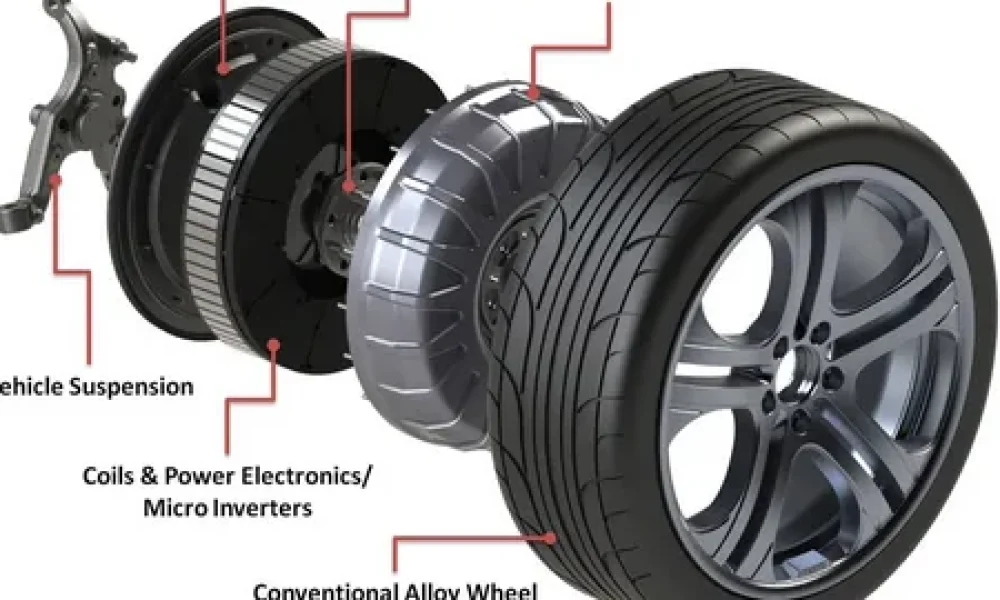
automotive in-wheel motors market is expected to provide widespread growth due to the increase of EV expected demand and high-power efficiency along with improved powertrain technology. The market was expected to grow from USD 4.18 Billion in 2025 to USD 24.02 Billion by 2035; from 2025 at a Compound Annual Growth Rate (CAGR) of 19.1% in the predicted period.
The global Automotive In-Wheel Motors Market is witnessing rapid expansion, driven by the increasing adoption of electric vehicles (EVs) and the need for enhanced vehicle efficiency. In-wheel motor technology is revolutionizing the EV industry by improving vehicle dynamics, reducing drivetrain complexity, and optimizing energy consumption.
Key Takeaways:
- The market is projected to grow at a robust CAGR, fueled by the surge in EV adoption and stringent emission regulations.
- In-wheel motors improve energy efficiency, offering better acceleration and regenerative braking.
- Advancements in power electronics and battery technology are enhancing motor performance.
- Growing demand for lightweight and compact EV powertrain solutions is driving market expansion.
- Integration of smart control systems and AI-driven motor management is a key trend in the industry.
Key Drivers:
- Increasing Electric Vehicle Sales – Government incentives and rising environmental concerns are boosting EV production and adoption.
- Demand for Enhanced Vehicle Performance – In-wheel motors offer improved torque vectoring and power distribution.
- Reduction in Vehicle Weight & Complexity – Removing traditional drivetrains results in lighter, more efficient EVs.
- Advancements in Battery Technology – High-performance batteries enable better compatibility with in-wheel motors.
- Stringent Emission Regulations – Governments worldwide are pushing for low-emission mobility solutions.
Challenges and Opportunities
Challenge
High Costs and Regulatory Complexities
The market is riding on the challenges provided associated with propelling production costs, administrative endorsements, and combination multifaceted nature. Automotive OEMs need to comply with strict ISO and UNECE standards for safety and performance, resulting in long development cycles and high costs.
Thermal Management and Durability Concerns
However, since in-wheel motors must fit in the tight space inside the wheel hub they must balance heat dissipation and durability. However, the absence of conventional cooling systems makes it difficult to maintain ideal motor efficiency and longevity at high speeds and off-road.
Opportunity
Growing Demand for Lightweight and Energy-Efficient Vehicles
As vehicles shift toward electrification and lightweight architectures, in-wheel motors bring energy efficiency, performance and reduced drivetrain complexity. Automakers will benefit from investing in advanced materials and power-dense motor designs as they will have a competitive advantage.
Advancements in Smart Mobility and Autonomous Vehicles
Highly integrated in-wheel motor systems will be needed to meet the demand of connected and autonomous mobility solutions. The in-wheel motors are the right choice for next gen autonomous electric cars due to their precision control, independent torque vectoring and modular scalability.
Growth Opportunities:
- Development of high-torque, high-efficiency in-wheel motors for heavy-duty EVs.
- Expansion of autonomous and connected vehicle applications using in-wheel motor technology.
- Increased investment in AI-driven predictive maintenance for in-wheel motor systems.
- Adoption of wireless charging solutions integrated with in-wheel motor technology.
Application Areas:
- Passenger Electric Vehicles
- Commercial Electric Vehicles
- Autonomous & Connected Vehicles
- Performance & Sports EVs
Key Players:
- Protean Electric
- Elaphe Propulsion Technologies
- NSK Ltd.
- Nidec Corporation
- Michelin (eWheel Drive)
- NTN Corporation
- Schaeffler AG
Market Segmentation:
- By Propulsion Type: Battery Electric Vehicle (BEV), Plug-in Hybrid Electric Vehicle (PHEV)
- By Motor Type: Axial Flux Motor, Radial Flux Motor
- By Power Output: Less than 50 kW, 50-100 kW, Above 100 kW
- By Vehicle Type: Passenger Vehicles, Commercial Vehicles
- By Region: North America, Europe, Asia-Pacific, Latin America, Middle East & Africa
About Future Market Insights (FMI)
Future Market Insights, Inc. (ESOMAR certified, recipient of the Stevie Award, and a member of the Greater New York Chamber of Commerce) offers profound insights into the driving factors that are boosting demand in the market. FMI stands as the leading global provider of market intelligence, advisory services, consulting, and events for the Packaging, Food and Beverage, Consumer Technology, Healthcare, Industrial, and Chemicals markets. With a vast team of 400 analysts worldwide, FMI provides global, regional, and local expertise on diverse domains and industry trends across more than 110 countries.




