
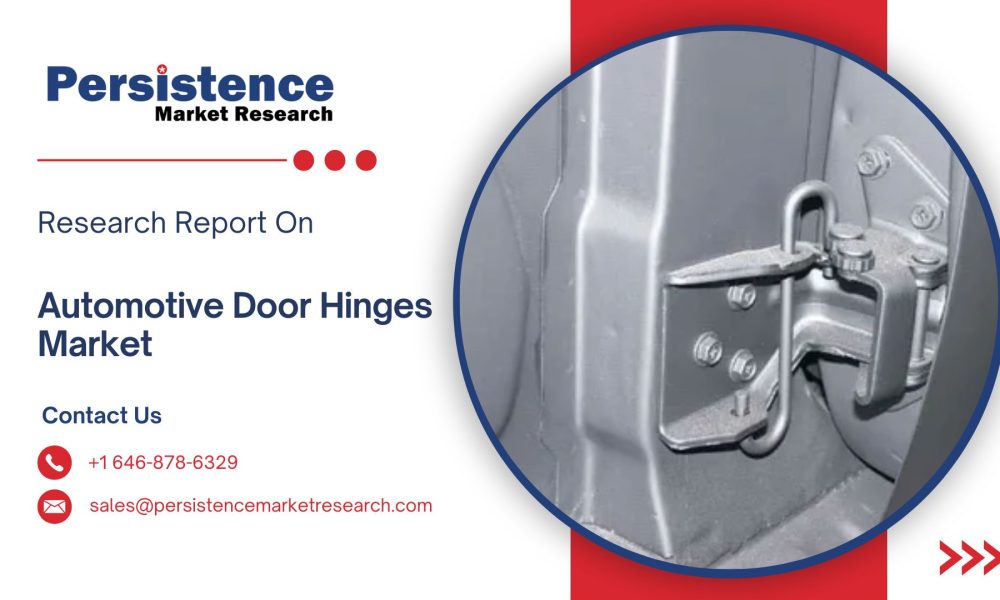
The automotive door hinges market is witnessing consistent growth, driven by the rising demand for passenger and commercial vehicles worldwide. According to Persistence Market Research, the global automotive door hinges market is estimated to reach a valuation of US$ 7.75 Bn in 2025. Over the assessment period, it is projected to grow at a CAGR of 4.3%, ultimately attaining a market size of US$ 10.41 Bn by 2032. This growth reflects the expanding vehicle production volumes and the integration of advanced hinge technologies to enhance safety, durability, and comfort.
Passenger cars remain the leading segment in the automotive door hinges market, owing to their high global production rates and the increasing consumer preference for vehicles with improved safety and ease of access. Geographically, Asia Pacific is expected to dominate the industry during the forecast period. Strong automotive production bases in China, India, Japan, and South Korea, coupled with rising disposable incomes and rapid urbanization, are fueling demand across the region. The combination of volume-driven growth and expanding export capabilities makes Asia Pacific the most promising market for automotive door hinges globally.
Get a Sample Copy of Research Report (Use Corporate Mail id for Quick Response): https://www.persistencemarketresearch.com/samples/35055
Key Highlights from the Report
➤ The global automotive door hinges market is set to reach US$ 7.75 Bn by 2025.
➤ Market valuation is projected to grow to US$ 10.41 Bn by 2032 at a CAGR of 4.3%.
➤ Passenger cars remain the leading segment due to higher production and sales volume.
➤ Asia Pacific dominates the market, supported by high vehicle production in China and India.
➤ Advanced lightweight hinge designs are gaining traction to improve fuel efficiency.
➤ Increasing focus on safety and durability is pushing OEMs to adopt innovative hinge materials.
Market Segmentation
The automotive door hinges market can be segmented based on product type, where conventional hinges and advanced lightweight hinges represent the key categories. Conventional hinges continue to hold a significant share due to their widespread adoption in both passenger and commercial vehicles. However, the demand for advanced lightweight hinges is growing rapidly as automakers focus on reducing vehicle weight to enhance fuel efficiency and meet stringent emission norms. This shift is also influenced by the rise of electric vehicles, where lightweight components directly improve battery efficiency and range.
Segmentation based on end-use highlights the dominance of original equipment manufacturers (OEMs) over the aftermarket. OEMs account for a larger share, given their role in integrating hinges into newly manufactured vehicles at scale. However, the aftermarket segment is also expected to see healthy growth, driven by the replacement demand for hinges in aging vehicle fleets. As vehicles remain on the road for longer durations, hinge replacements become increasingly necessary, ensuring consistent demand across regions.
Regional Insights
Asia Pacific leads the global automotive door hinges market, with China, India, Japan, and South Korea serving as the major hubs of automotive production. The region benefits from large-scale manufacturing capabilities, favorable government policies supporting automotive industries, and rising disposable incomes that fuel vehicle purchases. Demand for passenger vehicles, coupled with exports of automotive components, continues to strengthen the market outlook in this region.
North America and Europe also represent significant markets, supported by advanced automotive technologies and a strong presence of leading OEMs. In these regions, the emphasis is on incorporating innovative and durable hinge designs that align with stringent safety regulations. Growing adoption of electric and hybrid vehicles in Europe is further driving the demand for lightweight hinges that contribute to energy efficiency and compliance with emission targets.
Market Drivers
A primary driver for the automotive door hinges market is the rising global demand for vehicles, particularly passenger cars and SUVs. Increasing urbanization, improving road infrastructure, and growing disposable incomes in emerging economies are boosting vehicle sales. Additionally, automakers are introducing advanced hinge systems that enhance convenience, durability, and safety, responding to consumer demand for more reliable vehicles. Technological advancements in hinge design, such as corrosion-resistant materials and noise-free mechanisms, are also encouraging adoption across vehicle segments.
Another important driver is the push for lightweight materials in the automotive sector. With stringent emission norms and the transition to electric vehicles, manufacturers are increasingly focused on reducing overall vehicle weight. Lightweight automotive door hinges, often made from aluminum or composite materials, are being adopted to improve fuel efficiency and enhance electric vehicle performance. These innovations are aligning with global sustainability goals and government regulations, reinforcing steady growth in the market.
Market Restraints
Despite strong growth prospects, the automotive door hinges market faces several restraints. The rising costs of raw materials such as steel and aluminum present challenges for manufacturers, as price volatility can affect overall production costs. This may lead to higher hinge prices, potentially limiting adoption among cost-sensitive buyers in emerging markets.
Another restraint is the increasing complexity of hinge designs to meet evolving safety and comfort standards. While advanced designs offer benefits, they also increase manufacturing costs and require significant investment in research and development. Smaller manufacturers may find it difficult to compete with larger OEMs that have the resources to innovate. Moreover, disruptions in global supply chains, such as those caused by geopolitical tensions or pandemics, can hinder the steady flow of components, impacting production timelines.
Market Opportunities
The automotive door hinges market presents significant opportunities, particularly in the electric vehicle (EV) sector. As EV adoption grows, demand for lightweight and innovative hinge systems will surge. Automakers are expected to prioritize components that contribute to efficiency and performance, opening the door for specialized hinge manufacturers. Furthermore, the aftermarket segment offers growth potential, as consumers seek high-quality replacements for worn hinges in aging vehicles.
Technological advancements, including smart hinges integrated with sensors for enhanced safety and convenience, represent another major opportunity. With the rise of autonomous and connected vehicles, hinges that incorporate electronic components could become standard. Additionally, expansion into emerging economies in Africa and Latin America provides opportunities for hinge manufacturers to tap into new markets with rising vehicle ownership. Strategic collaborations between OEMs and component suppliers will further drive product innovation and market penetration.
Frequently Asked Questions (FAQs)
➤ How big is the automotive door hinges market?
➤ Who are the key players in the global automotive door hinges market?
➤ What is the projected growth rate of the automotive door hinges market?
➤ What is the market forecast for the industry through 2032?
➤ Which region is estimated to dominate the automotive door hinges industry during the forecast period?
Company Insights
Key players operating in the global automotive door hinges market include:
- Dorman Products Inc.
- Gestamp Automoción
- Aisin Seiki Co. Ltd.
- Multimatic Inc.
- Eberhard Manufacturing Company
- Mitsui Mining & Smelting Co. Ltd.
- HED Industries Inc.
- Midlake Products & Mfg. Co.
Recent Developments
- Leading OEMs have begun adopting lightweight hinge materials to align with global sustainability and emission-reduction targets.
- Several manufacturers have expanded their production capacity in Asia Pacific to cater to the growing demand for passenger vehicles and components.
Explore more related market insights and reports by visiting our website.




