
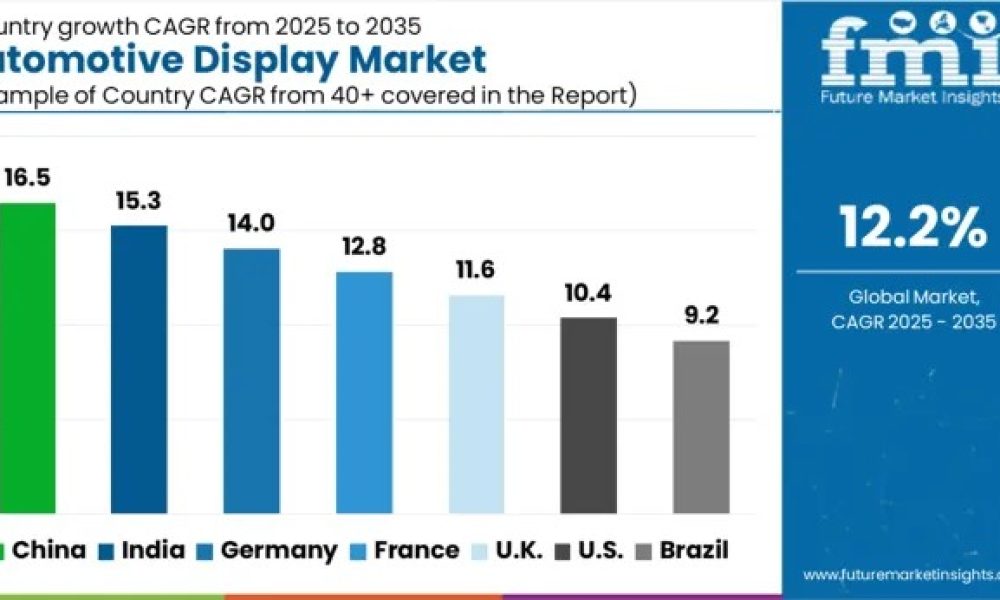
The global automotive display market is entering a phase of accelerated value expansion, driven by the deepening integration of digital interfaces within modern vehicles. Valued at USD 18.0 billion in 2025, the market is projected to reach USD 56.8 billion by 2035, registering a robust compound annual growth rate (CAGR) of 12.2%. This growth reflects the transition of displays from auxiliary infotainment components to core control and visualization systems central to vehicle functionality, safety, and differentiation.
Automotive displays now span instrument clusters, center stack systems, head-up displays (HUDs), and rear-seat entertainment units, forming the visual backbone of digital cockpits. As vehicles evolve toward connected, software-defined, and electrified architectures, displays increasingly function as primary human–machine interfaces, consolidating navigation, diagnostics, entertainment, and driver assistance into unified visual platforms.
Technology-Driven Value Formation Accelerates Market Momentum
Market expansion is being shaped by the diversification of display technologies, including TFT-LCD, OLED, micro-LED, and advanced touch-sensitive interfaces. Each technology contributes differently to revenue formation, with premium display solutions accounting for a growing share of incremental market value. OLED and advanced interactive displays are gaining traction due to superior contrast ratios, thinner form factors, energy efficiency, and design flexibility, enabling seamless integration into curved dashboards and multi-display layouts.
While TFT-LCD technology maintains leadership with a 55.4% share, supported by mature manufacturing ecosystems and cost efficiency, higher-end display technologies are redefining competitive positioning. OLED and emerging micro-LED solutions are particularly prominent in premium and electric vehicle segments, where demand for high-resolution, customizable, and driver-assist-compatible displays continues to rise.
LCD-based solutions remain critical in sustaining volume growth, particularly for instrument clusters and secondary displays, offering reliable performance under automotive operating conditions. However, year-on-year value analysis indicates that technology-led differentiation rather than unit volume growth is increasingly responsible for market expansion, reinforcing the strategic importance of innovation.
Get access to comprehensive data tables and detailed market insights — request your sample report today!
https://www.futuremarketinsights.com/reports/sample/rep-gb-25518
Center Stack Displays Anchor Demand Across Vehicle Segments
By product category, center stack displays account for 36.7% of total market share, making them the largest and most resilient segment. Their dominance reflects a central role in delivering infotainment, navigation, climate control, and connectivity features within the driver’s immediate field of interaction. Adoption spans both mass-market and premium vehicles, supported by ergonomic placement, consumer familiarity, and compatibility with connected services.
Automakers continue to prioritize center stack displays as foundational elements of digital cockpit architectures, leveraging improvements in resolution, brightness, touch responsiveness, and durability. Production scalability and competitive pricing from tier-1 suppliers have further reinforced adoption, while integration with AI-driven voice control and personalization features is expected to sustain long-term demand.
Optimal Screen Sizes Balance Functionality and Design Flexibility
Screen size segmentation reveals that displays ranging from 5” to 10” dominate with a 42.8% share, reflecting an optimal balance between usability, driver visibility, and dashboard integration. This size category supports high-volume deployment across vehicle classes, offering sufficient real estate for navigation, media, and vehicle status information without compromising safety or aesthetics.
Standardization around this screen range enables modular cockpit designs and software scalability, allowing automakers to deploy consistent user interfaces across platforms. Continuous enhancements in thin-bezel design, backlighting efficiency, and touch accuracy further strengthen the segment’s position, while aftermarket replacement demand contributes to sustained volume stability.
Displays Become Strategic Assets in Safety and Connectivity
Beyond infotainment, automotive displays are increasingly embedded within advanced driver assistance systems (ADAS) and regulatory safety frameworks. Instrument clusters and HUDs deliver real-time alerts for lane departure, adaptive cruise control, blind-spot monitoring, and parking assistance, improving situational awareness and reducing cognitive load.
Regulatory emphasis on clear driver information and reduced distraction elevates display performance requirements, driving adoption of high-brightness, anti-glare, and adaptive displays. Integration with sensors, connectivity platforms, and AI-based visualization further reinforces the role of displays as safety-critical components rather than discretionary features.
Regional Growth Anchored in Production Scale and Premium Adoption
Regionally, Asia Pacific leads global growth, supported by high vehicle production volumes, rapid electronics adoption, and strong demand for connected mobility solutions. China stands out with a forecast CAGR of 16.5%, driven by widespread deployment of digital dashboards, infotainment systems, and HUDs, alongside government support for electric and smart vehicles. India follows closely at 15.3% CAGR, supported by rising connected vehicle penetration and expanding automotive manufacturing capacity.
Europe and North America continue to emphasize premium and technologically advanced vehicles, with Germany projected to grow at 14.0% CAGR, reflecting strong adoption in luxury and electric vehicle segments. The United States, growing at 10.4% CAGR, benefits from high consumer demand for infotainment, customization, and connected vehicle features, reinforcing steady market expansion.
Drive Your Business Growth Strategy: Checkout the Report for Key Insights
https://www.futuremarketinsights.com/reports/sample/rep-gb-25518
Competitive Landscape Centers on Integration and Innovation
The competitive environment is defined by technology integration depth, display reliability, and OEM alignment. Leading players including LG Electronics, Panasonic Corporation, Visteon Corporation, Robert Bosch GmbH, Continental AG, and Hyundai Mobis are advancing high-resolution, energy-efficient display solutions designed for seamless integration with vehicle software and electronic architectures.
Strategic collaborations with OEMs, chipset providers, and software developers are accelerating the deployment of modular dashboards, augmented reality overlays, and AI-driven personalization features. Competitive differentiation increasingly depends on the ability to deliver scalable, durable, and visually sophisticated displays across diverse vehicle platforms.
Outlook: Displays Redefine Automotive Value Creation
The automotive display market is positioned for sustained double-digit growth through 2035, underpinned by digitalization of vehicle interiors, rising connectivity, and evolving safety requirements. As displays transition from standalone components to integrated control surfaces, their influence on vehicle design, user experience, and brand differentiation continues to expand.
With technology-driven value formation, strong regional momentum, and deepening integration across vehicle systems, automotive displays are set to remain a central pillar of automotive electronics investment, reinforcing the market’s long-term growth trajectory and strategic significance.
Why Choose FMI: Empowering Decisions that Drive Real-World Outcomes: https://www.futuremarketinsights.com/why-fmi
About Future Market Insights (FMI)
Future Market Insights, Inc. (FMI) is an ESOMAR-certified, ISO 9001:2015 market research and consulting organization, trusted by Fortune 500 clients and global enterprises. With operations in the U.S., UK, India, and Dubai, FMI provides data-backed insights and strategic intelligence across 30+ industries and 1200 markets worldwide.



