
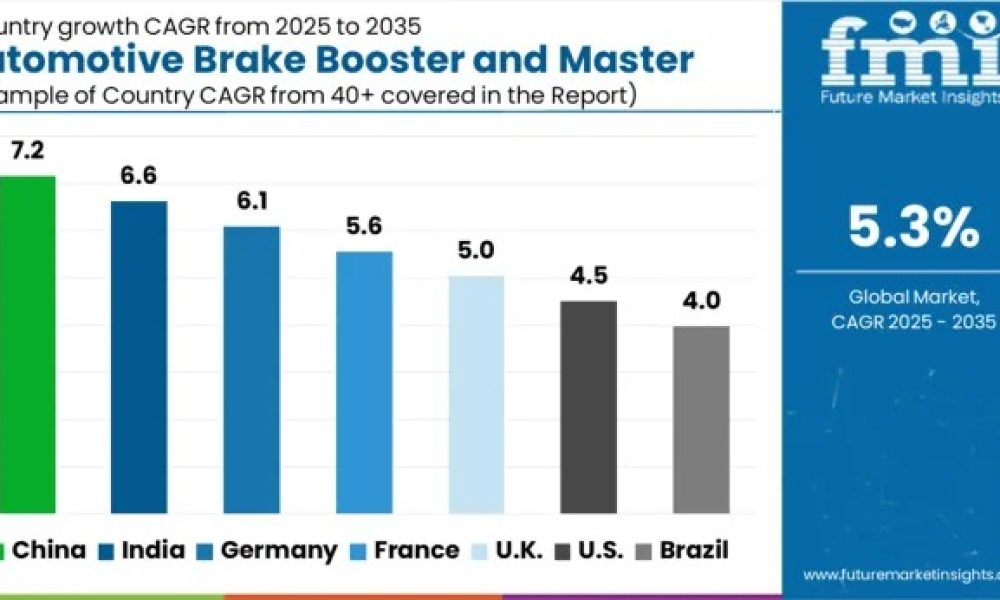
The global automotive brake booster and master cylinder market is positioned for steady and resilient expansion, projected to grow from USD 15.1 billion in 2025 to USD 25.2 billion by 2035, advancing at a compound annual growth rate (CAGR) of 5.3%. The growth trajectory reflects the non-discretionary nature of braking components within vehicle safety systems, supported by rising vehicle production volumes, tightening regulatory standards, and increasing adoption of advanced braking technologies across passenger and commercial vehicles.
Market progression remains consistent rather than cyclical, with values climbing from USD 17.6 billion in 2028 to USD 19.5 billion by 2030, followed by a sustained rise through the mid-2030s. This predictable curve highlights the role of brake boosters and master cylinders as long-cycle, safety-critical components with stable OEM and aftermarket demand.
Safety Regulations and Vehicle Production Anchor Market Stability
Growth in the automotive brake booster and master cylinder market is underpinned by mandatory safety regulations across major automotive regions. Braking performance remains a regulated parameter, ensuring continued fitment regardless of vehicle segment or price point.
Key structural growth drivers include:
- Rising global production of passenger and commercial vehicles
- Mandatory fitment of ABS, ESC, and AEB systems
- Increasing consumer expectations for pedal feel and braking responsiveness
Brake boosters and master cylinders play a foundational role in translating driver input into controlled hydraulic pressure, making them indispensable for both conventional and advanced braking architectures.
Get access to comprehensive data tables and detailed market insights — request your sample report today!
https://www.futuremarketinsights.com/reports/sample/rep-gb-25274
Market Positioning Within the Broader Automotive Ecosystem
The brake booster and master cylinder segment accounts for a meaningful share across multiple automotive value chains, underscoring its strategic importance.
Estimated contribution across parent markets:
- ~10% of the automotive brake systems market
- ~5% of the automotive components market
- ~12% of the automotive aftermarket
- ~7% of the automotive safety systems market
- ~6% of the commercial vehicle components market
These proportions highlight the segment’s cross-cutting relevance, spanning OEM production, safety compliance, and aftermarket replacement cycles.
Brake Booster Segment Maintains Revenue Leadership
Brake boosters are projected to account for 56.2% of market revenue in 2025, making them the dominant component category. Their ability to reduce pedal effort and enhance braking precision continues to drive widespread adoption.
Key factors supporting brake booster dominance:
- Improved braking comfort and reduced driver fatigue
- Compatibility with ADAS and electronic braking systems
- Ongoing innovation in vacuum, hydraulic, and electronic boosters
While vacuum and hydraulic boosters remain cost-effective mainstays, electronic brake boosters are gaining traction in hybrid and electric vehicles, where vacuum availability is limited.
ICE Vehicles Continue to Anchor Demand Despite Electrification
Internal combustion engine (ICE) vehicles are expected to represent 54.7% of market revenue in 2025, reflecting their continued dominance in global vehicle fleets, particularly in emerging economies.
Drivers supporting ICE segment strength:
- Large installed base of vacuum-assisted brake systems
- Continued affordability and infrastructure readiness
- High production volumes in cost-sensitive markets
Although electrified vehicles are growing rapidly, ICE platforms will remain a significant demand source for brake boosters and master cylinders throughout the forecast period.
Passenger Cars Lead Installation Volumes
Passenger cars are projected to account for 58.1% of market revenue in 2025, supported by high production volumes and rising safety feature penetration.
Demand within the passenger car segment is driven by:
- Mandatory safety compliance across entry-level models
- Rising consumer preference for refined braking feel
- Growing electrification of passenger vehicle platforms
The shift toward regenerative braking compatibility in electric and hybrid passenger cars further strengthens long-term demand for advanced master cylinder and booster designs.
Technology Trends Favor Electronic and Integrated Systems
While conventional systems remain dominant, market momentum is gradually shifting toward electronically assisted and integrated braking architectures.
Key technology trends include:
- Growth of electric brake boosters (e-boosters)
- Integration of pressure sensors and pedal simulators
- Readiness for brake-by-wire platforms
OEMs increasingly favor compact, lightweight, and electronically controllable systems that support autonomous driving functions and energy recovery in electrified vehicles.
Asia-Pacific Leads Regional Growth Momentum
Asia-Pacific remains the fastest-growing region, led by China (7.2% CAGR) and India (6.6% CAGR), supported by expanding vehicle production, rising safety mandates, and accelerating electrification.
Regional growth drivers include:
- Higher ABS and ESC penetration rates
- Rapid model refresh cycles
- Strong demand from passenger vehicles and logistics fleets
Europe follows closely, driven by premium vehicle production and early adoption of electronic braking systems, while North America maintains steady growth anchored in safety compliance and replacement demand.
Drive Your Business Growth Strategy: Checkout the Report for Key Insights
https://www.futuremarketinsights.com/checkout/25274
Competitive Landscape Defined by Engineering Depth and Scale
The competitive environment is shaped by global Tier-1 suppliers with deep braking expertise and strong OEM relationships. Key players such as Robert Bosch GmbH, Continental AG, Aisin Corporation, DENSO Corporation, ZF Friedrichshafen AG, and Brembo compete on reliability, system integration, and regulatory compliance.
Competitive differentiation centers on:
- Advanced electronic and brake-by-wire readiness
- Lightweight materials and modular system designs
- Localized manufacturing and aftermarket reach
As braking systems evolve toward higher electronic integration, suppliers with validated software, sensor integration, and functional safety capabilities are expected to gain platform advantages.
Market Outlook
The automotive brake booster and master cylinder market is set for durable, regulation-driven growth rather than cyclical volatility. As safety expectations rise and vehicle architectures evolve, these components will remain central to braking performance, system redundancy, and driver confidence. Suppliers aligned with electronic integration, electrification compatibility, and lifecycle reliability are well positioned to capture sustained value through 2035.
Why Choose FMI: Empowering Decisions that Drive Real-World Outcomes: https://www.futuremarketinsights.com/why-fmi
About Future Market Insights (FMI)
Future Market Insights, Inc. (FMI) is an ESOMAR-certified, ISO 9001:2015 market research and consulting organization, trusted by Fortune 500 clients and global enterprises. With operations in the U.S., UK, India, and Dubai, FMI provides data-backed insights and strategic intelligence across 30+ industries and 1200 markets worldwide.



