
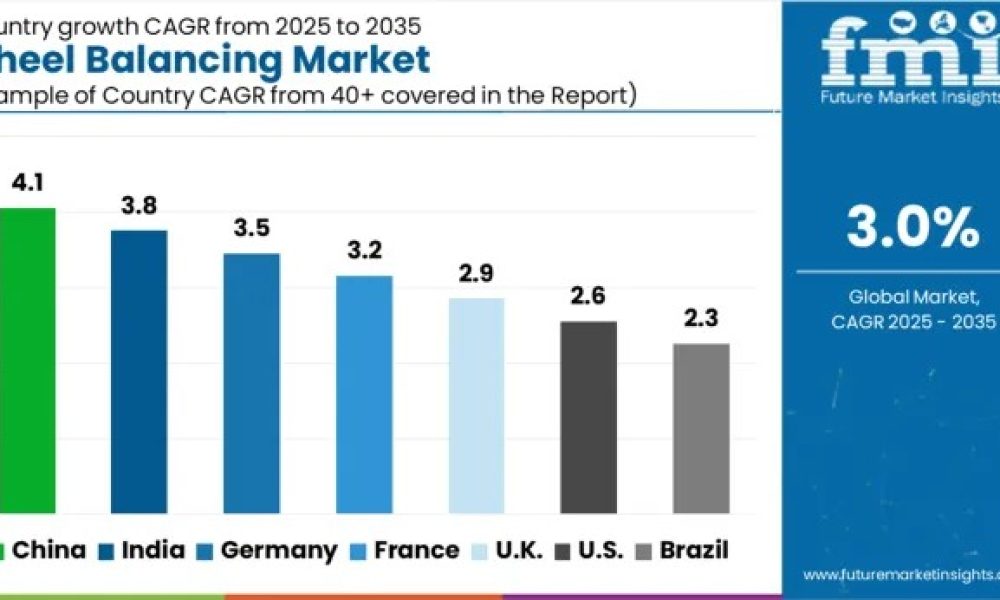
The global wheel balancing market continues to demonstrate resilient, maintenance-driven growth, supported by expanding vehicle fleets, rising safety awareness, and steady modernization of automotive service infrastructure. Valued at USD 2.6 billion in 2025, the market is projected to reach USD 3.5 billion by 2035, advancing at a compound annual growth rate (CAGR) of 3.0% over the forecast period.
Market performance is shaped by seasonal and cyclical demand patterns closely linked to automotive maintenance and repair activities. Demand typically peaks during pre-summer and pre-winter periods, when vehicle owners prepare for extreme temperature conditions that affect tire performance, ride comfort, and safety. These recurring cycles play a critical role in revenue planning for service centers, distributors, and equipment manufacturers.
Seasonal Dynamics and Maintenance Cycles Define Demand Patterns
Wheel balancing demand is closely aligned with tire replacement cycles, alignment checks, and preventive maintenance schedules. Replacement-driven surges occur during seasonal tire changes, while off-peak months see moderate but stable service activity. OEM production schedules, commercial fleet maintenance timelines, and promotional campaigns by tire manufacturers further contribute to cyclical fluctuations.
Get access to comprehensive data tables and detailed market insights — request your sample report today!
https://www.futuremarketinsights.com/reports/sample/rep-gb-25651
Regional variation is pronounced. Colder climates experience strong winter-related service spikes, driven by seasonal tire swaps, while regions with relatively stable temperatures exhibit more consistent year-round demand. Technological upgrades—including digital diagnostics, automated balancing systems, and integrated alignment sensors—are gradually smoothing extreme seasonality by increasing service efficiency and encouraging preventive maintenance adoption.
Service providers increasingly focus on inventory planning, workforce allocation, and promotional alignment to optimize revenue during peak periods while minimizing downtime during slower months. Despite seasonal variability, the long-term growth outlook remains stable, supported by global expansion in passenger vehicles and commercial fleets.
Market Growth Supported by Safety Awareness and Equipment Innovation
The wheel balancing market is experiencing steady expansion due to rising emphasis on vehicle safety, tire longevity, fuel efficiency, and ride quality. Consumers and fleet operators increasingly recognize that proper wheel balancing reduces uneven tire wear, minimizes vibration, and enhances overall driving comfort.
Technological advancements are reshaping service operations. Automated balancing systems, improved measurement accuracy, and user-friendly digital interfaces are improving workshop throughput and service consistency. Regulatory norms related to vehicle safety and performance further reinforce the importance of precision wheel balancing, particularly in mature automotive markets.
The transition toward electric vehicles (EVs) is also influencing demand. EVs often feature heavier drivetrains and specialized tire configurations, increasing the need for accurate balancing solutions. Combined with a global shift toward preventive maintenance, these trends continue to support gradual but sustained market growth.
Aftermarket, OEM, and Fleet Segments Anchor Market Demand
The wheel balancing market draws demand from multiple interconnected parent segments. The automotive aftermarket represents the largest share, accounting for approximately 40% of total demand. Repair shops, service centers, and tire dealers rely on wheel balancing to maintain vehicle safety and performance, driven by regular maintenance cycles and seasonal tire changes.
The OEM service and maintenance segment contributes around 25%, as manufacturers integrate wheel balancing into vehicle assembly, dealership servicing, and warranty programs. These programs emphasize compliance with manufacturer specifications, ride quality, and customer satisfaction.
The commercial fleet and logistics segment, representing roughly 15%, prioritizes wheel balancing to reduce tire wear, lower fuel consumption, and minimize downtime. Fleet operators increasingly adopt in-house and mobile balancing solutions to support predictive maintenance strategies. Specialty segments such as motorsport and high-performance vehicles, along with automotive retail and distribution, provide complementary growth opportunities.
Collectively, aftermarket, OEM, and fleet applications account for nearly 80% of total market demand, highlighting maintenance efficiency and safety as the primary growth drivers.
Static and Automatic Systems Lead Technology Adoption
By product type, static wheel balancing machines are projected to account for 46.7% of total market revenue in 2025, making them the leading segment. Their cost-effectiveness, operational simplicity, and suitability for a wide range of vehicles make them especially attractive to small and medium-sized workshops. Low maintenance requirements and adaptability to various tire sizes further reinforce adoption.
By operation type, automatic wheel balancing machines dominate with a 53.2% revenue share. Automatic systems deliver faster cycle times, higher accuracy, and reduced operator dependency—critical advantages for high-volume service centers. Integration of advanced sensors, digital calibration, and intuitive software supports consistent performance and productivity gains.
OEM Sales Channel Maintains Market Leadership
The OEM sales channel is expected to hold 58.6% of total market revenue in 2025, reflecting strong partnerships between equipment manufacturers and automotive OEMs. OEM-aligned equipment ensures vehicles leave assembly lines with optimal wheel balance and supports standardized service practices across dealership networks. Perceived reliability and compatibility drive long-term adoption and recurring demand.
Drive Your Business Growth Strategy: Checkout the Report for Key Insights
https://www.futuremarketinsights.com/checkout/25651
Asia Leads Growth as Mature Markets Sustain Stability
Regionally, Asia-Pacific leads growth, driven by expanding vehicle populations, rising maintenance awareness, and strong aftermarket development. China records the highest CAGR at 4.1%, supported by passenger vehicle production, commercial fleet expansion, and mandatory safety inspections. India follows at 3.8%, driven by diverse road conditions, growing service networks, and increasing preventive maintenance adoption.
In Europe, Germany (3.5%), France (3.2%), and the UK (2.9%) benefit from advanced manufacturing standards, seasonal tire changes, and high-quality workshop requirements. The United States, growing at 2.6%, maintains stable demand through aftermarket services, OEM maintenance programs, and commercial fleet management.
Competitive Landscape Emphasizes Precision and Integration
Competition in the wheel balancing market centers on accuracy, efficiency, and adaptability across vehicle types. Hunter Engineering Company leads with advanced digital balancing solutions integrated with alignment diagnostics. Snap-on Incorporated and Robert Bosch GmbH focus on premium, connected workshop equipment, while Corghi S.p.A., BendPak Holdings LLC, ravaglioli.com, and 3M strengthen the market through precision engineering, durability, and complementary solutions.
Outlook
The wheel balancing market is positioned for steady, maintenance-led growth through 2035, supported by preventive service awareness, automation, and expanding vehicle fleets. While seasonal fluctuations will remain inherent, increasing equipment sophistication and service optimization strategies are expected to enhance market resilience and long-term value creation.
Why Choose FMI: Empowering Decisions that Drive Real-World Outcomes: https://www.futuremarketinsights.com/why-fmi
About Future Market Insights (FMI)
Future Market Insights, Inc. (FMI) is an ESOMAR-certified, ISO 9001:2015 market research and consulting organization, trusted by Fortune 500 clients and global enterprises. With operations in the U.S., UK, India, and Dubai, FMI provides data-backed insights and strategic intelligence across 30+ industries and 1200 markets worldwide.



