
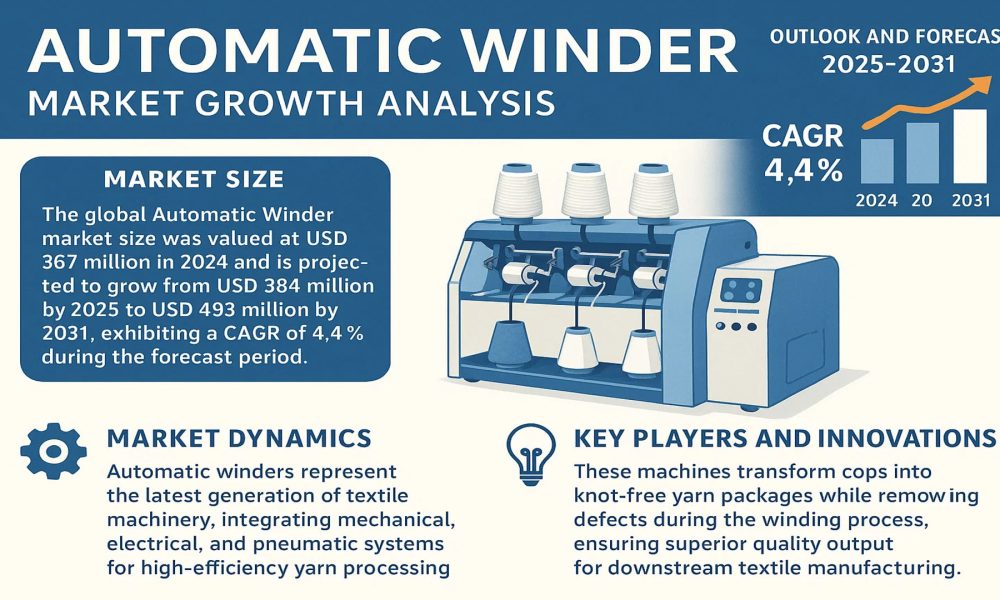
Automatic Winder market size was valued at USD 367 million in 2024 and is projected to grow from USD 384 million in 2025 to USD 493 million by 2031, exhibiting a CAGR of 4.4% during the forecast period.
Automatic winders represent the latest generation of textile machinery, integrating mechanical, electrical, and pneumatic systems for high-efficiency yarn processing. These machines transform cops into knot-free yarn packages while removing defects during the winding process, ensuring superior quality output for downstream textile manufacturing.
The market continues to evolve with technological advancements in automation and Industry 4.0 integration, though growth faces some constraints from the cyclical nature of textile industry investments. Notably, three dominant players – Italy’s SAVIO (40.14% market share), Japan’s Murata Machinery (35.54%), and Germany’s Schlafhorst (22.16%) – collectively control nearly 98% of the global automatic winder market through international bidding processes. While Asian manufacturers are gaining traction, European engineering excellence maintains strong competitive advantages in precision and reliability.
Request Your Free Sample Report- https://www.intelmarketresearch.com/download-free-sample/9888/automatic-winder-market
MARKET DYNAMICS MARKET DRIVERS
Growing Textile Industry Demand to Fuel Adoption of Automatic Winders
The global textile industry is experiencing sustained growth, with production volumes increasing by approximately 3-4% annually as fabric demand rises across apparel, home textiles, and technical textiles. This expansion directly correlates with higher adoption of automated winding solutions because modern textile manufacturers increasingly prioritize efficiency, quality consistency, and reduced labor dependency. Automatic winders significantly enhance productivity in yarn processing a crucial stage where traditional manual winding causes bottlenecks. Industry data suggests automated systems can process 30-50% more yarn per hour compared to semi-automated alternatives while maintaining superior quality standards through precision winding and defect detection.
Technological Advancements in Smart Manufacturing to Accelerate Market Growth
Industry 4.0 integration is revolutionizing textile machinery capabilities, with leading manufacturers embedding IoT sensors, AI-driven predictive maintenance, and cloud connectivity in automatic winders. These innovations reduce downtime by up to 25% through real-time monitoring of critical components like tensioners and spindles. For instance, recent models from market leaders feature self-adjusting winding parameters based on yarn type and end-use specifications, achieving optimal package density with minimal manual intervention. Such advancements align with the broader industrial automation trend, where textile equipment spending is projected to grow at 6-7% CAGR through 2030 as manufacturers modernize production floors.
Shift Toward Sustainable Textile Production to Boost Winder Upgrades
Environmental regulations and consumer preferences are driving textile producers to adopt energy-efficient machinery. Modern automatic winders consume 15-20% less power than previous generations through regenerative braking systems and optimized motor controls. Additionally, precision winding reduces yarn waste by ensuring maximum material utilization a critical factor as sustainability benchmarks tighten globally. Several European textile hubs have introduced subsidies for manufacturers replacing equipment with energy-certified models, creating tangible economic incentives for automatic winder adoption. This aligns with the textile sector’s commitment to reduce carbon emissions by 30% before 2030 across production processes.
MARKET OPPORTUNITIES
Emerging Textile Markets in Asia-Pacific to Drive Future Demand Growth
Asia-Pacific economies are witnessing accelerated textile industry expansion, accounting for over 60% of global yarn production. Countries like Vietnam, Bangladesh, and India are investing heavily in modernizing spinning and winding operations to meet export quality standards. This creates substantial opportunities for automatic winder suppliers, particularly for mid-range models balancing automation and affordability. Localized production partnerships are emerging as key strategy, with international manufacturers establishing regional assembly units to reduce costs and improve maintenance responsiveness a critical factor for mills operating continuous production schedules.
Integration with Digital Thread Management Systems to Unlock New Value
Forward-thinking manufacturers are developing winders with seamless connectivity to enterprise resource planning (ERP) and manufacturing execution systems (MES). This allows real-time production data integration from yarn inventory levels to winding efficiency metrics enabling predictive material replenishment and optimized machine scheduling. Such digital integration significantly enhances overall equipment effectiveness (OEE) in large-scale textile operations. Early adopters report 15-18% productivity gains by correlating winding performance data with downstream processes like warping and weaving, presenting compelling ROI arguments for next-generation equipment investments.
Segment Analysis:
By Type
- Automatic Type
- Semi-automatic Type
Automatic Type dominates the market due to its high efficiency, reduced labor costs, and seamless integration in modern textile production lines.
By Application
- Textile Industry
- Manufacturing
- Industrial
- Others
Textile Industry is the largest application segment as automatic winders are essential for yarn processing, ensuring high productivity and minimal defects.
By End User
- Large-scale Textile Manufacturers
- SMEs
- Industrial Enterprises
Large-scale Textile Manufacturers lead the market due to their higher adoption of advanced machinery for bulk production and competitive efficiency.
List of Key Automatic Winder Companies Profiled
- Murata Machinery, Ltd. (Japan)
- SAVIO (Italy)
- Schlafhorst (Germany)
- Lohia Corp Limited (India)
- Kisan Engineering (India)
- Georg Sahm (Germany)
- GOEBEL IMS (Germany)
- MATTHYS GROUP (Belgium)
- RIUS-COMATEX (Spain)
- MECCANICA NICOLETTI (Italy)
- Arc Specialties (U.S.)
AUTOMATIC WINDER MARKET TRENDS
Automation and Digitalization Transforming the Textile Industry
The global automatic winder market is undergoing a significant transformation, driven by the rapid adoption of automation and digitalization in the textile industry. Automatic winders, pivotal in converting cops into knot-free yarn packages while eliminating defects, are witnessing higher demand as manufacturers seek efficiency and precision. Modern automatic winders now incorporate advanced sensors, real-time monitoring systems, and IoT-enabled controls, reducing downtime and enhancing productivity. The integration of AI for predictive maintenance and error detection has further optimized the winding process, minimizing waste and improving yarn quality. With the textile industry striving for lean manufacturing, the adoption of fully automated winders is projected to accelerate at a CAGR of 4.4% through 2031.
Other Trends
Rising Demand for High-Speed Winding Solutions
Emerging economies are fueling textile production capacities, pushing manufacturers to invest in high-speed automatic winders that can process large volumes of yarn efficiently. In Asia, particularly China and India, nearly 65% of textile mills have upgraded to automated winding solutions, driven by the need to meet export-quality standards while reducing labor costs. Companies like Murata Machinery and Schlafhorst dominate this segment with winders capable of reaching speeds exceeding 2,000 meters per minute. While productivity remains a key driver, the shift towards finer yarns in apparel and technical textiles has necessitated precision winding technologies that prevent breakage and ensure uniformity.
Sustainability and Energy Efficiency in Focus
Sustainability initiatives are reshaping purchasing decisions in the textile machinery sector, with energy-efficient automatic winders gaining traction due to their lower power consumption and reduced carbon footprint. Leading manufacturers now design winders with regenerative braking systems and optimized motor controls, cutting energy usage by up to 30% compared to conventional models. Additionally, the push for eco-friendly textile production has increased demand for winders that minimize material waste through precision tension control. Governments in Europe and North America are incentivizing green technologies, further encouraging textile firms to adopt next-generation winding solutions that align with environmental regulations.
Request Your Free Sample Report- https://www.intelmarketresearch.com/download-free-sample/9888/automatic-winder-market
Automatic Winder Market – Recent Developments
- Technological Advancements
- Manufacturers are integrating smart automation features like app-based control, programmable winding cycles, and energy-efficient motors.
- Incorporation of IoT and AI to optimize winding performance and predictive maintenance is on the rise.
- Expansion of Product Portfolio
- Leading companies are launching multi-watch winders capable of handling various watch sizes and winding requirements.
- Customizable designs and premium materials are being introduced to cater to luxury watch enthusiasts.
- Strategic Partnerships and Collaborations
- Companies are collaborating with luxury watch brands and retailers to expand distribution channels.
- Partnerships with technology providers are boosting smart features integration.
- Geographical Market Growth
- Significant demand growth reported in North America and Asia-Pacific, driven by rising luxury watch adoption.
- E-commerce platforms are increasingly being used for global sales.
- Sustainability and Eco-Friendly Focus
- Some manufacturers are adopting energy-efficient motors and recyclable materials in winder production.
- Mergers & Acquisitions
- Key players are consolidating to strengthen market presence and expand their product lines globally.
About Intel Market Research
Intel Market Research delivers actionable insights in technology and infrastructure markets. Our data-driven analysis leverages:
- Real-time infrastructure monitoring
- Techno-economic feasibility studies
Competitive intelligence across 100+ countries
Trusted by Fortune 500 firms, we empower strategic decisions with precision.
International: +1(332) 2424 294 | Asia: +91 9169164321
Website: https://www.intelmarketresearch.com
Follow us on LinkedIn: https://www.linkedin.com/company/intel-market-research
Market Research Reports | Market Trends | SWOT Analysis | Industrial Survey – Intelmarketresearch
Intel market research provides market research reports and company research reports across worldwide industries. We also offers customized market research solutions




