
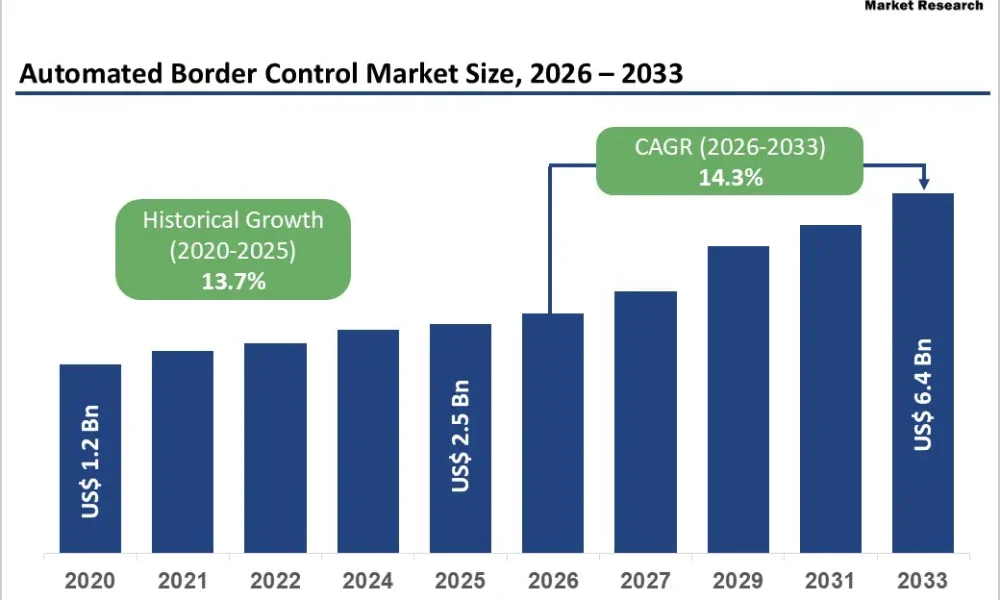
The global Automated Border Control (ABC) market is witnessing rapid transformation as governments worldwide invest heavily in biometric technologies and smart border infrastructure. According to industry projections, the automated border control market size is expected to reach US$ 6.4 billion by 2033, growing from US$ 2.5 billion in 2026 at a CAGR of 14.3% between 2026 and 2033.
Automated border control systems are becoming an essential component of modern immigration and security frameworks. These solutions enable faster, safer, and more efficient passenger processing through technologies such as biometric authentication, AI-powered identity verification, facial recognition, fingerprint scanning, and iris detection.
The rapid recovery of global travel, coupled with increasing cross-border security challenges, is compelling governments to adopt automated systems that enhance both border security and operational efficiency.
Understanding Automated Border Control Systems
Automated Border Control (ABC) systems are self-service immigration processing platforms that use biometric technologies and digital identity verification to authenticate travelers without requiring manual inspection by border officers.
These systems are commonly deployed in:
- International airports
- Land border crossings
- Seaports
- Immigration checkpoints
ABC solutions typically include e-gates, biometric kiosks, document readers, and AI-driven verification platforms. By combining passport scanning with biometric matching, these systems allow travelers to clear immigration in seconds.
The adoption of automated border control is part of a broader global shift toward smart border management, where advanced technologies improve both traveler experience and national security.
Rising International Travel Driving Border Automation
One of the most significant drivers of the automated border control market is the surging volume of global travelers.
International air travel is expected to exceed 5.6 billion passengers annually by 2027, placing tremendous pressure on immigration authorities to process travelers quickly while maintaining strict security standards.
Manual passport verification systems are increasingly insufficient to manage such high traffic volumes. Automated systems offer a solution by enabling travelers to complete immigration checks in 10 to 20 seconds, significantly reducing queues and operational bottlenecks.
Major airports around the world are adopting biometric e-gates to manage this surge in travel demand. For example, São Paulo–Guarulhos International Airport, Brazil’s busiest airport, installed 42 automated biometric gates, improving passenger throughput by approximately 40%.
These systems demonstrate how automation can simultaneously improve security, efficiency, and traveler satisfaction.
Elevate your business strategy with comprehensive market data. Request a sample report now: https://www.persistencemarketresearch.com/samples/21205
Government Initiatives Accelerating Market Adoption
Government policies and regulatory mandates are playing a crucial role in accelerating the deployment of automated border control systems.
One of the most influential initiatives is the European Union’s Entry/Exit System (EES), which requires all 29 Schengen countries to implement biometric border verification for third-country nationals by April 2026.
This initiative represents one of the largest coordinated border modernization programs globally.
Similarly, several other governments are implementing digital border initiatives:
- India’s Digital Yatra program enabling biometric-based passenger identification
- IATA’s One ID initiative promoting standardized digital travel identity
- Canada’s Digital Border Strategy targeting full border automation by 2030
- Mexico’s Automated Border Entry program expanding biometric self-service kiosks
These initiatives are creating significant opportunities for technology providers developing biometric authentication systems, AI analytics, and digital identity solutions.
Key Challenges Hindering Market Growth
Despite the promising growth outlook, several challenges may limit the widespread adoption of automated border control systems.
High Infrastructure and Deployment Costs
The installation of ABC systems requires significant capital investment.
An individual automated e-gate can cost between US$200,000 and US$500,000, depending on the technology and integration requirements. Large airport terminals often require 50 to 100 gates, resulting in investments ranging from US$10 million to US$50 million.
Additionally, governments must invest in:
- Biometric databases
- System integration services
- Training for border officers
- Cybersecurity infrastructure
For developing nations with limited budgets, these costs can slow adoption.
Privacy and Biometric Data Protection Concerns
Another major challenge is the sensitive nature of biometric data.
ABC systems collect and process information such as:
- Facial images
- Fingerprint scans
- Iris patterns
Privacy regulations such as GDPR in Europe require strict safeguards for biometric data collection, storage, and processing. Governments must implement robust data protection frameworks, which increases system complexity and deployment costs.
Civil rights groups have also raised concerns about mass surveillance and misuse of biometric databases, making public acceptance an important factor for market growth.
Emerging Opportunities in Land Borders and Seaports
While airports currently dominate ABC deployments, land border crossings and seaports represent major future growth opportunities.
Land border automation is expected to grow at a CAGR of 17.5%, driven by increasing cross-border trade and security concerns.
For example, the U.S.–Mexico border, one of the busiest land borders in the world, records approximately 320,000 monthly crossings. Governments are investing in smart border technologies to streamline travel while preventing illegal activities.
Similarly, seaports are adopting biometric systems to verify identities of cargo workers, port employees, and international travelers. Integration with cargo security systems helps strengthen overall maritime security.
These sectors represent relatively untapped markets, offering strong opportunities for ABC solution providers.
Artificial Intelligence Transforming Border Security
Artificial intelligence is rapidly transforming automated border control systems by enabling advanced threat detection and predictive analytics.
Modern ABC platforms incorporate AI technologies such as:
- Behavioral anomaly detection
- Facial micro-expression analysis
- Gait recognition
- Real-time travel pattern analysis
These systems can identify suspicious behavior or potential security risks much faster than manual screening.
AI-powered analytics also allow border agencies to cross-check traveler data against international security databases, watchlists, and immigration records, improving overall border security.
As AI technologies continue to evolve, their integration with ABC systems will significantly enhance the accuracy, speed, and reliability of border management operations.
Market Segmentation Insights
Control Type: ABC E-Gates Leading the Market
ABC e-gates dominate the automated border control market, accounting for approximately 66% of total market share in 2025.
These systems allow travelers to complete immigration procedures using biometric authentication and passport scanning.
Key advantages of e-gates include:
- Faster processing times
- Reduced staffing requirements
- Improved passenger experience
- High throughput capacity
E-gates can process travelers in 10–17 seconds, making them ideal for busy international airports handling large passenger volumes.
Application Segment: Airports Leading Adoption
Airports represent the largest application segment, accounting for about 72% of global market share in 2025.
Major international airports rely heavily on automated border control to manage high passenger volumes efficiently.
Some of the world’s most advanced ABC implementations can be found in major aviation hubs such as:
- London Heathrow Airport
- Paris Charles de Gaulle Airport
- Singapore Changi Airport
- Tokyo Narita Airport
These airports use hundreds of biometric gates and kiosks to process thousands of travelers daily.
Elevate your business strategy with comprehensive market data. Request a sample report now: https://www.persistencemarketresearch.com/samples/21205
Regional Analysis
North America
North America currently leads the automated border control market with approximately 29% global market share.
The region benefits from strong government investment in smart border technologies and homeland security initiatives.
The United States is the largest market in the region, with agencies such as the Department of Homeland Security (DHS) and the Transportation Security Administration (TSA) investing heavily in biometric border systems.
Canada is also expanding automated immigration infrastructure through its Digital Border Strategy, which aims to fully automate border operations by 2030.
Europe
Europe represents the second-largest market, accounting for around 26% of global revenue.
The European Union’s Entry/Exit System (EES) mandate is expected to drive large-scale deployment of biometric border infrastructure across the Schengen region.
Countries such as Germany, the United Kingdom, France, and Spain are investing in next-generation e-gates equipped with facial recognition and advanced document verification technologies.
The EU’s Smart Borders Initiative is also promoting cross-border interoperability and secure data sharing among member states.
Asia Pacific
Asia Pacific is the fastest-growing regional market, expected to expand at a CAGR of 18.8% through 2033.
The region’s growth is fueled by:
- Rapid expansion of international air travel
- Government border modernization initiatives
- Large population bases and increasing tourism
China currently leads the regional market with extensive smart airport projects.
India is emerging as one of the fastest-growing markets, supported by the Digital Yatra initiative, which promotes biometric passenger identification across airports.
Countries such as Japan, Singapore, and Australia have already implemented highly advanced biometric border systems.
Competitive Landscape
The automated border control market is moderately consolidated and includes several global technology companies specializing in biometrics, digital identity, and security systems.
Leading vendors compete by offering integrated platforms that combine hardware, software, analytics, and managed services.
Competitive differentiation is increasingly based on:
- Accuracy of biometric algorithms
- AI-powered threat detection capabilities
- Privacy-compliant system design
- Cloud-enabled infrastructure
- Integration with national security databases
Many companies are also expanding through partnerships with governments and airport authorities to secure long-term contracts.
Key Companies in the Automated Border Control Market
Major players operating in the global market include:
- Gemalto N.V.
- Indra Sistemas, S.A.
- Atos SE
- SITA SA
- IDEMIA Group
- Secunet Security Networks AG
- Vision-Box
- DERMALOG Identification Systems GmbH
- Veridos GmbH
- Gunnebo Group
- Vancouver Airport Authority
- Thales Group
- NEC Corporation
- Unisys
- Cisco Systems Inc.
- IN Groupe
These companies continue to invest in AI-powered biometrics, cybersecurity, and digital identity solutions to strengthen their competitive positions.
Future Outlook
The future of automated border control lies in fully digital, contactless, and AI-driven border management systems.
Emerging technologies expected to shape the next generation of border control include:
- Digital travel identities
- Blockchain-based identity verification
- Cloud-based biometric platforms
- Predictive security analytics
- Contactless passenger processing
As governments prioritize national security while improving traveler experience, automated border control systems will become a critical infrastructure component worldwide.
Conclusion
The automated border control market is entering a period of rapid expansion as global travel rebounds and governments modernize border security infrastructure.
With the market projected to grow from US$ 2.5 billion in 2026 to US$ 6.4 billion by 2033, opportunities are expanding across airports, land borders, and seaports.
Advancements in biometric technology, artificial intelligence, and digital identity frameworks will continue to drive innovation in the industry. While challenges related to cost and privacy remain, the long-term benefits of automated border control—including faster travel processing and enhanced security—are expected to ensure sustained market growth in the coming decade.
Related Reports:




