
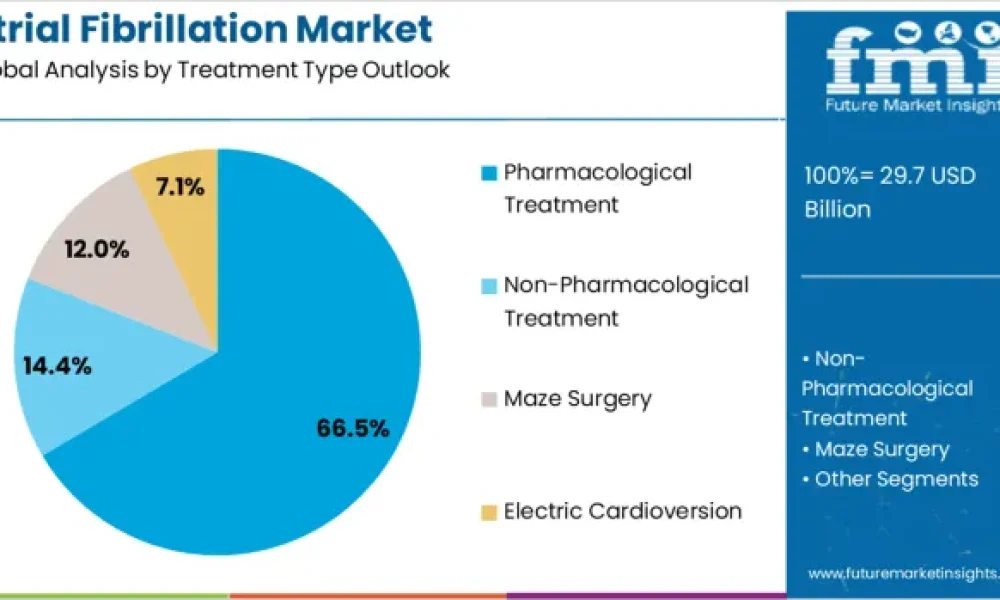
The global atrial fibrillation (AF) market is entering a period of profound growth and transformation, with its value projected to rise from USD 29.7 billion in 2025 to approximately USD 80.1 billion by 2035. This remarkable expansion represents an absolute increase of USD 50.4 billion, equivalent to a 170% surge over the decade, and highlights the growing importance of cardiovascular health solutions in a rapidly aging world. With a compound annual growth rate (CAGR) of 10.4%, the market is forecast to grow nearly 2.7 times during this period, powered by advances in treatment technologies, increased awareness of cardiac health, and the rising prevalence of atrial fibrillation globally.
Between 2025 and 2030 alone, the market is expected to jump from USD 29.7 billion to USD 53.9 billion, delivering nearly half of the decade’s forecast expansion. The second half of the decade, from 2030 to 2035, will continue this momentum, adding another USD 26.2 billion as innovation accelerates in minimally invasive techniques, artificial intelligence (AI)-driven diagnostics, and personalized therapeutic approaches.
Full Market Report available for delivery. For purchase or customization, please request here: https://www.futuremarketinsights.com/reports/sample/rep-gb-26065
Market Dynamics Shaping Growth
The market’s rapid expansion is underpinned by multiple factors. Chief among them is the increasing prevalence of atrial fibrillation worldwide, closely linked to the aging global population. With cardiovascular diseases already among the leading causes of mortality, the demand for effective and comprehensive AF management solutions has never been greater.
Pharmacological treatments remain the backbone of AF management, representing 66.5% of the market share in 2025. These treatments, which include anti-arrhythmic and anticoagulant drugs, form the foundation of clinical guidelines across hospitals and specialty clinics. Their accessibility, proven efficacy, and broad applicability make them indispensable, especially in acute and long-term care scenarios.
Hospitals are projected to account for 60.4% of the end-use share in 2025, reflecting their role as the central hubs of AF management. With specialized cardiac care units, state-of-the-art electrophysiology labs, and integrated multidisciplinary care teams, hospitals provide both immediate interventions and long-term treatment pathways for patients with AF.
Embracing Innovation: Digital Health and AI
One of the defining trends shaping the AF market is the rapid integration of digital health technologies and artificial intelligence. Remote monitoring systems and telemedicine platforms are empowering physicians to track patients continuously, detect early warning signs of arrhythmia, and ensure better treatment adherence. These innovations are particularly vital for elderly populations, offering them access to timely care from the comfort of their homes.
Artificial intelligence and machine learning are also revolutionizing diagnostics and treatment planning. By enhancing the accuracy of AF detection and enabling personalized treatment protocols, AI is driving superior outcomes and reducing the risks associated with traditional treatment approaches.
Regional Growth Leaders
Growth trajectories vary significantly across regions, reflecting differences in healthcare infrastructure, aging demographics, and technology adoption.
China leads the global AF market with a projected CAGR of 14.1% through 2035, fueled by its rapidly aging population, growing healthcare investments, and increasing awareness of cardiovascular disease prevention. International and domestic players alike are building robust distribution networks across tier-1 and tier-2 cities to meet rising demand.
India follows closely with a CAGR of 13.1%, supported by expanding healthcare access, an enlarging middle class, and increased investments in electrophysiology centers and catheterization laboratories. Awareness of stroke prevention is also playing a critical role in driving treatment adoption across both urban and semi-urban centers.
Germany, with a CAGR of 12%, continues to showcase its excellence in precision cardiac care, research-driven clinical trials, and strong collaborations between academic institutions and device manufacturers. France’s growth at 11% underscores its emphasis on specialized cardiac centers and medical innovation, while the United Kingdom’s 9.9% expansion highlights the strength of its evidence-based treatment protocols and integrated cardiac care networks.
In the United States, the market is expected to grow at 8.9% CAGR, driven by advanced healthcare infrastructure, strong adoption of minimally invasive procedures, and increasing reliance on precision medicine. Medicare expansions and value-based care models further support broader treatment access.
Japan and South Korea are also playing significant roles in shaping AF market innovation. Japan’s sophisticated healthcare industry prioritizes quality-driven treatment solutions, AI integration, and automated monitoring systems, while South Korea is leveraging its technological strengths to develop intelligent AF treatment systems with predictive and real-time optimization features.
Request Market Research Draft Report: https://www.futuremarketinsights.com/reports/brochure/rep-gb-26065
Competitive Landscape
The competitive landscape of the AF market is marked by a blend of established global leaders and emerging innovators. Abbott, through its St. Jude Medical division, continues to lead with advanced cardiac ablation and electrophysiology technologies, emphasizing minimally invasive approaches. AtriCure Inc. focuses on surgical ablation and maze procedure technologies, while Boehringer Ingelheim GmbH and Bristol-Myers Squibb remain pivotal in the anticoagulant drug segment, driving advancements in stroke prevention.
Boston Scientific Corporation offers a broad electrophysiology portfolio, including advanced catheter ablation systems, while Johnson & Johnson strengthens its presence through Biosense Webster and other subsidiaries offering cutting-edge mapping and visualization tools. Sanofi-Aventis continues to provide established pharmacological therapies with a global reach, and CardioFocus contributes specialized ablation solutions tailored for pulmonary vein isolation procedures.
Meanwhile, emerging companies and new entrants are bringing disruptive technologies to market, especially in the realms of digital health, AI-driven diagnostics, and minimally invasive surgical tools. These players are focusing on patient-centric solutions, affordability, and accessibility—critical factors in meeting the rising demand in developing regions.
Opportunities and Challenges Ahead
Despite its strong growth outlook, the atrial fibrillation market faces challenges such as high treatment costs, disparities in access to specialized care in low-income regions, and potential complications associated with certain interventions. However, ongoing innovation in minimally invasive procedures, digital health adoption, and precision medicine is expected to mitigate many of these challenges and open up new avenues of opportunity.
For established companies, the challenge lies in maintaining their competitive edge through continuous innovation, regulatory compliance, and global expansion. For emerging players, opportunities abound in developing accessible, cost-effective, and technology-driven treatment solutions that cater to diverse patient populations across developed and emerging markets alike.
About Future Market Insights (FMI)
Future Market Insights, Inc. (ESOMAR certified, recipient of the Stevie Award, and a member of the Greater New York Chamber of Commerce) offers profound insights into the driving factors that are boosting demand in the market. FMI stands as the leading global provider of market intelligence, advisory services, consulting, and events for the Packaging, Food and Beverage, Consumer Technology, Healthcare, Industrial, and Chemicals markets. With a vast team of over 400 analysts worldwide, FMI provides global, regional, and local expertise on diverse domains and industry trends across more than 110 countries.
Contact Us:
Future Market Insights Inc.
Christiana Corporate, 200 Continental Drive,
Suite 401, Newark, Delaware – 19713, USA
T: +1-347-918-3531
For Sales Enquiries: [email protected]



