
Atrial fibrillation (AF) is one of the most prevalent and challenging arrhythmias globally, with an increasing number of cases as populations age and cardiovascular disease becomes more common. The Atrial Fibrillation Devices Market has experienced significant growth in recent years due to innovations in diagnostic and treatment devices, technological advancements in cardiac procedures, and the rising global prevalence of AF. This market includes devices for diagnosing, monitoring, and treating atrial fibrillation, particularly focusing on therapies like catheter ablation, rhythm monitoring, and mapping technologies. The demand for these devices is expected to continue growing as healthcare systems around the world increasingly embrace minimally invasive treatments.
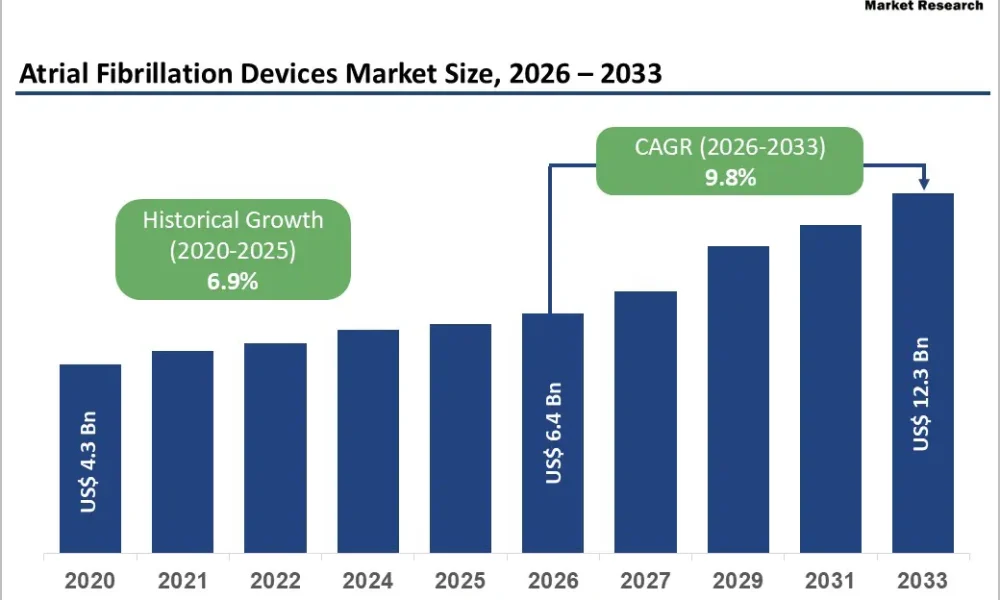
The global Atrial Fibrillation Devices Market is projected to be valued at USD 6.4 billion in 2026, with expectations of reaching USD 12.3 billion by 2033, growing at a compound annual growth rate (CAGR) of 9.8%. This growth is being driven by multiple factors such as the rising prevalence of AF, an aging population, and increased adoption of minimally invasive cardiac procedures. The market is also benefiting from innovations such as advanced catheter designs, improved imaging, and the integration of remote monitoring systems. These advancements are enhancing clinical outcomes and procedural efficiency, leading to a wider adoption of AF treatment devices, especially in hospitals and specialized cardiac centers.
Download Your Free Sample & Explore Key Insights: https://www.persistencemarketresearch.com/samples/31531
Key Highlights from the Report
• North America leads the Atrial Fibrillation Devices market with a 39% share in 2025, driven by high prevalence and advanced healthcare infrastructure.
• Asia Pacific is the fastest-growing region, with a robust 12% CAGR, driven by expanding healthcare infrastructure and rising healthcare investments.
• Radiofrequency (RF) technology dominates the market, accounting for 46% of market share due to its proven efficacy in catheter ablations.
• Cryotherapy is the fastest-growing technology, with a 15% CAGR, driven by its safety profile and efficacy in balloon-based ablations.
• Pulsed Field Ablation (PFA) presents a major opportunity, expected to grow at a 32% CAGR due to its safer procedural profiles and reduced collateral damage.
• Minimally invasive procedures continue to rise, further boosting the adoption of device-based therapies for atrial fibrillation treatment.
Market Segmentation
The Atrial Fibrillation Devices Market is segmented into several categories based on product type, technology, end user, and geographical regions.
Product Type
The market can be divided into devices used for diagnosis, monitoring, and treatment of atrial fibrillation. Treatment devices, especially those used in catheter ablation, dominate the market due to the growing preference for device-based interventions over long-term pharmacological therapies. The key treatment modalities include radiofrequency (RF) ablation, cryoablation, and the emerging pulsed field ablation (PFA) technology. Diagnosis and monitoring tools are primarily used for detecting AF and tracking heart rhythm over time, often in the form of wearable ECG monitors, implantable devices, and advanced mapping systems.
Technology
The technology landscape is characterized by the use of different ablation techniques. Radiofrequency (RF) technology has been the dominant method for AF ablation for several years due to its long-standing clinical acceptance and high success rate. Cryotherapy, a more recent advancement, is gaining traction due to its minimal tissue damage and efficacy in balloon-based ablation. Pulsed Field Ablation (PFA) is an emerging technology that holds substantial growth potential, with its high safety profile and the promise of reduced collateral damage during procedures.
End Users
Hospitals are the leading end users of atrial fibrillation devices, accounting for the highest share of the market. Hospitals possess the necessary infrastructure, including skilled electrophysiologists and advanced imaging systems, to perform complex procedures. Furthermore, they can manage high-risk cases, such as persistent AF, and often offer multidisciplinary care, ensuring improved procedural outcomes. Specialized cardiac centers, which are equipped with state-of-the-art electrophysiology labs, also represent a significant market segment. Other end users include outpatient centers and ambulatory surgical centers (ASCs), which are becoming more common due to the increasing shift toward outpatient care.
Regional Insights
North America
North America holds the largest share of the Atrial Fibrillation Devices Market, largely due to the region’s advanced healthcare infrastructure, high incidence of AF, and the increasing adoption of innovative cardiac technologies. The region is home to numerous specialized cardiac centers, hospitals, and healthcare systems that are equipped with the latest ablation technologies, such as radiofrequency, cryoablation, and wearable monitoring devices. The high adoption of minimally invasive procedures and favorable reimbursement policies have further fueled the demand for AF devices in North America.
Asia Pacific
The Asia Pacific region is experiencing rapid growth in the atrial fibrillation devices market, driven by the increasing prevalence of cardiovascular diseases, expanding healthcare infrastructure, and rising public awareness about the benefits of advanced cardiac care. Countries such as China, India, and Japan are seeing a growing number of patients opting for catheter ablations and implantable monitoring devices. Government initiatives to improve healthcare access, along with rising insurance coverage, are helping to make these treatments more affordable in the region. The Asia Pacific market is expected to grow at the fastest pace globally, with a projected CAGR of 12%.
Get Custom Insights Designed for Your Business: https://www.persistencemarketresearch.com/request-customization/31531
Market Drivers
Rising Prevalence of Atrial Fibrillation
The increasing prevalence of atrial fibrillation is a primary driver behind the growth of the AF devices market. As one of the most common types of arrhythmia, AF affects millions of people globally, with the condition’s prevalence rising due to aging populations, lifestyle-related risk factors (e.g., hypertension, diabetes, obesity), and improved awareness. The growing number of diagnosed cases creates a substantial demand for accurate diagnostic tools, continuous monitoring systems, and effective interventional devices such as ablation catheters and implantable devices. As a chronic condition, AF often requires long-term management, contributing to the sustained demand for devices across healthcare systems worldwide.
Advancements in Ablation Technologies
Technological advancements in ablation technologies have significantly improved the effectiveness and safety of atrial fibrillation treatments. Newer energy delivery systems, such as next-generation radiofrequency and cryoablation platforms, have enhanced precision, enabling electrophysiologists to treat patients more effectively and safely. Innovations like contact-force sensing catheters, real-time feedback systems, and advanced 3D mapping have further improved procedural success rates, reducing complications and the need for repeat procedures. These developments have made ablation therapies more accessible and efficient, encouraging earlier adoption of device-based interventions.
Market Restraints
High Costs of Procedures and Devices
One of the major restraints facing the Atrial Fibrillation Devices Market is the high cost of procedures and devices, which can limit adoption, particularly in developing regions. The cost of advanced equipment, including catheters, mapping systems, and implantable devices, can be prohibitive for healthcare systems with limited budgets. Additionally, specialized procedures like catheter ablations require skilled electrophysiologists and advanced infrastructure, further increasing treatment costs. The limited reimbursement coverage in certain regions also poses a financial barrier to both healthcare providers and patients, hindering the widespread adoption of device-based treatments.
Market Opportunities
Pulsed Field Ablation Expansion
Pulsed Field Ablation (PFA) presents a major opportunity in the Atrial Fibrillation Devices Market. PFA technology uses non-thermal electric fields to selectively target cardiac tissue, sparing surrounding structures and reducing the risk of collateral damage. With its improved safety profile and promising early clinical results, PFA is expected to gain traction in the coming years. As more long-term data becomes available, the technology is poised to expand, offering a compelling alternative to traditional thermal-based ablation methods.
Ambulatory Surgical Center Proliferation
The rise of ambulatory surgical centers (ASCs) represents another significant opportunity for growth in the AF devices market. These centers provide an efficient and cost-effective setting for minimally invasive procedures such as catheter ablations. ASCs often feature advanced imaging systems and electrophysiology labs, enabling the performance of high-quality cardiac interventions without the need for extended hospital stays. As more ASCs open across North America and Asia Pacific, they are expected to contribute significantly to the demand for advanced AF devices.
Checkout Now & Download Complete Market Report: https://www.persistencemarketresearch.com/checkout/31531
Company Insights
Key players operating in the Atrial Fibrillation Devices Market include:
• Biosense Webster, Inc. (Johnson & Johnson)
• Abbott Laboratories
• Medtronic Plc
• Boston Scientific Corporation
• AtriCure, Inc.
• Japan Lifeline Co.
• Biotronik, Inc.
• MicropORT Scientific Corporation
• Biomerics
• CathRx
Market Segmentation
Product
- Electrophysiology Diagnostic
- Conventional
- Advanced EP Mapping Catheters
- Coronary Sinus Catheters
- Intracardiac Catheters
- Therapeutics
- Maze surgery
- LAA Management Devices
Technology
- Radiofrequency
- Cryotherapy
- Ultrasound
- Others
End User
- Hospital
- Ambulatory Surgical Centers
- Cardiac Catheterization Labs
Regions
- North America
- Europe
- Asia Pacific
- Latin America
- Middle East & Africa
Recent Market Developments
• In May 2025, Abbott launched the TactiFlex Sensor-Enabled Ablation Catheter, the first ablation catheter with a flexible tip and contact force technology.
• In October 2025, AtriCure, Inc. announced the enrollment of the first patient in its BoxX-NoAF clinical trial, investigating the combination of surgical ablation with left atrial appendage exclusion to reduce new-onset atrial fibrillation.
Conclusion
The Atrial Fibrillation Devices Market is poised for significant growth, driven by the increasing prevalence of AF, technological advancements in ablation and monitoring technologies, and the rising adoption of minimally invasive procedures. While high treatment costs and economic barriers remain challenges, innovations like Pulsed Field Ablation (PFA) and the proliferation of ambulatory surgical centers (ASCs) offer significant opportunities for market expansion. With key players investing in R&D and advancing the capabilities of AF devices, the future of the market looks promising, especially in regions like North America and Asia Pacific. As demand for more efficient, safer, and less invasive treatments continues to grow, the Atrial Fibrillation Devices Market will play a critical role in transforming the management and treatment of atrial fibrillation worldwide.




