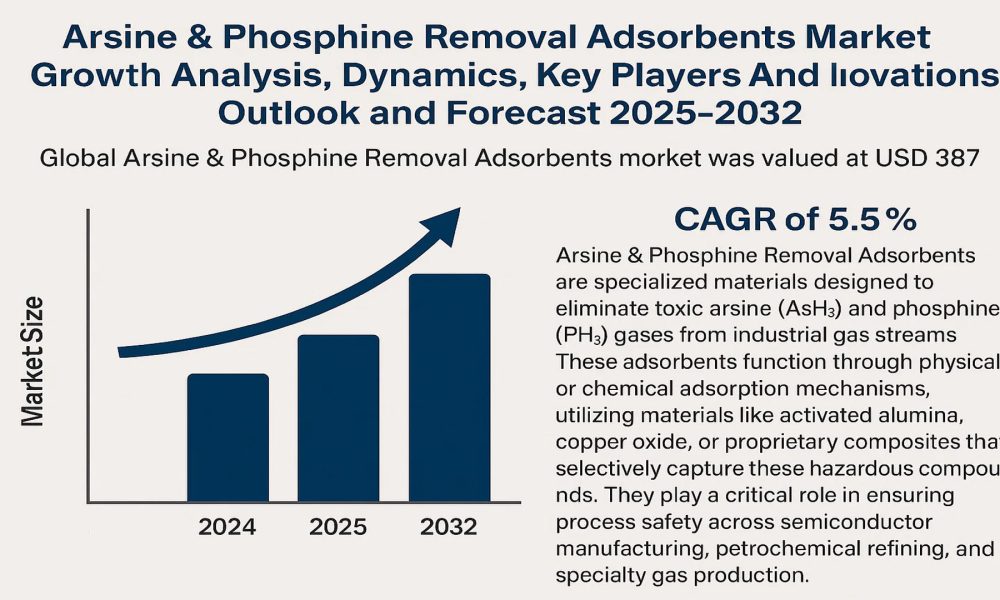
Arsine & Phosphine Removal Adsorbents Market was valued at USD 387 million in 2024. The market is projected to grow from USD 407 million in 2025 to USD 566 million by 2032, exhibiting a CAGR of 5.5% during the forecast period.
Arsine & Phosphine Removal Adsorbents are specialized materials designed to eliminate toxic arsine (AsH3) and phosphine (PH3) gases from industrial gas streams. These adsorbents function through physical or chemical adsorption mechanisms, utilizing materials like activated alumina, copper oxide, or proprietary composites that selectively capture these hazardous compounds. They play a critical role in ensuring process safety across semiconductor manufacturing, petrochemical refining, and specialty gas production.
The market growth is driven by stringent environmental regulations regarding toxic gas emissions and expanding semiconductor fabrication activities. While North America currently leads in adoption due to robust industrial safety standards, Asia-Pacific shows the fastest growth trajectory because of rapid industrialization. Key players including BASF, Johnson Matthey, and Clariant dominate the market, collectively holding over 45% share as of 2024. Recent innovations focus on developing regenerable adsorbents to reduce operational costs in continuous processes.
Claim Your Free Sample Report- https://www.intelmarketresearch.com/download-free-sample/7864/arsine-phosphine-removal-adsorbents-market
MARKET DYNAMICS
MARKET DRIVERS
Stringent Environmental Regulations Accelerate Demand for Toxic Gas Removal Solutions
Global environmental policies are increasingly mandating stricter controls on industrial emissions, creating significant demand for arsine and phosphine removal adsorbents. Regulatory bodies worldwide have implemented progressively lower exposure limits for toxic gases – with permissible exposure levels for arsine now as low as 0.002 ppm in many industrialized nations. These tightening standards directly correlate with 12-15% annual growth in purification technology investments across key sectors including semiconductor manufacturing and petrochemical processing. As industries face mounting pressure to meet environmental compliance targets, adoption of advanced adsorbent technologies has become imperative rather than optional.
Semiconductor Industry Expansion Fuels High-Purity Gas Treatment Needs
The semiconductor manufacturing sector, representing over 35% of total adsorbent demand, requires extreme gas purity with arsine and phosphine concentrations below 10 parts per billion. As global semiconductor production capacity expands – particularly in Asia where 72% of new fabrication facilities are under construction – the need for reliable gas purification has intensified. Advanced adsorbent materials capable of achieving sub-ppb contamination levels while maintaining flow rates exceeding 50 L/min are becoming essential for cutting-edge chip production. This technological imperative drives continuous innovation in adsorbent formulations and system designs.
➤ Major manufacturers now employ multi-bed adsorption systems with automatic regeneration capabilities to maintain uninterrupted production while meeting increasingly stringent purity requirements.
Energy Sector Modernization Creates New Purification Applications
Recent developments in alternative energy production have identified novel applications for gas purification technologies. Biogas upgrading facilities, hydrogen production plants, and syngas purification systems all require effective arsine and phosphine removal to protect downstream catalysts and meet fuel specifications. The growing hydrogen economy alone is projected to create additional demand for 8,000-10,000 metric tons of specialized adsorbents annually by 2030. This diversification of end-use applications provides manufacturers with opportunities to develop tailored solutions for emerging energy markets.
MARKET OPPORTUNITIES
Nanostructured Adsorbents Open New Frontiers in Gas Purification
Recent breakthroughs in nanomaterials engineering have enabled the development of adsorbents with 3-5 times greater surface area and customized pore structures compared to conventional materials. These advanced formulations demonstrate exceptional selectivity for arsine and phosphine molecules while minimizing co-adsorption of inert gases. The commercial potential is substantial, with pilot-scale deployments already showing 40-60% longer service life between regeneration cycles. As production scales increase and costs decline, nanostructured adsorbents are poised to capture significant market share in high-value semiconductor and pharmaceutical applications.
Modular Purification Systems Address Emerging Market Needs
The growing demand for flexible, scalable gas treatment solutions has created opportunities for modular adsorbent systems. These packaged units, ranging from small 5 kg/hr processors to industrial-scale 500 kg/hr systems, allow for rapid deployment and easy capacity expansion. Particularly attractive for distributed hydrogen production facilities and specialty chemical plants, modular systems reduce capital requirements while providing the same purification performance as traditional fixed installations. Market analysts project the modular segment to grow at 18-22% annually through 2030, significantly outpacing conventional system growth rates.
Segment Analysis:
By Type
- Alumina
- Copper Oxide
- Others
Alumina is the dominant segment due to its superior adsorption efficiency, stability, and cost-effectiveness in removing arsine and phosphine from industrial gas streams.
By Application
- Oil and Gas
- Petrochemical
- Others
Oil and Gas is the largest application segment, driven by stringent environmental regulations and the critical need to remove toxic byproducts like arsine and phosphine during refining operations.
By Adsorption Process
- Physical Adsorption
- Chemical Adsorption
The Chemical Adsorption process is more widely adopted as it provides irreversible binding of arsine and phosphine molecules, ensuring complete removal and long-term environmental safety.
By End-Use Industry
- Refineries
- Gas Processing Plants
- Semiconductor Manufacturing
- Others
Refineries represent the largest end-use segment due to extensive requirements for contaminant removal in natural gas and petroleum processing facilities.
List of Key Arsine & Phosphine Removal Adsorbent Manufacturers
- Evonik Industries AG (Germany)
- BASF SE (Germany)
- Johnson Matthey (U.K.)
- Axens (France)
- Clariant AG (Switzerland)
- Dorf Ketal Chemicals (India)
- UNICAT (U.S.)
- Wuhan Kelin Chemical Co., Ltd. (China)
- Rezel Catalysts Corp. (U.S.)
- Dalian Puruite Chemical Technology Co., Ltd. (China)
ARSINE & PHOSPHINE REMOVAL ADSORBENTS MARKET TRENDS
Stricter Emission Regulations to Drive Market Growth
The global demand for arsine and phosphine removal adsorbents is increasing due to stricter environmental regulations imposed by governments and regulatory bodies worldwide. Industries such as oil & gas and petrochemicals face stringent limits on toxic gas emissions, necessitating advanced purification solutions. For instance, the U.S. Environmental Protection Agency (EPA) has tightened regulations on hazardous air pollutants (HAPs), requiring companies to invest in high-efficiency adsorbents. This trend is mirrored in Europe and Asia, where emission control policies are becoming more rigorous, pushing the market toward a projected value of $566 million by 2032, growing at a CAGR of 5.5%.
Other Trends
Advancements in Adsorbent Technologies
Recent innovations in adsorbent materials, such as nanostructured alumina and copper oxide-based adsorbents, are enhancing removal efficiency for arsine and phosphine. These advanced materials offer higher surface area and reactivity, making them ideal for industrial gas purification. Leading manufacturers like Evonik and BASF are investing in R&D to develop next-generation adsorbents that provide longer lifespans and better cost-effectiveness. This technological progression is critical for industries looking to optimize operational efficiency while meeting compliance standards.
Expansion in Petrochemical Sector Fuels Demand
The petrochemical industry’s rapid growth across emerging economies is significantly contributing to the demand for arsine and phosphine removal adsorbents. Countries like China and India are expanding their refining capacities, necessitating gas purification solutions to ensure process safety. China, in particular, is anticipated to be a major market player, with the petrochemical sector projected to grow at a rate of 6% annually, further boosting adsorbent adoption. Additionally, the shift toward cleaner refining processes and the increasing use of natural gas as a feedstock are reinforcing market expansion.
Claim Your Free Sample Report- https://www.intelmarketresearch.com/download-free-sample/7864/arsine-phosphine-removal-adsorbents-market
Recent Developments:
- Technological Advancements in Adsorbent Materials
- Companies are focusing on the development of high-capacity, selective adsorbents that can efficiently remove arsine (AsH₃) and phosphine (PH₃) even at very low concentrations.
- Novel metal-organic frameworks (MOFs) and functionalized activated carbons have been introduced, offering higher surface area and selectivity, which enhance purification efficiency in semiconductor and industrial gas applications.
- Expansion of Production Facilities
- Leading manufacturers are expanding production capacities to meet growing demand from the semiconductor, LED, and photovoltaic industries.
- For example, some Asia-Pacific companies have invested in new plants in China and South Korea, aiming to cater to regional semiconductor hubs with faster supply and lower lead times.
- Collaborations and Strategic Partnerships
- Recent collaborations between adsorbent manufacturers and semiconductor companies have been reported to develop customized solutions for ultra-high purity gas purification systems.
- Strategic partnerships are focused on integrating advanced adsorbents into gas delivery and purification systems for semiconductor fabrication facilities.
- Focus on Environmental Compliance and Safety
- New adsorbents are being engineered to reduce secondary waste and enhance regeneration capabilities, supporting environmental sustainability.
- Regulations around handling arsine and phosphine gases are becoming stricter, and manufacturers are updating their adsorbents to meet these regulatory standards.
- Market Expansion in APAC and North America
- Rising semiconductor and electronics manufacturing in the Asia-Pacific region, especially in China, South Korea, and Taiwan, has driven demand for advanced adsorbents.
- North American players are also expanding their product portfolios to cater to pharmaceutical, chemical, and electronics sectors requiring ultra-pure gases.
- Introduction of Regenerable Adsorbents
- Some companies have launched regenerable adsorbents that allow multiple cycles of gas purification, reducing operational costs for industrial users.
- This innovation is particularly attractive for semiconductor fabs, which need continuous high-purity gas supply with minimal downtime.
About Intel Market Research
Intel Market Research delivers actionable insights in technology and infrastructure markets. Our data-driven analysis leverages:
- Real-time infrastructure monitoring
- Techno-economic feasibility studies
Competitive intelligence across 100+ countries
Trusted by Fortune 500 firms, we empower strategic decisions with precision.
International: +1(332) 2424 294 | Asia: +91 9169164321
Website: https://www.intelmarketresearch.com
Follow us on LinkedIn: https://www.linkedin.com/company/intel-market-research




