
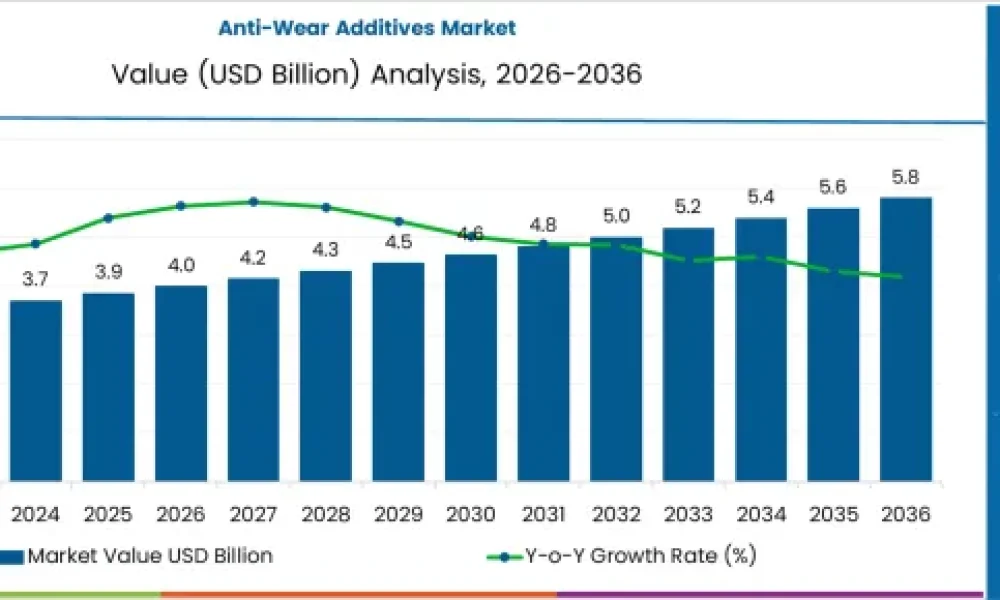
The global anti-wear additives market is entering a phase of steady, long-term expansion, with market value projected to rise from approximately USD 4.0 billion in 2026 to nearly USD 5.8 billion by 2036, registering a compound annual growth rate (CAGR) of around 3.8% over the forecast period. This growth is being driven by rising demand for advanced lubricant solutions that minimize friction, reduce component wear, and enhance operational efficiency across automotive, industrial, and heavy-equipment applications. As industries worldwide prioritize asset longevity and cost-effective maintenance, anti-wear additives have become a critical component of modern lubrication strategies.
The market’s momentum is closely tied to increasing global vehicle production, expanding industrial machinery usage, and the need to comply with stringent performance and efficiency standards. Anti-wear additives play a vital role in protecting engine and equipment surfaces under extreme pressure and temperature conditions, supporting both productivity gains and sustainability objectives.
Key Market Insights at a Glance
Anti-wear additives account for a significant share of the overall lubricant additives industry, with engine oil applications alone representing nearly 38% of total consumption. Demand continues to grow steadily as lubricant formulators focus on enhancing durability, fuel efficiency, and reliability. The shift toward high-performance and long-drain lubricants has further amplified the importance of advanced anti-wear chemistries, particularly in sectors where equipment downtime translates directly into financial losses.
Segment Overview
By product type, the market is led by zinc-based anti-wear additives, particularly zinc dialkyldithiophosphates, due to their proven effectiveness and widespread acceptance in engine oils and industrial lubricants. Alongside these, ashless and phosphorus-based alternatives are gaining traction, especially in applications where emissions control and after-treatment system compatibility are critical. From an application standpoint, engine oils dominate demand, followed by hydraulic fluids, gear oils, transmission fluids, and industrial greases. Automotive remains the largest end-use segment, while manufacturing, energy, mining, and construction industries continue to generate consistent demand.
Regional Overview
Regionally, Asia-Pacific stands out as the fastest-growing market, supported by strong automotive manufacturing activity, rapid industrialization, and infrastructure development across China, India, and Southeast Asia. North America holds a substantial share, driven by advanced industrial operations, a mature automotive sector, and strict maintenance standards. Europe maintains steady growth due to its focus on high-efficiency machinery, emissions compliance, and advanced lubricant formulations. Meanwhile, Latin America and the Middle East & Africa are witnessing gradual expansion as industrial and transportation sectors continue to modernize.
To access the complete data tables and in-depth insights — Request Your Sample Report Now
Competitive Landscape
The anti-wear additives market is moderately consolidated, with global chemical manufacturers and specialized additive producers competing on formulation performance, regulatory compliance, and supply reliability. Market leaders are strengthening their positions through continuous innovation, portfolio optimization, and strategic partnerships with lubricant blenders and OEMs. Product differentiation increasingly centers on enhanced wear protection, oxidation stability, and compatibility with next-generation engines and equipment.
Market Outlook: Powering the Next Decade
Looking ahead, the market outlook remains positive as industries seek lubricants that deliver superior performance while supporting sustainability goals. The development of low-phosphorus, ashless, and environmentally optimized anti-wear additives is expected to accelerate, particularly as regulatory pressures intensify. Advances in synthetic and bio-based lubricants will further create opportunities for additive technologies that balance durability with environmental responsibility. Over the next decade, anti-wear additives will continue to play a pivotal role in improving energy efficiency and extending equipment service life across global industries.
Key Players of Sustainable Label Industry
Prominent market participants include multinational additive manufacturers and specialty chemical companies with strong research and development capabilities. These players focus on delivering consistent quality, meeting evolving regulatory requirements, and offering customized solutions tailored to diverse end-use industries. Their emphasis on sustainable innovation positions them to remain competitive in a rapidly evolving market environment.
Recent Strategic Developments
Recent developments in the market include increased collaboration between additive suppliers and lubricant formulators to develop application-specific solutions. Companies are also investing in next-generation additive technologies designed to meet emerging engine designs and industrial performance standards. Expansion of production capacities and optimization of global supply chains further highlight the industry’s commitment to long-term growth and resilience.
Have a specific Requirements and Need Assistant on Report Pricing or Limited Budget please contact us – [email protected]
About Future Market Insights (FMI)
Future Market Insights, Inc. (FMI) is an ESOMAR-certified, ISO 9001:2015 market research and consulting organization, trusted by Fortune 500 clients and global enterprises. With operations in the U.S., UK, India, and Dubai, FMI provides data-backed insights and strategic intelligence across 30+ industries and 1200 markets worldwide.
Why Choose FMI: https://www.futuremarketinsights.com/why-fmi



