
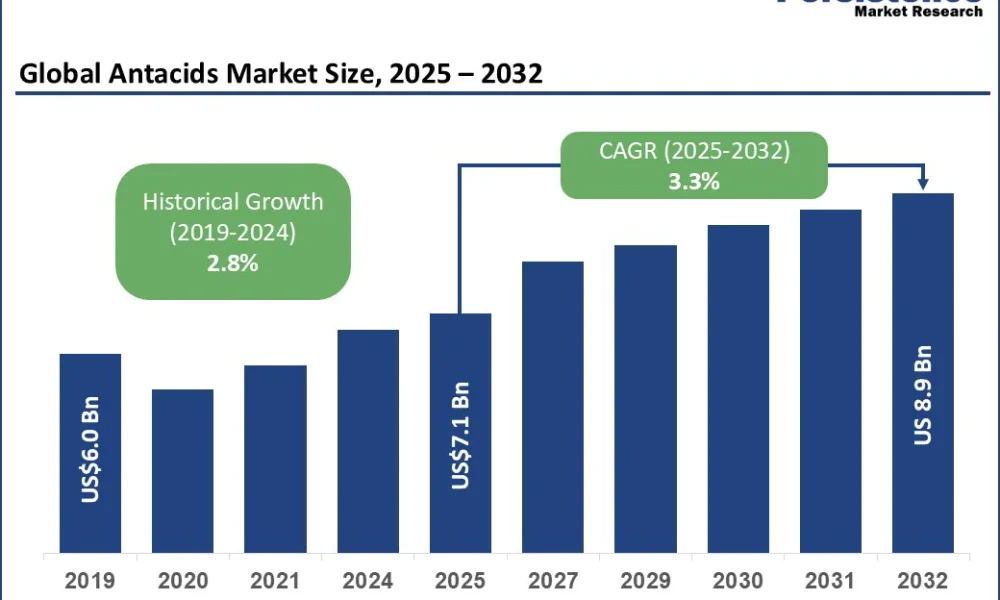
The global antacids market has witnessed steady growth over the past decade, supported by rising digestive health concerns and a growing inclination toward over-the-counter (OTC) medications. Antacids are widely used medications that neutralize stomach acid and provide quick relief from symptoms such as heartburn, indigestion, and acid reflux. The market is projected to be valued at approximately US$7.1 billion in 2025 and is expected to reach US$8.9 billion by 2032, expanding at a compound annual growth rate (CAGR) of 3.3% during 2025–2032. The historical growth rate between 2019 and 2024 stood at around 2.8%, indicating stable but gradually increasing demand for digestive health solutions worldwide. The expansion of the OTC pharmaceutical sector, combined with rising awareness regarding gastrointestinal disorders, continues to play a vital role in shaping the market landscape. Additionally, pharmaceutical companies are adopting advanced marketing approaches such as digital campaigns, product diversification, and flavor variations to attract consumers and enhance brand engagement.
Several factors are driving the growth of the antacids market globally. Increasing prevalence of gastrointestinal disorders, sedentary lifestyles, unhealthy dietary habits, and stress-related digestive conditions have significantly increased the consumption of antacid products. Among different formulations, tablet-based antacids are projected to hold about 26.3% of the market share in 2025 due to their convenience, portability, and long shelf life. In terms of active ingredients, calcium carbonate dominates the market with around 39.7% share, owing to its rapid acid-neutralizing properties and additional calcium supplementation benefits. From an indication perspective, gastroesophageal reflux disease (GERD) represents the leading application, accounting for approximately 50.1% of market demand due to the increasing prevalence of acid reflux-related symptoms. Regionally, North America leads the global market with nearly 43.6% share in 2025, largely due to a high prevalence of digestive disorders, advanced healthcare infrastructure, and a large aging population. Meanwhile, the Asia Pacific region is expected to record the fastest growth, driven by expanding healthcare access, increasing disposable income, and rapid growth of retail pharmacy networks.
Download Your Free Sample & Explore Key Insights: https://www.persistencemarketresearch.com/samples/35655
Key Highlights from the Report
• The global antacids market is projected to grow from US$7.1 billion in 2025 to US$8.9 billion by 2032 at a CAGR of 3.3%.
• Tablets remain the leading formulation segment, accounting for approximately 26.3% of market share due to convenience and shelf stability.
• Calcium carbonate dominates the active ingredient segment with nearly 39.7% share owing to its rapid acid-neutralizing capability.
• GERD represents the largest indication segment, holding about 50.1% of total market demand.
• North America leads the global market with nearly 43.6% share because of high prevalence of digestive disorders and strong OTC adoption.
• Asia Pacific is the fastest-growing regional market with a projected CAGR of around 5.2% through 2032.
Antacids Market Segmentation
The antacids market can be segmented based on formulation, active ingredient, indication, and distribution channel. Each of these segments plays a critical role in shaping demand patterns and influencing product innovation within the industry.
From a formulation perspective, antacids are commonly available in tablets, liquids, chewable tablets, effervescent tablets, powders, and gummies. Among these, tablets continue to dominate the market because of their ease of storage, portability, and long shelf life. Consumers prefer tablets for on-the-go relief, particularly those experiencing occasional heartburn or indigestion. Liquid formulations are also popular because they provide faster relief by quickly neutralizing stomach acid. However, their bulkier packaging and shorter shelf life sometimes limit widespread adoption compared to tablets. Chewable tablets and gummies are emerging as attractive alternatives, especially among children and individuals who have difficulty swallowing pills. The availability of flavored chewable antacids has further enhanced patient compliance and broadened the consumer base.
Based on active ingredients, the market includes calcium carbonate, magnesium hydroxide, aluminum hydroxide, sodium bicarbonate, and alginate-based formulations. Calcium carbonate holds the largest share due to its strong acid-neutralizing ability and dual role as a calcium supplement. Many widely used antacid products rely on calcium carbonate for immediate symptom relief from acidity and indigestion. Alginate-based antacids are gaining popularity due to their unique reflux-suppressing mechanism. When alginate interacts with gastric acid, it forms a protective gel-like barrier that floats on the stomach contents and prevents acid from flowing back into the esophagus. This mechanism makes alginate formulations particularly effective for treating GERD symptoms.
In terms of indication, the antacids market is primarily driven by conditions such as GERD, heartburn, acid indigestion, and stomach ulcers. GERD represents the largest segment because it involves chronic acid reflux that requires frequent symptom management. Antacids provide quick relief by neutralizing excess stomach acid, making them a preferred first-line solution for individuals experiencing mild to moderate symptoms. Heartburn and acid indigestion also contribute significantly to market demand, especially among consumers who experience occasional discomfort after consuming spicy, fatty, or acidic foods. In many cases, antacids serve as an immediate remedy before patients consider prescription medications or medical consultations.
Distribution channels also play an important role in market expansion. Retail pharmacies dominate the market due to their accessibility and wide product availability. Supermarkets and convenience stores are also key outlets for OTC antacids, particularly in developed markets. In recent years, e-commerce platforms have gained momentum, enabling consumers to purchase digestive health products online with greater convenience. Online pharmacies and digital healthcare platforms are expected to become increasingly important in expanding market reach and improving accessibility to OTC medications.
Regional Insights
The antacids market shows significant regional variations in terms of demand patterns, healthcare infrastructure, and consumer awareness. North America currently holds the largest share of the global market, accounting for approximately 43.6% of total revenue in 2025. The region’s dominance is attributed to the high prevalence of gastrointestinal disorders, a well-established OTC pharmaceutical market, and a large aging population that is more susceptible to digestive health issues. The United States represents the largest contributor to the regional market due to strong consumer awareness, advanced healthcare infrastructure, and widespread availability of digestive health products. Retail pharmacy chains and online pharmaceutical platforms further strengthen distribution networks, ensuring easy accessibility of antacids for consumers.
Europe also represents a significant share of the global antacids market, supported by increasing awareness of digestive health and growing demand for OTC medications. Countries such as Germany, the United Kingdom, and France are key contributors to regional growth. Consumers in these markets frequently rely on antacids for quick relief from heartburn and acid reflux, particularly in response to dietary habits that include high-fat and spicy foods. The growing adoption of digital commerce and online pharmacies has also improved product accessibility in the region. However, increasing awareness of potential side effects associated with long-term antacid use has led to a balanced approach where consumers combine antacids with other treatment options.
The Asia Pacific region is expected to experience the fastest growth during the forecast period, with a projected CAGR of around 5.2% through 2032. Rapid urbanization, changing dietary patterns, increasing stress levels, and sedentary lifestyles are contributing to a rise in gastrointestinal disorders across countries such as China, India, and Japan. In India, the antacids market is expanding rapidly due to the growing OTC pharmaceutical sector and the expansion of retail pharmacy networks. Rising disposable income and improved healthcare access are encouraging consumers to seek immediate relief for digestive discomfort. The growth of e-commerce platforms in the region is also facilitating easier access to digestive health products.
Get Custom Insights Designed for Your Business: https://www.persistencemarketresearch.com/request-customization/35655
Market Drivers
One of the primary drivers of the antacids market is the increasing prevalence of gastrointestinal disorders across the world. Conditions such as GERD, heartburn, and acid indigestion are becoming increasingly common due to lifestyle changes, dietary habits, and rising stress levels. According to healthcare estimates, millions of people suffer from digestive disorders each year, creating sustained demand for quick and accessible treatment solutions. Antacids remain one of the most commonly used medications for immediate relief from acid-related symptoms, making them a staple product in the OTC pharmaceutical segment.
Another major factor contributing to market growth is the widespread availability of antacids as over-the-counter medications. Consumers are increasingly adopting self-medication practices to manage mild health conditions without visiting healthcare professionals. The convenience of purchasing antacids from pharmacies, supermarkets, and online platforms has significantly boosted product consumption. Additionally, modern lifestyles characterized by irregular eating patterns, high consumption of spicy and fatty foods, and excessive intake of caffeinated or alcoholic beverages contribute to digestive discomfort, further driving demand for antacid products.
Market Restraints
Despite steady demand, the antacids market faces certain limitations that may restrain its growth. One of the key challenges is the potential health risks associated with prolonged or excessive use of antacids. Long-term consumption may lead to complications such as acid rebound, electrolyte imbalance, and hypercalcemia. In some cases, excessive use of antacids can interfere with the absorption of essential nutrients, resulting in deficiencies that may affect overall health. These concerns have led healthcare professionals to recommend cautious and limited use of antacids.
Another significant restraint is the growing preference for alternative medications such as proton pump inhibitors (PPIs) and H2 receptor antagonists. These medications provide longer-lasting relief by reducing stomach acid production rather than simply neutralizing it. As a result, many healthcare providers recommend these alternatives for chronic gastrointestinal conditions, which may reduce the reliance on traditional antacids. The increasing availability of such prescription and OTC alternatives may limit the long-term growth potential of the antacids market.
Market Opportunities
The antacids market presents numerous growth opportunities, particularly through innovation in formulation and drug delivery technologies. Pharmaceutical companies are increasingly focusing on developing advanced formulations that enhance the effectiveness and convenience of antacid products. Innovations such as gastro-retentive drug delivery systems (GRDDS), floating tablets, and controlled-release formulations allow antacids to remain in the stomach for longer periods, providing sustained relief from acid-related symptoms. These advancements improve therapeutic outcomes and enhance patient compliance.
Emerging markets also present significant opportunities for industry growth. Rapid economic development in countries such as India and China has led to rising healthcare expenditure and improved access to pharmaceutical products. As awareness of digestive health increases in these regions, consumers are becoming more proactive in managing mild gastrointestinal conditions through OTC medications. The expansion of retail pharmacy chains and online pharmaceutical platforms further enhances product accessibility, creating a favorable environment for market expansion. Additionally, strategic marketing campaigns and localized branding initiatives are helping companies strengthen their presence in developing markets.
Checkout Now & Download Complete Market Report: https://www.persistencemarketresearch.com/checkout/35655
Company Insights
The global antacids market is highly competitive, with several multinational pharmaceutical companies and regional players competing for market share. These companies focus on product innovation, strategic partnerships, and expansion into emerging markets to strengthen their competitive position.
• Bayer AG
• Johnson & Johnson (Kenvue)
• Haleon Plc
• WellSpring Pharmaceutical Corporation
• Sanofi S.A.
• Sun Pharmaceutical Industries Ltd.
• CVS Health Corporation
• Advance Pharmaceutical Inc.
• Takeda Pharmaceutical Company Ltd.
• Reckitt Benckiser Group Plc
• Safetec Of America Inc.
• Dr. Reddy’s Laboratories Ltd.
• Perrigo Company Plc
• Procter & Gamble Co.
Recent Industry Developments
In August 2025, Mankind Pharma launched a marketing campaign for its Gas-O-Fast antacid brand, emphasizing localized solutions for digestive health problems in India and promoting the product as an authentic Indian remedy for acidity.
In July 2025, Abbott introduced Digene Insta On The Go, a ready-to-use, water-free antacid formulation designed to provide rapid relief from heartburn and acidity within seconds. The product targets consumers seeking convenient digestive health solutions during travel or busy lifestyles.
Conclusion
The global antacids market is expected to maintain steady growth over the forecast period, driven by increasing digestive health concerns, expanding OTC pharmaceutical markets, and rising consumer awareness about gastrointestinal disorders. Lifestyle factors such as sedentary behavior, unhealthy dietary habits, and rising stress levels continue to contribute to the growing prevalence of acid-related conditions, thereby sustaining demand for antacid products. While challenges such as safety concerns related to prolonged use and competition from alternative medications exist, ongoing innovation in drug formulations and expanding healthcare access in emerging economies present significant opportunities for market expansion. As pharmaceutical companies continue to invest in product development, digital marketing, and distribution network expansion, the antacids market is likely to remain an essential segment of the global digestive health industry.




