
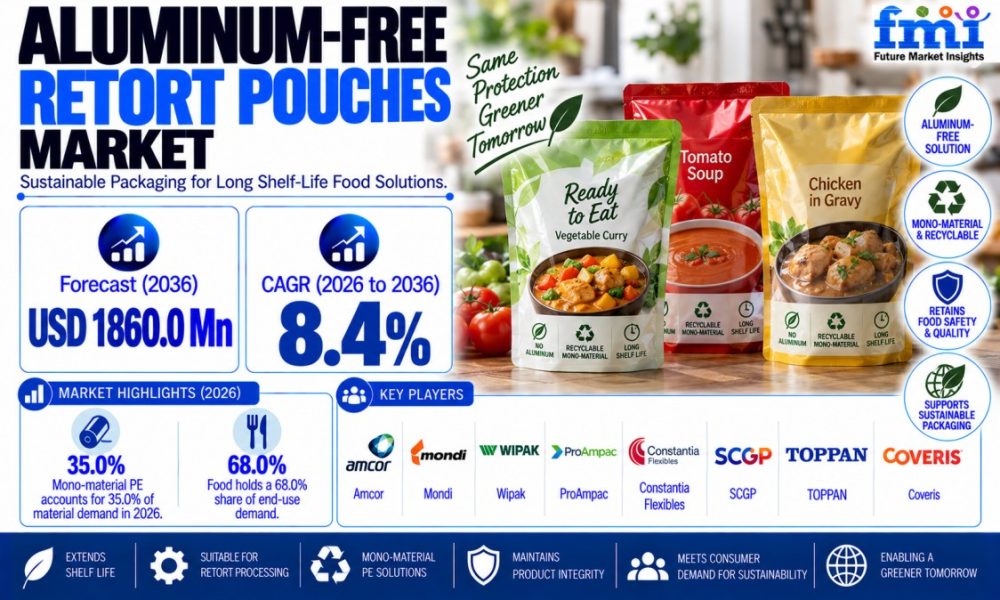
The global Aluminum-Free Retort Pouches Market is projected to grow from USD 832.5 million in 2026 to USD 1.86 billion by 2036, expanding at a 8.4% CAGR, according to Future Market Insights (FMI).
The market is being shaped by growing qualification activity for foil-free retort structures that can maintain barrier protection, seal reliability, and shelf life during commercial thermal processing. Food manufacturers are evaluating aluminum-free alternatives as packaging sustainability requirements increase and recyclable material structures gain attention.
The transition, however, involves more than replacing aluminum foil. Each new pouch structure needs to demonstrate reliable performance across sterilization, filling, storage, and distribution conditions.
>> Get Detailed Market Forecasts, Competitive Benchmarking, and Pricing Trends: https://www.futuremarketinsights.com/reports/sample/rep-gb-34134
Mono-Material PE Accounts for 35% of Material Demand
Mono-material PE is expected to represent 35.0% of material demand in 2026, supported by simpler polymer identification and improving barrier performance.
The material structure can reduce the number of polymer families that recovery systems need to identify while retaining the protection required for shelf-stable food applications.
Package engineers continue to evaluate oxygen protection and seal strength across specific food recipes rather than treating polymer composition alone as sufficient qualification.
Commercial production trials are therefore becoming an important part of material selection. Manufacturers need evidence that a structure can withstand sterilization and subsequent distribution without compromising package integrity.
Food Represents 68% of End-Use Demand
Food is projected to account for 68.0% of end-use demand in 2026, reflecting the recurring sterilization and ambient shelf-life requirements associated with prepared foods.
Sauces, ready meals, and other shelf-stable products create recurring demand once a pouch structure has successfully completed recipe-specific processing and shelf-life trials.
For food manufacturers, aluminum-free retort structures can provide an alternative route for packaging redesign while maintaining the requirements of commercial thermal processing.
The qualification process remains important because different recipes can have different acidity, fat content, processing temperatures, and shelf-life requirements.
Pouches Lead the Format Category
Pouches are projected to account for 11.0% of format demand in 2026.
Their compact structure can reduce storage space and shipping weight compared with rigid retort containers. However, flexible pouch walls also require controlled mechanical support during filling and commercial retorting.
Pilot filling and sealing facilities are helping package engineers evaluate seal windows, package deformation, and filling performance before commercial production changes are introduced.
This approach allows manufacturers to identify potential failures before scaling a new structure across a production portfolio.
Grease Resistance Supports Demanding Food Applications
Grease resistance is expected to represent 15.0% of the barrier or feature category in 2026.
Oil-rich sauces and prepared meals can expose seals and printed surfaces to moisture and fatty food components during filling and retorting.
Grease-resistant structures can help protect package appearance and reduce contamination around sealing areas. However, package engineers also need to assess grease exposure alongside oxygen protection, print adhesion, and seal durability.
The commercial requirement is therefore broader than a single barrier feature.
Qualification Remains a Major Consideration
One of the central challenges in aluminum-free retort pouch adoption is process validation.
Changing the pouch structure can influence heat transfer, seal behavior, and container performance during scheduled thermal processing. As a result, a material change can become part of food-safety validation rather than a routine packaging substitution.
The qualification process can increase both time and cost, particularly for manufacturers with large portfolios containing multiple recipes and container configurations.
Pilot-line support offers a practical route to address this challenge. Commercial trials can evaluate seal performance, shelf life, physical handling, and package behavior under real production conditions.
👉 Access the Complete Report in PDF Format: https://www.futuremarketinsights.com/reports/brochure/rep-gb-34134
India and the United States Show Strong Growth
Country-level forecasts indicate strong expansion across several major markets.
India is projected to grow at an 11.3% CAGR through 2036, supported by expanding prepared-food production, domestic film investment, and broader shelf-stable distribution.
The United States is projected to grow at 10.5% CAGR, supported by mature thermal-processing rules and an established flexible-packaging service network.
Other country forecasts include:
- United Kingdom: 9.7% CAGR
- Germany: 8.8%
- France: 8.0%
- Japan: 7.1%
The different regulatory and technical environments across these markets make local qualification and technical support important factors in commercialization.
Regulatory and Recyclability Requirements Influence Packaging Design
Packaging redesign is also being influenced by regulatory developments.
In Europe, recyclability assessment is becoming increasingly important in packaging design. Food manufacturers must balance recovery compatibility with the barrier and thermal-processing performance required for shelf-stable products.
In the United States, commercial processors of shelf-stable acidified and low-acid foods must comply with process-filing requirements that connect product, container configuration, and processing method.
These requirements reinforce the importance of documented process validation when introducing aluminum-free retort structures.
Competitive Landscape
The market includes Amcor, Mondi, Wipak, ProAmpac, Constantia Flexibles, SCGP, TOPPAN, and Coveris.
Competition is focused on high-barrier film development, mono-material structures, pouch conversion, pilot filling, and technical support.
Recent developments include Amcor’s expansion of high-barrier recyclable packaging capacity in Italy, Constantia Flexibles’ EcoVer Retort Pouch development, and Coveris’ acquisition of GEFO assets to expand cast-polypropylene film capabilities in Germany.
TOPPAN has also reported commercial adoption of an all-PP mono-material retort pouch for retort curry in Japan.
These developments illustrate the industry’s focus on moving aluminum-free structures from material development toward verified commercial production.
About the Aluminum-Free Retort Pouches Market Report
The FMI report analyzes the market by material, format, barrier or feature, end use, and region.
Materials include paper, molded fiber, recycled PET, mono-material PE, and bio-based polymers. Formats include pouches, trays, labels, mailers, and inserts. End-use categories include food, pharmaceutical, e-commerce, personal care, and cold chain.
The report covers North America, Latin America, Europe, East Asia, South Asia and Pacific, and the Middle East and Africa.
To explore how FMI Custom Research can support your strategic priorities, connect with our team at – [email protected]
About Future Market Insights (FMI)
Future Market Insights, Inc. is an ESOMAR-certified, ISO 9001:2015 market research and consulting organization trusted by Fortune 500 companies. With a global presence across the U.S., UK, India, and Dubai, FMI delivers data-driven insights across 30+ industries and 1200 markets worldwide.



