
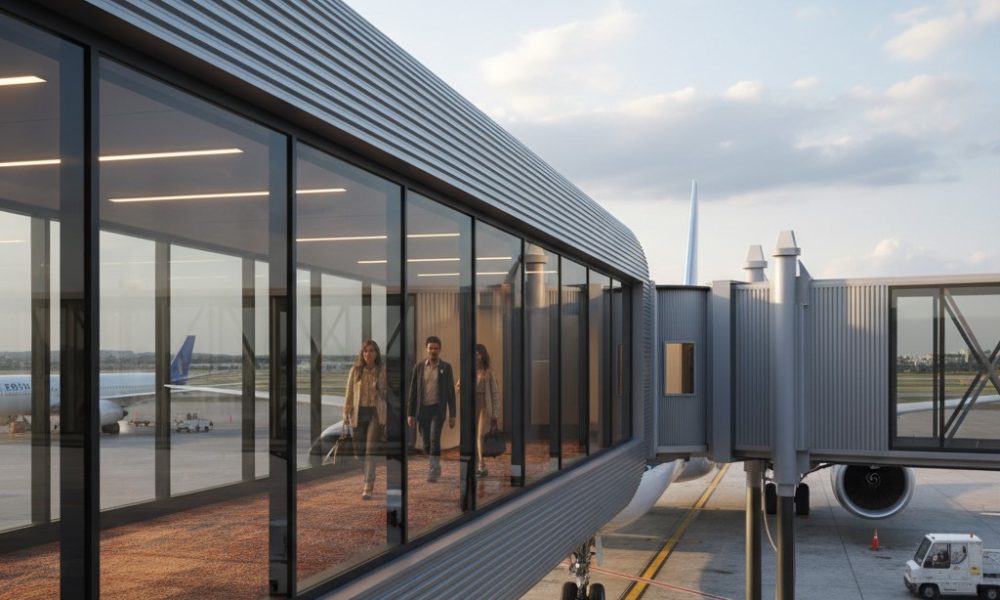
The global airport passenger boarding bridge (PBB) market is projected to grow from USD 2.3 billion in 2025 to USD 4.5 billion by 2035, registering a CAGR of 7.0%. Growth is driven by rising air passenger traffic, large-scale airport modernization projects, and the replacement of aging ground infrastructure. Demand for advanced, energy-efficient, and passenger-friendly boarding bridges continues to accelerate as airports prioritize safety, comfort, and operational efficiency.
Investments in terminal upgrades, coupled with technological innovations such as automated docking, climate-controlled tunnels, and modular designs, are reshaping the competitive landscape. Major players are focusing on long-term contracts, product innovation, and global collaborations to capture the market opportunity worth over USD 2.2 billion between 2025 and 2035.
Full Market Report available for delivery. For purchase or customization, please request here – https://www.futuremarketinsights.com/reports/sample/rep-gb-25086
Report Coverage & Deliverables
The report provides in-depth market insights covering:
- Market size and growth forecasts (2025–2035) with CAGR analysis.
- Breakpoints & absolute opportunity analysis, highlighting key phases of expansion.
- Segmental breakdown by type, model, tunnel type, docking type, foundation, and technology.
- Regional and country-level analysis across 40+ markets including China, India, USA, Germany, and the UK.
- Competitive landscape and company profiling, covering product strategies, innovations, and market positioning.
- Key deliverables include market share analysis, regulatory impact, technology adoption, and revenue forecasts by sub-segments.
Key Factors Shaping Market Dynamics
- Rising Air Traffic & Airport Modernization
Growing passenger numbers and fleet expansions are fueling demand for efficient, safe, and modern boarding solutions. - Technology & Automation
Integration of automated docking systems, smart controls, and IoT-based monitoring improves operational safety, reduces turnaround times, and enhances passenger experience. - Passenger Comfort & Experience
Adoption of air-conditioned tunnels and ergonomic boarding bridges is rising, especially in hot and humid regions, to improve passenger satisfaction. - Replacement Demand
Aging airport infrastructure across developed economies is creating strong replacement opportunities, driving the adoption of next-gen boarding bridges. - High Costs & Compliance Challenges
High installation and maintenance costs, along with stringent aviation safety regulations, remain barriers, particularly for smaller airports in emerging economies.
Key Takeaways
- Market value to rise from USD 2.3 billion in 2025 to USD 4.5 billion in 2035.
- CAGR forecast: 7.0% (2025–2035).
- Moving passenger boarding bridges lead the market with 55.4% share in 2025, favored for versatility and operational efficiency.
- Apron drive bridges account for 37.8% share in 2025, supporting wide adoption across new airport projects and terminal upgrades.
- Air-conditioned tunnels dominate with 61.2% share in 2025, reflecting growing emphasis on passenger comfort.
- Breakpoints identified in 2028–2029 and 2031–2032, where accelerated adoption and replacement demand drive incremental opportunities.
Regional Analysis
- China (CAGR 9.5%) – Leading market growth driven by massive airport expansion, government-backed aviation initiatives, and rising domestic passenger volumes.
- India (CAGR 8.8%) – Supported by private airport projects, rising air travel, and increasing deployment of mobile and telescopic bridges.
- Germany (CAGR 8.1%) – Strong adoption in premium international airports, supported by EU safety regulations and modernization programs.
- United Kingdom (CAGR 6.7%) – Moderate growth from replacement demand, with rising adoption of automated docking and smart boarding systems.
- United States (CAGR 6.0%) – A mature but stable market, dominated by replacement of aging infrastructure and integration with smart airport initiatives.
Together, Asia-Pacific, North America, and Europe account for the majority of global demand, while the Middle East and Africa present emerging opportunities due to new hub developments.
Key Segments of the Market Report
- By Boarding Bridge Type:
- Moving Passenger Boarding Bridge (dominant)
- Fixed Passenger Boarding Bridge
- By Model Type:
- Apron Drive Bridge (leading segment)
- Dual Boarding System, Commuter Bridge, Nose Loader Bridge, T-Bridge, Over-the-Wing Bridge
- By Tunnel Type:
- Air-Conditioned Tunnel (majority share)
- Non Air-Conditioned Tunnel
- By Docking Type:
- Intelligent Docking System
- Manual Docking System
- By Foundation:
- Fixed, Movable, Hydraulic, Electro-Mechanical
- By Technology:
- Hydraulic Bridges, Electrical Bridges, Fixed Tunnel Bridges
Competitive Landscape
The airport passenger boarding bridge market is competitive, with global and regional players focusing on innovation, cost-effectiveness, and compliance with international safety standards.
- CIMC-TianDa, HÜBNER GmbH, and ShinMaywa Industries focus on motorized, weather-resistant boarding bridges with advanced docking precision.
- AERO Bridgeworks, ADELTE, and TK Elevator (thyssenkrupp) emphasize automation, modularity, and energy-efficient drive systems.
- John Bean Technologies (JBT), UBS Airport Systems, and Mitsubishi Heavy Industries are enhancing operator control systems, durability, and integration with smart airport technologies.
- FMT Aircraft AB and Oshkosh AeroTech target modular and rapid-deployment solutions for busy international airports.
Key strategies include partnerships with airport authorities, product customization for diverse aircraft fleets, and expansion of after-sales service networks. Brochures and datasheets highlight load capacity, telescopic extension, safety interlocks, energy efficiency, and modularity as critical differentiators in procurement decisions.
Stay Ahead – Grab the Report: https://www.futuremarketinsights.com/reports/brochure/rep-gb-25086
About Future Market Insights (FMI)
Future Market Insights, Inc. (ESOMAR certified, recipient of the Stevie Award, and a member of the Greater New York Chamber of Commerce) offers profound insights into the driving factors that are boosting demand in the market. FMI stands as the leading global provider of market intelligence, advisory services, consulting, and events for the Packaging, Food and Beverage, Consumer Technology, Healthcare, Industrial, and Chemicals markets. With a vast team of over 400 analysts worldwide, FMI provides global, regional, and local expertise on diverse domains and industry trends across more than 110 countries.



