
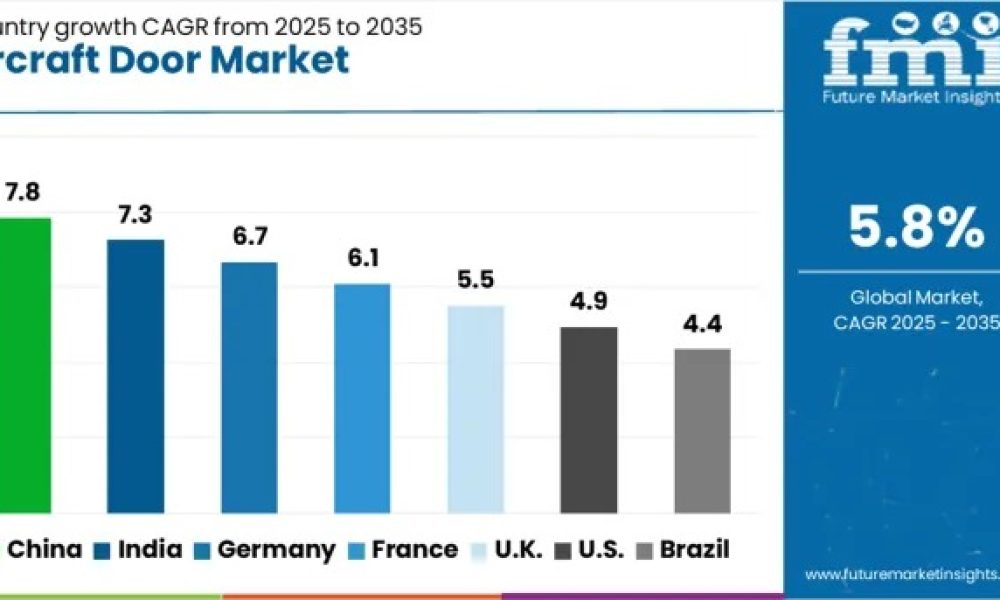
The global Aircraft Door Market is positioned for steady expansion, with market value projected to grow from USD 6.3 billion in 2025 to USD 11.1 billion by 2035, registering a compound annual growth rate (CAGR) of 5.8% over the forecast period. This growth reflects rising aircraft production rates, increasing passenger traffic, and the aviation industry’s accelerating focus on lightweight, high-durability components that improve operational efficiency and fuel performance.
Between 2025 and 2030, the market is expected to increase from USD 6.3 billion to USD 8.3 billion, supported by consistent year-on-year improvements. Market value is forecast to reach USD 6.7 billion in 2026, USD 7.0 billion in 2027, and USD 7.5 billion by 2028, before expanding to USD 7.9 billion in 2029 and USD 8.3 billion by 2030. These gains are being driven by growing global aircraft fleet sizes and heightened requirements for safety, reliability, and faster turnaround times in commercial operations.
Lightweight Materials and Advanced Sealing Systems Reshape Door Engineering
A key growth engine of the aircraft door market is the industry-wide shift toward composite and hybrid materials that significantly reduce structural weight while preserving strength, fatigue resistance, and pressurization integrity. Door manufacturers are increasingly adopting advanced carbon fiber-reinforced polymers, aluminum-lithium alloys, and fire-resistant composites to meet both fuel efficiency targets and stringent aviation safety standards.
Technological innovation is reshaping aircraft door architectures through the integration of enhanced sealing systems, electric and electro-hydraulic actuation, and intelligent locking mechanisms. These advancements improve cabin pressurization control, reduce air leakage, and enhance real-time system monitoring, enabling safer and more reliable door performance throughout the aircraft lifecycle.
Subscribe for Year-Round Insights → Stay ahead with quarterly and annual data updates
https://www.futuremarketinsights.com/reports/sample/rep-gb-23392
Commercial Aircraft Segment Maintains Dominant Market Position
The commercial aircraft segment is projected to command 63.5% of total market revenue in 2025, establishing it as the largest contributor to global demand. Rising air passenger volumes, strong narrow-body and wide-body aircraft order backlogs, and ongoing airline fleet modernization programs are reinforcing this leadership.
Commercial aircraft require multiple door configurations, including passenger, cargo, service, and emergency exit doors, which increases unit door demand per aircraft compared to other platforms. Next-generation aircraft featuring composite fuselages and higher cabin pressurization requirements have further elevated the strategic importance of advanced door systems.
Passenger Doors Lead by Door Type as Safety Regulations Tighten
Passenger doors are expected to account for 38.7% of total market share in 2025, driven by their mandatory inclusion in all commercial aircraft and their critical role in boarding, deplaning, and emergency evacuation. These doors are engineered to meet rigorous standards related to structural integrity, rapid opening, pressure sealing, and fail-safe locking.
Innovations such as smart pressure sensors, plug-type mechanisms, and automated locking systems are improving operational reliability while reducing the risk of human error. Manufacturers are increasingly focusing on seamless fuselage integration to balance structural strength with aerodynamic performance and fuel efficiency.
Hydraulic Actuation Systems Remain the Industry Standard
Hydraulic operating mechanisms are forecast to represent 71.2% of total market revenue in 2025, reflecting their proven reliability in managing high-load doors under extreme altitude and temperature variations. Hydraulic systems offer superior force transmission and consistent sealing performance, making them essential for large passenger and cargo doors.
Recent design improvements, including compact actuators and built-in redundancy systems, have enhanced durability and safety performance. While electric actuation systems are gaining attention due to lower maintenance requirements, hydraulic systems continue to dominate heavy-duty, high-frequency aircraft door applications.
Asia-Pacific Emerges as the Fastest-Growing Regional Market
Regional analysis highlights Asia-Pacific as the most dynamic growth hub. China is projected to grow at a 7.8% CAGR, supported by rapid commercial aviation expansion, domestic aircraft production, and government initiatives to strengthen local aerospace capabilities. India follows closely at 7.3% CAGR, driven by rising air travel demand, growth in low-cost carriers, and increasing localization of aircraft manufacturing.
Germany records a 6.7% CAGR, benefiting from advanced engineering capabilities and strong investments in composite materials. The United Kingdom grows at 5.5% CAGR, while the United States expands at 4.9% CAGR, reflecting steady demand in mature markets that are increasingly focused on fuel efficiency, safety, and next-generation door technologies.
Competitive Landscape Driven by Innovation and OEM Integration
The aircraft door market is characterized by strong competition among global OEMs and Tier-1 suppliers. Leading manufacturers such as Airbus SE, Mitsubishi Heavy Industries Ltd., Bombardier Aerospace, Elbit Systems Ltd., and Saab AB are investing aggressively in lightweight materials, automation-ready designs, and smart door technologies. Their focus on reliability, structural integrity, and digital integration is defining the next generation of aircraft door systems.
Emerging and specialized players, including Hellenic Aerospace Industry, KF Aerospace, and CHC Group Ltd., are strengthening their positions by offering customized solutions and retrofit-focused products to serve regional, business, and military aircraft segments.
Market Outlook
With ongoing investments in electric actuation, smart automation, advanced composites, and digital health monitoring, aircraft door systems are evolving from purely structural components into intelligent subsystems that support aircraft safety, efficiency, and operational agility. As aircraft platforms become more technologically advanced and regulatory frameworks tighten globally, demand for high-performance, lightweight, and automated aircraft door solutions is expected to accelerate steadily through 2035.
About Future Market Insights (FMI)
Future Market Insights, Inc. (FMI) is an ESOMAR-certified, ISO 9001:2015 market research and consulting organization, trusted by Fortune 500 clients and global enterprises. With operations in the U.S., UK, India, and Dubai, FMI provides data-backed insights and strategic intelligence across 30+ industries and 1200 markets worldwide.



