
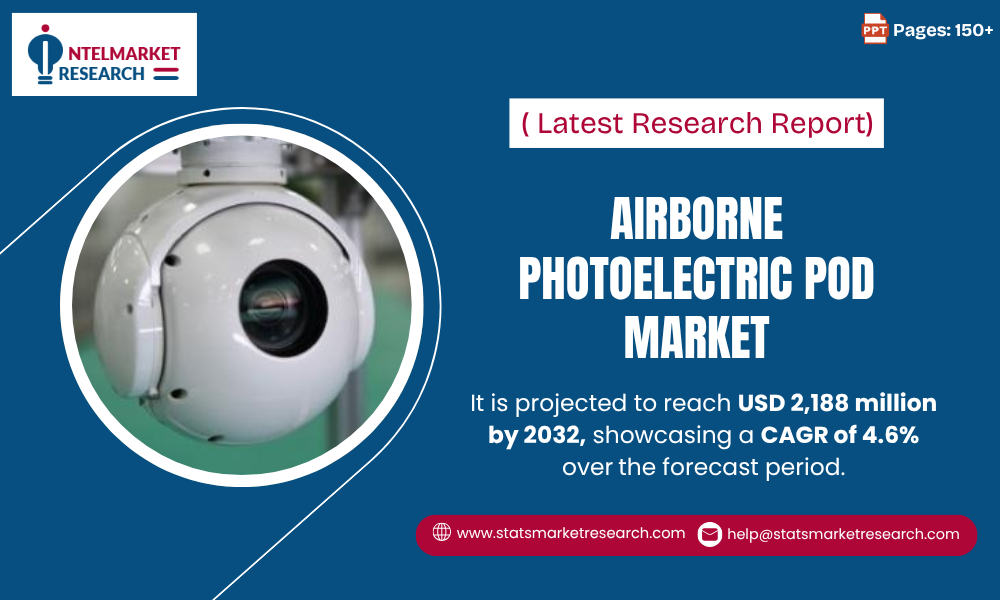
Definition
Airborne Photoelectric Pods are sophisticated electro-optical systems designed to be mounted on various aerial platforms, including unmanned aerial vehicles (UAVs), helicopters, and fixed-wing aircraft. These pods integrate multiple sensor technologies such as electro-optical (EO) cameras, infrared (IR) imagers, laser rangefinders, and laser designators, enabling real-time surveillance, target tracking, reconnaissance missions, and data collection across diverse operational environments.
Traditionally, these pods have been predominantly utilized for military applications, providing critical support for intelligence, surveillance, and reconnaissance (ISR) operations. They are essential for modern defense strategies, offering enhanced situational awareness, accurate target acquisition, and precision strike capabilities.
However, recent technological innovations and the rise of commercial UAVs have expanded their applications into civilian sectors, including border security, disaster management, environmental monitoring, infrastructure inspections, and agriculture. Advanced AI integration now allows these pods to perform automated object recognition, multispectral imaging, and data fusion, greatly enhancing operational efficiency while reducing the need for human intervention.
In essence, airborne photoelectric pods serve as multi-functional, modular sensor platforms capable of delivering high-resolution imagery and real-time analytics in both military and civilian domains.
Recent Developments in Airborne Photoelectric Pod Market
Recent developments in the Airborne Photoelectric Pod market are heavily driven by technological convergence and military modernization. A primary trend is the integration of Artificial Intelligence (AI) and Machine Learning (ML) into these systems for enhanced real-time data analysis, automated target recognition, and improved decision-making. Furthermore, manufacturers are focusing on miniaturization and lightweight design, which is essential for the increasing adoption of these pods onto smaller Unmanned Aerial Vehicles (UAVs) without compromising performance. Multi-sensor fusion, incorporating technologies like hyperspectral and multispectral imaging alongside traditional Electro-Optical/Infrared (EO/IR) sensors, is also a key development to boost situational awareness and target precision.
Market Size
Global airborne photoelectric pod market was valued at USD 1,639 million in 2024 and is projected to reach USD 2,188 million by 2032, registering a CAGR of 4.6% over the forecast period.
Get FREE Sample of this Report at https://www.intelmarketresearch.com/download-free-sample/1917/airborne-photoelectric-pod-2025-2032-514
Historical and Current Trends
- Military Investment: The surge in global defense expenditure has significantly boosted demand. For example, global military spending reached USD 2.72 trillion in 2024, reflecting a 9.4% year-on-year increase, the highest since the Cold War era. A significant portion of this budget is allocated toward ISR systems, where airborne photoelectric pods play a crucial role.
- Commercial Drone Market: The rise of professional drones has created new revenue streams. The global commercial drone market exceeded USD 22 billion in 2023, with photoelectric pods being a fast-growing accessory segment for thermal mapping, infrastructure inspections, and precision agriculture.
- Technological Advancements: AI-powered analytics, miniaturization, multispectral imaging, and multi-sensor fusion are enhancing the pods’ value proposition. These improvements support long-range detection, low-visibility operations, and rapid data processing, making them attractive across both defense and civilian sectors.
Future Projections
- By 2030, the market is expected to experience steady growth driven by UAV adoption, increased defense modernization programs, and civilian surveillance applications.
- The AI-integrated pods segment is anticipated to lead future growth due to its capacity for autonomous threat recognition and predictive maintenance, offering measurable efficiency gains over conventional systems.
Regional Analysis
The global airborne photoelectric pod market exhibits significant regional variations based on defense expenditure, UAV adoption, and industrial growth.
North America
- Dominant Market Player: The U.S. leads in military investments, particularly in ISR systems. Key players include Teledyne FLIR, Lockheed Martin, and Northrop Grumman, focusing on AI-enabled, multi-sensor pod systems.
- Market Drivers: High defense budgets, a growing UAV ecosystem, and stringent border security initiatives.
- Market Trend: Increasing integration of AI analytics and high-resolution EO/IR sensors to reduce response times and enhance precision targeting.
Europe
- Key Players: Germany’s Hensoldt, France’s Thales, Italy’s Leonardo, and the U.K.’s BAE Systems dominate.
- Growth Factors: European nations emphasize advanced surveillance for both defense and civilian purposes, including maritime security, disaster response, and industrial monitoring.
- Market Trend: Development of compact, multi-spectral pods suitable for UAVs and light helicopters, aligned with EU dual-use technology policies.
Asia-Pacific
- Emerging Market Leader: China’s AVIC Jonhon Optronic Technology is expanding rapidly due to domestic defense modernization programs.
- Market Opportunities: Rising defense budgets in India, Japan, South Korea, and Australia, combined with UAV proliferation, are driving demand.
- Trend: Focus on cost-effective solutions compatible with both legacy and modern aerial platforms.
Middle East & Africa
- Growth fueled by geopolitical tensions, border surveillance needs, and rising defense expenditure.
- Civilian applications in oil & gas infrastructure monitoring, disaster management, and environmental surveillance are gaining traction.
Latin America
- Market Characteristics: Slower adoption due to budget constraints; however, increasing UAV usage in agriculture and environmental monitoring is gradually creating demand.
Global Airborne Photoelectric Pod: Market Segmentation Analysis
This report provides a deep insight into the global Airborne Photoelectric Pod market, covering all its essential aspects. This ranges from a macro overview of the market to micro details of the market size, competitive landscape, development trend, niche market, key market drivers and challenges, SWOT analysis, value chain analysis, etc.
The analysis helps the reader to shape the competition within the industries and strategies for the competitive environment to enhance the potential profit. Furthermore, it provides a simple framework for evaluating and assessing the position of the business organization. The report structure also focuses on the competitive landscape of the Global Airborne Photoelectric Pod. This report introduces in detail the market share, market performance, product situation, operation situation, etc., of the main players, which helps the readers in the industry to identify the main competitors and deeply understand the competition pattern of the market.
Market Segmentation (by Application)
- National Defense
- Air Traffic Control
- Drone Industry
- Environmental Monitoring
- Disaster Management
Market Segmentation (by Type)
- Multispectral
- Hyperspectral
- Infrared
- Electro-optical
Key Company
- Teledyne FLIR (U.S.)
- Hensoldt (Germany)
- AVIC Jonhon Optronic Technology (China)
- Lockheed Martin (U.S.)
- Thales (France)
- Rafael Advanced Defense Systems Ltd. (Israel)
- Northrop Grumman (U.S.)
- Elbit Systems (Israel)
- BAE Systems (U.K.)
- Leonardo (Italy)
- Safran (France)
- Israel Aerospace Industries (Israel)
- Aselsan (Turkey)
- Elcarim Optronic (Israel)
- Wuhan Guide Infrared (China)
Get the Complete Report & TOC at https://www.intelmarketresearch.com/aerospace-and-defense/1917/airborne-photoelectric-pod-2025-2032-514
FAQ
Q1: What is the current market size of the Airborne Photoelectric Pod market?
A1: The market was valued at USD 1,639 million in 2024 and is projected to reach USD 2,188 million by 2032, growing at a CAGR of 4.6%.
Q2: Which are the key companies operating in the Airborne Photoelectric Pod market?
A2: Key players include Teledyne FLIR, Hensoldt, AVIC Jonhon Optronic Technology, Lockheed Martin, Thales, Rafael Advanced Defense Systems, Northrop Grumman, Elbit Systems, BAE Systems, Leonardo, Safran, Israel Aerospace Industries, Aselsan, Elcarim Optronic, and Wuhan Guide Infrared.
Q3: What are the key growth drivers in the Airborne Photoelectric Pod market?
A3: Major growth drivers include rising defense expenditure, increased UAV deployment, AI-enhanced pod capabilities, and civilian adoption for disaster management, border security, and environmental monitoring.
Q4: Which regions dominate the Airborne Photoelectric Pod market?
A4: North America dominates due to high defense spending and UAV integration, followed by Europe and Asia-Pacific, which are rapidly adopting advanced pod technologies.
Q5: What are the emerging trends in the Airborne Photoelectric Pod market?
A5: Emerging trends include AI integration, multi-sensor fusion, miniaturization for UAVs, dual-use civilian applications, and enhanced low-visibility performance.
About Us
Intel Market Research is a leading provider of strategic intelligence, offering actionable insights in information technology, digital media solutions, and communication infrastructure. Our research capabilities include:
- Real-time competitive benchmarking
- Global technology adoption monitoring
- Country-specific regulatory and market analysis
- Over 500+ technology reports annually
Trusted by Fortune 500 companies, our insights empower decision-makers to drive innovation with confidence.
🌐 Website: https://www.intelmarketresearch.com
📞 International: +1 (332) 2424 294
📞 Asia-Pacific: +91 9169164321
🔗 LinkedIn: Follow Us




