
Overview
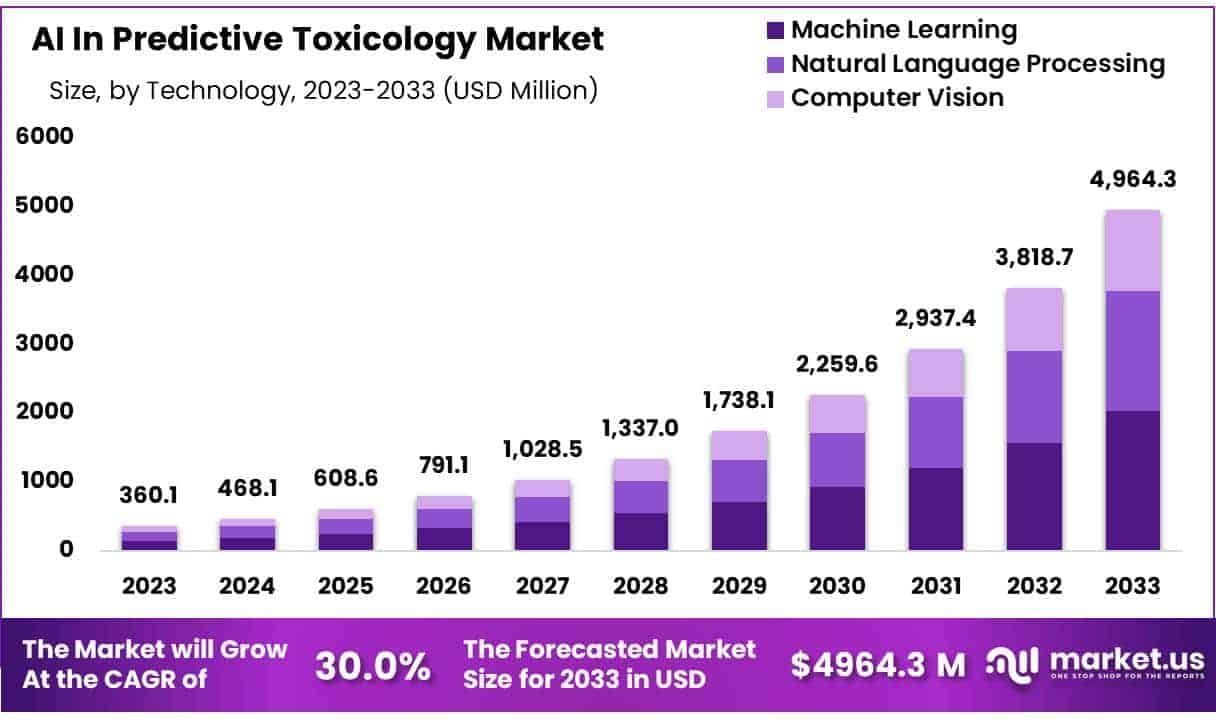
The Global AI In Predictive Toxicology Market size is expected to be worth around USD 4,964.3 Million by 2033 from USD 360.1 Million in 2023, growing at a CAGR of 30.0% during the forecast period from 2024 to 2033.
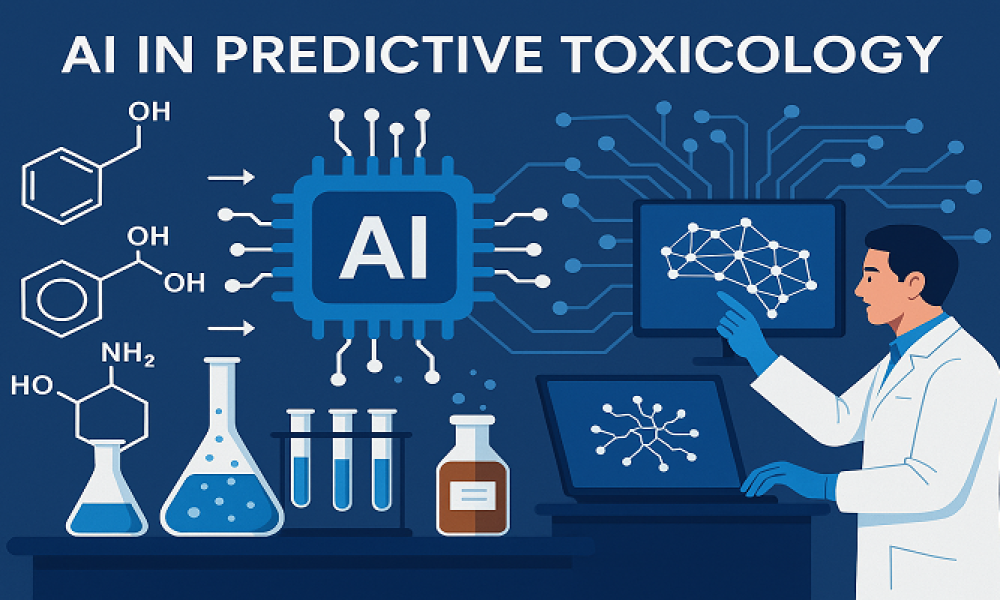
The integration of Artificial Intelligence (AI) in predictive toxicology is revolutionizing the way chemical, pharmaceutical, and environmental risks are evaluated. Predictive toxicology uses computational models to forecast the toxic effects of substances without relying solely on animal testing or time-consuming clinical trials. The application of AI technologies such as machine learning, deep learning, and natural language processing enables the rapid analysis of vast toxicological datasets, leading to more accurate, efficient, and ethical toxicity assessments.
AI models are trained using historical toxicity data and molecular descriptors to identify patterns and predict adverse outcomes such as hepatotoxicity, carcinogenicity, or neurotoxicity. This significantly enhances early-stage drug development, environmental safety evaluations, and regulatory decision-making. Key AI tools also aid in reducing the cost and duration of toxicology studies while ensuring compliance with stringent regulatory frameworks like REACH (Registration, Evaluation, Authorisation and Restriction of Chemicals) and OECD guidelines.
The global AI in predictive toxicology market is poised for robust growth due to increasing demand for safer product development and regulatory pressure to minimize animal testing. Leading stakeholders include pharmaceutical companies, environmental agencies, academic institutions, and AI startups specializing in cheminformatics and bioinformatics.
As data availability increases and algorithms improve, AI-driven predictive toxicology is expected to play a central role in shaping future toxicology research and public health protection strategies.
Click here to get a Sample report copy @ https://market.us/report/ai-in-predictive-toxicology-market/free-sample/
Key Takeaways
- Market Size: The global AI in Predictive Toxicology market was valued at USD 360.1 million in 2023 and is projected to reach approximately USD 4,964.3 million by 2033.
- Market Growth: The market is anticipated to expand at a strong compound annual growth rate (CAGR) of 30.0% during the forecast period from 2024 to 2033.
- Technology Analysis: In 2023, machine learning emerged as the leading technology, capturing 41% of the total market share due to its superior data modeling and prediction capabilities.
- Toxicity Endpoint Analysis: Genotoxicity remained the most assessed toxicity endpoint in 2023, accounting for a significant 35% share of the overall market.
- Component Analysis: Solution-based offerings dominated the market landscape, contributing 61% of the total revenue in 2023, driven by the increasing demand for integrated software platforms.
- End-User Analysis: Corporate entities, including pharmaceutical and biotechnology firms, represented the largest end-user segment, holding 53% of the market share in 2023.
- Regional Analysis: North America led the global market in 2023, commanding approximately 44% of total revenue, supported by advanced healthcare infrastructure, strong regulatory frameworks, and high investment in AI research.
Segmentation Analysis
- Technology Analysis: The AI in Predictive Toxicology Market is witnessing strong growth, led by machine learning, which held 41% of the market share in 2023. These algorithms enable efficient analysis of complex biological data and enhance drug safety assessments. Natural language processing aids in extracting insights from vast toxicology databases, improving prediction accuracy. Additionally, computer vision is increasingly used for histopathological image analysis, providing deeper insight into tissue toxicity while reducing reliance on traditional animal testing methods.
- Toxicity Endpoint Analysis: In 2023, genotoxicity emerged as the leading toxicity endpoint, accounting for 35% of the market share. This highlights the importance of evaluating genetic mutation risks during early drug development. AI tools also showed growing application in predicting hepatotoxicity, neurotoxicity, and cardiotoxicity. These models identify organ-specific toxicity risks with high accuracy, reducing animal testing. The adoption of AI technologies streamlines regulatory compliance, enhances safety profiling, and supports the efficient development of safer therapeutic compounds.
- Component Analysis: Solutions dominated the AI in Predictive Toxicology market in 2023, contributing 61% of total revenue. These AI-powered software platforms support early toxicity prediction, helping reduce development costs and accelerate timelines. By leveraging machine learning and large toxicological datasets, solutions offer improved accuracy and decision-making capabilities. Services such as implementation and consultation also play a vital role, enabling integration and customization of AI tools within drug discovery workflows. Demand for both components is expected to grow significantly.
- End User Analysis: Companies accounted for 53% of the market share in 2023, making them the largest end-user group. Pharmaceutical, chemical, and cosmetics firms rely on AI to predict compound toxicity early in development, minimizing risk and improving regulatory outcomes. AI supports high-throughput screening and enhances product safety. Research institutions are adopting AI for toxicology innovation, while agriculture and food sectors are exploring similar applications. This broad usage reinforces AI’s role in advancing cross-industry safety and efficiency.
Market Segments
By Technology
- Machine Learning
- Natural Language Processing
- Computer Vision
By Toxicity Endpoints
- Genotoxicity
- Hepatotoxicity
- Neurotoxicity
- Cardiotoxicity
By Component
- Solution
- Services
By End User
- Pharma and Biotechnology Companies
- Chemical and Cosmetics
- Research Organization
- Others
To Purchase this Premium Report @ https://market.us/purchase-report/?report_id=125030
Regional Analysis
In 2023, North America accounted for approximately 44% of the global revenue share in the AI in Predictive Toxicology market. This dominant position is supported by the region’s robust pharmaceutical industry and growing demand for efficient drug development processes. Pharmaceutical companies are actively adopting AI technologies to enhance predictive toxicology capabilities, enabling faster and more accurate toxicity assessments.
AI integration allows for accelerated drug discovery and optimization of research workflows, while simultaneously reducing development costs. These efficiencies are driving widespread adoption across major pharmaceutical firms. The region’s competitive pharmaceutical landscape and continuous innovation culture further contribute to the growing reliance on advanced AI tools.
The increasing application of AI reflects a strategic commitment to improving safety, reducing time-to-market, and enhancing regulatory compliance. As AI technologies continue to advance, their role in predictive toxicology is expected to expand, offering significant opportunities for innovation and sustained market growth in North America.
Key Players Analysis
Key players in the AI in Predictive Toxicology market are spearheading innovation by integrating cutting-edge technologies into their research and development efforts. Their primary focus lies in improving the accuracy and efficiency of toxicity predictions through advanced AI-driven platforms. These companies are making substantial investments in machine learning algorithms and high-throughput screening tools to enable early-stage toxicity assessments, thereby reducing the time and cost associated with conventional testing approaches.
To maintain a competitive edge, leading firms are actively collaborating with academic institutions and research organizations. Such partnerships foster continuous technological advancement and help tailor AI solutions to meet the evolving needs of the pharmaceutical, chemical, and cosmetic industries. These companies are also expanding their AI capabilities to address a wide array of toxicity endpoints and regulatory compliance demands.
By consistently advancing AI models and delivering reliable, precise predictions, these market leaders are strengthening safety evaluation processes and enhancing the overall efficiency of drug development pipelines. Their commitment to innovation and regulatory alignment ensures a strong and sustained presence in the global predictive toxicology landscape.
Market Key Players
- Benevolent AI
- Berg Health
- Biovista
- Cyclica
- Exscientia PLC
- Insilico Medicine
- Instem plc
- Lhasa Limited
- Recursion Pharmaceuticals
Market Dynamics
Market Driver: The key driver of the AI in Predictive Toxicology market is the growing demand for faster and more cost-effective toxicity assessments in drug development. Traditional methods are time-consuming, expensive, and often rely on animal testing. AI models enable early-stage toxicity prediction using large datasets and machine learning, significantly improving accuracy and reducing development timelines. This efficiency is especially critical in pharmaceutical R&D, where rapid decision-making is essential. Regulatory support for alternative testing methods also strengthens market growth.
Market Trend: A prominent trend in the AI in Predictive Toxicology market is the integration of multi-modal data sources into AI models. Companies are increasingly combining omics data, chemical structures, imaging, and clinical records to improve the predictive power of toxicity assessments. The rise of explainable AI (XAI) is also gaining momentum, enabling researchers to understand the rationale behind toxicity predictions. This trend enhances transparency, builds trust in AI applications, and aligns well with evolving regulatory expectations in safety evaluation.
Market Opportunity: A significant opportunity lies in the expansion of AI applications across non-pharmaceutical sectors, including chemicals, cosmetics, food safety, and agriculture. As global regulatory bodies tighten restrictions on animal testing, industries are adopting AI-driven toxicity models to ensure compliance and safety. Emerging markets, particularly in Asia-Pacific and Latin America, present untapped potential due to increasing R&D investments and digital infrastructure. This creates a favorable environment for AI solution providers to scale operations and introduce innovative predictive tools.
Conclusion
The AI in Predictive Toxicology market is undergoing rapid transformation, driven by technological advancements, rising regulatory pressures, and a strong demand for safer, faster, and cost-effective toxicity assessments. With machine learning, NLP, and computer vision at the core, AI is enabling high-accuracy predictions while reducing reliance on traditional testing methods.
North America leads the global landscape, while emerging markets present strong future opportunities. As key players continue to innovate and expand their AI capabilities, the market is well-positioned for sustained growth, revolutionizing toxicology practices across pharmaceutical, chemical, and broader life sciences industries.
View More Reports:
AI in Endoscopy Market Set for Explosive Growth, Hitting USD 838.9 Million by 2033
Hospital Services Market Sector Forecasted to Hit USD 24.1 Trillion by 2033
Pediatric Drugs Market to Hit USD 95.4 Billion by 2033, Reports 12.7% CAGR



