
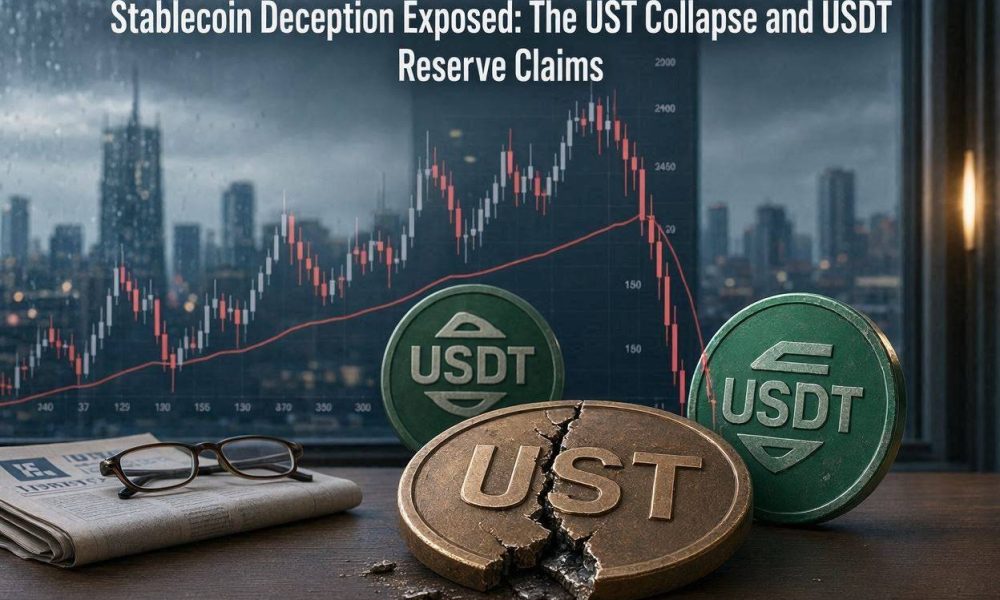
Terraform Labs’ algorithmic meltdown, federal settlements involving Terraform and Tether, and the substantial financial risks concealed behind reassuring “one-to-one” stablecoin narratives.
WASHINGTON, July 22, 2026 — Stablecoins are marketed as dependable bridges between traditional money and digital finance, yet the collapse of Terraform Labs’ TerraUSD and enforcement actions involving Tether revealed how identical one-dollar prices can conceal profoundly different reserves, redemption rights, governance systems, and failure risks.
TerraUSD, commonly identified by the ticker UST, attempted to preserve its dollar value through an algorithmic relationship with Terraform’s volatile LUNA token, whereas Tether’s USDT depends upon reserve assets controlled by a centralized issuer that promises redemption under established contractual conditions.
Those contrasting structures produced different controversies, but both challenged the comforting assumption that every token trading near one dollar represents an ordinary digital dollar supported continuously by equivalent cash sitting untouched within a regulated bank account.
Terraform’s collapse ultimately destroyed tens of billions of dollars in market value, destabilized interconnected cryptocurrency businesses, and generated civil and criminal consequences, while Tether paid substantial regulatory settlements addressing historical statements concerning the composition and sufficiency of reserves supporting USDT.
Understanding these events requires separating algorithmic stabilization from asset-backed issuance, temporary market pricing from legally enforceable redemption, promotional language from audited evidence, and a token’s visible exchange value from the financial condition of the organization responsible for maintaining it.
Stablecoins Promise Simplicity Within a Complicated Market
Stablecoins became essential cryptocurrency infrastructure because traders needed digital instruments capable of moving quickly between exchanges, settling blockchain transactions, preserving nominal dollar value, supporting decentralized lending, and avoiding repeated conversions through slower conventional banking networks.
The simplest marketing narrative presented each token as equivalent to one American dollar, encouraging users to treat stablecoins like electronic cash even when issuers operated through offshore companies, invested reserves, restricted redemptions, or depended upon market incentives rather than direct asset backing.
That narrative concealed important legal distinctions because a stablecoin holder may possess a contractual claim against an issuer, a transferable token redeemable only through qualified intermediaries, an unsecured financial interest, or merely an asset whose price depends upon continuing market confidence.
Stablecoin safety therefore cannot be measured exclusively by observing whether a token currently trades at $1.00, since stable prices can persist until concentrated redemptions, falling collateral values, banking interruptions, technological failures, or confidence shocks expose weaknesses that ordinary trading never revealed.
TerraUSD Was Not Backed Like a Conventional Dollar Token
TerraUSD did not promise that every circulating UST token corresponded with one dollar held within a segregated bank account, because its stability mechanism depended principally upon an arbitrage relationship allowing users to exchange UST and LUNA according to protocol rules.
When UST traded below one dollar, traders were expected to purchase discounted UST and exchange it for one dollar’s worth of LUNA, theoretically reducing UST supply while creating profitable arbitrage that pulled the stablecoin’s market price upward.
When UST traded above one dollar, participants could exchange LUNA for newly created UST and sell that UST at a premium, increasing circulating supply until competition returned the token toward its intended dollar price.
The design appeared elegant while market confidence remained strong, although its reliability depended upon continuing demand for LUNA, functioning arbitrage markets, sufficient transaction capacity, trustworthy governance, and widespread belief that newly created LUNA would retain meaningful value during severe stress.
The Algorithm Created a Dangerous Feedback Loop
An algorithmic stablecoin can enter a self-reinforcing decline when holders lose confidence, because falling stablecoin demand creates additional volatile tokens, the expanding volatile-token supply depresses market prices, and those declining prices further weaken confidence in the stabilization mechanism.
TerraUSD’s structure became vulnerable to precisely that dynamic because enormous UST redemptions required the creation of increasing quantities of LUNA, causing dilution that undermined the asset expected to absorb the stablecoin’s mounting exit pressure.
As LUNA’s value collapsed, the system needed to create progressively larger quantities to provide each departing UST holder with one dollar of theoretical value, transforming an orderly arbitrage mechanism into an accelerating cycle of issuance, selling, dilution, and panic.
The mechanism consequently resembled an emergency exit whose capacity disappeared as more people attempted to use it, because the collateral-like token supporting redemption lost value at the same moment demand for reliable support became most urgent.
Anchor Protocol Encouraged Extraordinary UST Demand
Terraform’s ecosystem expanded rapidly because the Anchor Protocol offered yields approaching 20% annually on deposited UST, creating a powerful financial incentive for investors to acquire and retain the stablecoin regardless of whether organic borrowing activity could sustainably generate those returns.
Such yields attracted retail customers, professional investors, cryptocurrency funds, and decentralized-finance participants who regarded UST as both a stable dollar substitute and an unusually profitable savings instrument within an environment offering minimal returns through conventional bank deposits.
The apparent combination of stability, liquidity, and exceptional yield should have invited intense skepticism, because sustainable returns ordinarily require borrowers, business profits, investment gains, subsidies, or risk-bearing activities capable of producing enough revenue to compensate depositors.
Instead, promotional enthusiasm frequently emphasized innovation and community growth while giving insufficient attention to the subsidies supporting Anchor’s yields, the concentration of UST demand within one application, and the destabilizing consequences that could follow declining incentive payments.
The May 2022 Collapse Destroyed the Peg
During May 2022, substantial withdrawals and selling pressure pushed UST below its intended dollar value, triggering arbitrage activity that failed to restore lasting confidence while rapidly expanding LUNA’s circulating supply and destroying the token’s market price.
The stablecoin’s decline accelerated as investors attempted to leave simultaneously, exchanges suspended or restricted certain transactions, blockchain operations experienced interruptions, and the market recognized that algorithmic incentives could not provide dependable redemption when confidence in both connected tokens disappeared.
UST eventually traded for only a small fraction of one dollar, while LUNA suffered near-total value destruction despite previously ranking among the cryptocurrency market’s most valuable assets and supporting an ecosystem promoted as a significant alternative financial network.
The collapse erased approximately $40 billion in combined market value, inflicted devastating personal losses, and intensified a cryptocurrency credit crisis that later affected lenders, hedge funds, exchanges, token projects, and customers who never knowingly invested directly within Terra.
Terraform’s Stability Representations Faced Federal Scrutiny
The Securities and Exchange Commission alleged that Terraform Labs and co-founder Do Kwon deceived investors concerning TerraUSD’s stability, the commercial adoption of Terraform’s blockchain technology, and the circumstances surrounding an earlier restoration of the stablecoin’s dollar peg.
Federal evidence showed that a third-party trading organization had intervened by purchasing UST during a previous destabilization, although Terraform publicly presented the recovery as proof that the protocol’s automated mechanism had successfully restored the peg without outside assistance.
That distinction was material because investors evaluating an algorithmic system needed to know whether stabilization occurred naturally through transparent protocol incentives or resulted from undisclosed market intervention arranged with a sophisticated external participant.
A jury found Terraform and Kwon liable for civil fraud during April 2024, establishing that the case concerned more than an experimental technology that failed unexpectedly because material representations surrounding its reliability and adoption had misled cryptocurrency investors.
The SEC Settlement Reached Approximately $4.47 Billion
Terraform subsequently agreed to a settlement valued at approximately $4.47 billion, including disgorgement, prejudgment interest, and a substantial civil penalty, while Kwon accepted separate monetary obligations and restrictions connected with the federal judgment.
A Reuters report examining the Terraform settlement explained that the resolution followed a jury’s fraud findings and required the bankrupt company to wind down operations, although actual creditor recoveries depended upon available assets and bankruptcy priorities.
The headline settlement amount did not mean Terraform possessed billions of liquid dollars ready for immediate distribution, because the company’s bankruptcy estate contained substantially fewer available assets and faced competing claims governed through a separate judicial process.
Nevertheless, the judgment established significant legal accountability, prohibited continuing violations, and demonstrated that cryptocurrency developers can face securities-fraud consequences when representations concerning stability, technological adoption, investment returns, or market intervention become materially false or misleading.
Do Kwon’s Criminal Case Deepened the Accountability
Kwon’s legal exposure extended beyond the civil SEC proceeding after authorities pursued criminal charges alleging that Terraform’s founder participated in a broader scheme to deceive investors concerning the company’s products, commercial relationships, and stablecoin technology.
Following extradition to the United States, Kwon pleaded guilty during 2025 to conspiracy and wire-fraud charges, abandoning his right to require prosecutors to prove the criminal allegations beyond a reasonable doubt before a unanimous jury.
A federal judge later sentenced Kwon to fifteen years in prison, transforming the TerraUSD collapse from a prominent regulatory dispute into a criminal fraud case carrying one of the cryptocurrency industry’s most severe individual punishments.
The criminal outcome reinforced an essential distinction: developing a risky financial product is not automatically fraudulent, whereas intentionally providing materially false information about stability, adoption, interventions, or performance can create criminal responsibility when investors rely on those misrepresentations.
Tether Uses a Fundamentally Different Model
USDT differs from TerraUSD because Tether describes its stablecoin as supported by a reserve portfolio rather than an algorithmic conversion relationship with another freely collapsing token, making the adequacy, composition, liquidity, and legal availability of those reserves central considerations.
Users generally acquire and trade USDT through exchanges and market intermediaries, while qualifying direct customers may redeem tokens through Tether subject to account verification, minimum transaction requirements, contractual provisions, fees, geographic restrictions, and compliance procedures.
That structure can offer greater resilience than an uncollateralized algorithmic design when reserves remain sufficient and liquid, although it introduces centralized risks involving custody, banking relationships, asset management, corporate governance, transparency, regulation, and the issuer’s willingness or ability to process redemptions.
A reserve-backed stablecoin is therefore only as dependable as the assets, records, institutions, legal rights, operational controls, and management practices supporting its promise, regardless of how consistently secondary-market trading maintains the expected one-dollar price.
The “One-to-One” Claim Required Greater Precision
Tether historically represented that every USDT token was backed one-to-one by corresponding traditional currency held within reserves, language that many customers reasonably interpreted as meaning an equivalent American dollar remained safely deposited and continuously available.
Regulators later determined that this description did not accurately reflect Tether’s reserve position throughout portions of the examined period, because reserves included assets beyond cash and were not always sufficient under the narrow representation communicated publicly.
According to the Commodity Futures Trading Commission’s Tether resolution, Tether agreed during 2021 to pay a $41 million civil monetary penalty concerning misleading statements that USDT was fully backed by American dollars.
The order found that Tether possessed sufficient fiat reserves to support circulating tokens for only approximately one-quarter of the days examined during a twenty-six-month period, directly challenging the impression of uninterrupted dollar-for-token bank backing.
Reserve Composition Matters as Much as Reserve Size
A stablecoin issuer holding assets nominally equal to outstanding tokens may still face serious liquidity problems when reserves include longer-term securities, secured loans, commercial paper, volatile investments, affiliated obligations, or instruments that cannot be sold immediately without significant losses.
Cash and short-term Treasury obligations generally provide stronger immediate liquidity than loans to private borrowers or speculative investments, although even government securities can fluctuate in market value and depend upon dependable custody, settlement, and banking access.
Users therefore need detailed reserve information explaining asset categories, maturities, counterparties, valuation methods, custodians, encumbrances, concentration, and liabilities rather than a single assurance that consolidated reserve value exceeds circulating stablecoin obligations.
A portfolio can appear fully backed under ordinary accounting assumptions while remaining vulnerable during a rapid redemption wave, particularly when assets must be sold faster than markets can absorb them or when legal restrictions prevent immediate conversion.
Attestations Are Not Complete Financial Audits
Stablecoin issuers frequently publish independent attestations reporting reserve balances at specific points in time, giving users additional information while stopping short of the comprehensive examination ordinarily associated with a full financial-statement audit.
An attestation can confirm information presented for a specified date and defined scope, whereas an audit generally examines broader financial statements, internal controls, liabilities, transactions, accounting policies, risks, and supporting evidence across an extended reporting period.
Point-in-time reporting may also miss temporary borrowing, asset movements, related-party transactions, or balance management occurring before or after the measurement date, making consistent methodology and continuing disclosure particularly important for meaningful evaluation.
Investors should consequently avoid describing an attestation as an audit unless the engagement genuinely satisfies applicable auditing standards, because overstating the assurance provided recreates the same transparency problem that reserve reporting is intended to solve.
Tether Also Settled With New York Authorities
Before the federal commodities settlement, Tether and the affiliated Bitfinex exchange resolved an investigation by the New York attorney general concerning reserve representations and financial transactions connected with an approximately $850 million loss involving a third-party payment processor.
That 2021 resolution required an $18.5 million payment, restricted trading activities involving New York residents, and imposed periodic reporting obligations intended to provide additional information concerning reserve composition and transfers between Tether and affiliated entities.
Tether and Bitfinex did not admit wrongdoing through that agreement, an important qualification distinguishing negotiated civil resolutions from criminal convictions while preserving the significance of the restrictions, disclosures, and monetary consequences imposed.
These actions should not be inaccurately described as SEC settlements involving Tether because the principal historical reserve resolutions came from the Commodity Futures Trading Commission and New York authorities, while Terraform separately settled its securities-fraud litigation with the SEC.
UST and USDT Should Not Be Treated as Equivalent
TerraUSD depended upon reflexive market incentives connecting UST with LUNA, whereas Tether depends upon centralized reserve management, meaning each stablecoin presents a distinctive risk profile even though both were designed to maintain prices near one American dollar.
UST holders faced algorithmic death-spiral risk because the stabilizing asset could be created without limitation and decline alongside the stablecoin, while USDT holders face reserve, custody, redemption, transparency, counterparty, banking, and corporate-governance risks.
This comparison does not establish that every reserve-backed stablecoin is safe or every algorithmic design must fail, but it demonstrates why investors cannot infer structural security merely from a common price target or familiar stablecoin label.
Classification should therefore begin with the mechanism maintaining value, including direct redemption, cash reserves, Treasury portfolios, cryptocurrency collateral, overcollateralized lending, market-maker support, algorithmic issuance, or combinations involving several interconnected safeguards.
Market Price Is Not the Same as Redemption Value
A stablecoin may trade at one dollar because arbitrageurs trust that redemption remains available, although that secondary-market price can separate quickly from underlying value when customers doubt reserves, encounter withdrawal delays, or lose access to banking channels.
Exchange prices also depend upon local liquidity because one platform may quote a stablecoin differently from another during stress, particularly when traders cannot transfer tokens, obtain verified issuer accounts, or complete arbitrage transactions rapidly.
Retail customers may therefore receive considerably less than one dollar even when an issuer continues reporting complete backing, since exchange fees, withdrawal limits, market depth, network congestion, compliance reviews, and regional restrictions influence practical exit value.
The most meaningful question is not whether a dashboard currently displays $1.00, but whether holders can convert substantial token quantities into dependable bank money promptly, legally, and without suffering material discounts during unfavorable market conditions.
Redemption Rights Can Exclude Ordinary Holders
Many stablecoin users never maintain direct contractual relationships with the issuer because they obtain tokens through cryptocurrency exchanges, brokers, payment applications, decentralized platforms, or private transfers rather than approved primary issuance accounts.
Those users may depend upon intermediaries to aggregate redemptions, maintain banking access, process identity verification, preserve liquidity, and honor customer withdrawals, creating additional counterparty exposure beyond the stablecoin issuer’s underlying reserve portfolio.
If an exchange fails, freezes accounts, restricts withdrawals, or becomes subject to sanctions, insolvency, hacking, or regulatory action, customers may lose access even when the stablecoin itself remains operational and fully supported.
Investors must therefore evaluate both layers of risk, examining the issuer maintaining the token’s value and the intermediary controlling their account, private keys, withdrawal permissions, transaction records, and relationship with conventional banking systems.
Stablecoins Can Transmit Financial Contagion
Stablecoins function as settlement assets, collateral, trading pairs, treasury holdings, and payment instruments across cryptocurrency markets, allowing disruption within one widely used token to affect exchanges, lenders, decentralized protocols, hedge funds, and individual customers.
TerraUSD demonstrated this interconnectedness when its collapse weakened LUNA, damaged investment funds, eliminated collateral value, forced asset sales, and contributed to liquidity pressures that exposed leverage throughout the wider digital-asset industry.
A major reserve-backed stablecoin disruption could produce different but equally serious consequences because traders might rush toward competing tokens or conventional dollars while exchanges confront liquidity shortages and decentralized applications liquidate suddenly impaired collateral.
The concentration of activity within a limited number of stablecoins consequently creates systemic concerns extending beyond individual holders, especially when reserve assets, banking providers, custodians, market makers, and trading venues remain concentrated among interconnected institutions.
Depegging Can Begin With Confidence Rather Than Insolvency
Stablecoins can temporarily trade below one dollar even when assets remain sufficient, because fear, limited exchange liquidity, operational delays, misinformation, or temporary banking interruptions may persuade sellers to accept discounted prices for immediate certainty.
However, confidence and solvency cannot be separated indefinitely because an issuer facing large redemptions must demonstrate that reserves exist, remain liquid, can be accessed legally, and are not pledged against undisclosed obligations.
Transparent reporting can reduce unnecessary panic, while vague statements and delayed disclosures may intensify uncertainty by encouraging users to imagine losses, encumbrances, counterparties, or restrictions more severe than the issuer’s actual condition.
Trust therefore represents a functional component of stablecoin design, although durable trust must arise from verifiable reserves, enforceable rights, competent governance, dependable operations, and credible oversight rather than social-media assurances or defensive public relations.
Regulation Must Address Several Stablecoin Models
Effective regulation cannot treat every stablecoin identically because reserve-backed issuers resemble payment or money-market structures, overcollateralized tokens depend upon liquidation systems, and algorithmic projects rely upon market incentives that can disappear during coordinated selling.
Lawmakers and regulators must determine appropriate requirements involving reserve quality, segregation, redemption timing, disclosures, audits, capital, operational resilience, cybersecurity, consumer claims, insolvency treatment, marketing language, governance, and restrictions upon risky collateral.
Rules should also address whether customer assets remain protected if an issuer enters bankruptcy, because nominal reserve backing offers limited comfort when creditors, custodians, banks, or affiliated companies possess competing claims against the same property.
The strongest framework would preserve legitimate innovation while preventing issuers from using the word “stable” to imply government insurance, guaranteed redemption, cash-only backing, or risk-free savings when none of those protections actually exists.
Investors Must Examine Yield Separately From Stability
Stablecoin yield does not emerge automatically from a token’s dollar peg because returns require lending, staking, trading, subsidies, token incentives, or other activities that introduce risks beyond simply holding the underlying stablecoin.
Anchor’s extraordinary advertised returns attracted UST demand while obscuring questions about economic sustainability, demonstrating why investors should identify who pays the yield, what risks produce it, and whether temporary incentives support the published rate.
A platform promising high returns upon a stable asset may be lending customer tokens to leveraged borrowers, deploying them within vulnerable smart contracts, converting them into riskier investments, or subsidizing yields through newly issued tokens.
Investors should consequently evaluate stablecoin risk and yield-platform risk independently, because a dependable token can be lost through an insolvent lender, while an unreliable token can collapse even when the surrounding application operates exactly as programmed.
Proof of Assets Without Liabilities Remains Incomplete
A reserve statement showing billions of dollars in assets cannot establish full backing unless users also understand liabilities, including outstanding tokens, loans, secured obligations, legal claims, affiliate balances, derivatives exposure, and pending redemption commitments.
Asset ownership also matters because reserves held through custodians, affiliates, investment funds, or nominees may become subject to freezes, liens, insolvency disputes, jurisdictional restrictions, or competing claims that delay access during emergencies.
Independent verification should establish not only that assets appear within identified accounts, but that the issuer owns them beneficially, controls them operationally, values them appropriately, and has not pledged them repeatedly.
Customers should remain cautious whenever promotional materials emphasize impressive gross reserve figures while providing limited information concerning consolidated liabilities, related-party transactions, custodial arrangements, redemption queues, or the legal structure protecting token holders.
Lawful Cross-Border Planning Requires Transparent Records
Stablecoins can support legitimate international payments, treasury management, and digital commerce, but users moving substantial value across borders must still satisfy taxation, sanctions, anti-money-laundering, beneficial-ownership, source-of-funds, and reporting requirements.
Responsible international asset protection and cross-border planning depend upon consistent ownership records, reputable custodians, regulated financial relationships, accurate declarations, and contingency arrangements capable of surviving account reviews, litigation, incapacity, or institutional failure.
Using stablecoins does not erase documentary obligations because blockchain transactions may create permanent evidence, while exchanges, banks, wallet providers, payment processors, and counterparties can maintain identity information connecting addresses with identifiable individuals or businesses.
Cross-border users should preserve acquisition records, wallet histories, conversion values, tax calculations, redemption confirmations, account agreements, and beneficiary arrangements rather than assuming that digital transfers remain private, informal, or legally invisible.
Privacy Must Not Become Concealment
Individuals may legitimately use stablecoins to reduce payment friction, protect commercial confidentiality, limit unnecessary personal exposure, or diversify operational banking relationships, provided those purposes remain consistent with applicable laws and contractual obligations.
Lawful privacy and international risk-management services should produce accurate documentation, transparent beneficial ownership, compliant taxation, dependable succession plans, and verifiable transaction histories rather than contradictory identities or arrangements designed to conceal criminal proceeds.
The Terraform and Tether controversies demonstrate why opacity can damage legitimate privacy objectives: incomplete disclosure about interventions or reserves weakens confidence throughout digital finance and invites broader scrutiny of responsible users.
Privacy protects personal information from unnecessary exposure, whereas concealment withholds material facts from investors, regulators, banks, courts, or tax authorities that have lawful reasons to require complete and accurate information.
What Stablecoin Holders Should Verify
Before acquiring a stablecoin, users should identify the issuer, governing jurisdiction, redemption eligibility, minimum redemption amount, reserve composition, reporting frequency, independent assurance provider, custodians, banking relationships, fees, sanctions policy, and insolvency protections.
They should also determine whether reserves are segregated, invested, lent, pledged, controlled through affiliates, or exposed to assets whose value could decline sharply during the same market stress producing heavy redemptions.
For algorithmic or cryptocurrency-collateralized stablecoins, investors should examine collateral ratios, liquidation procedures, oracle dependencies, governance powers, emergency controls, concentration, transaction capacity, smart-contract audits, and historical performance during sudden market declines.
No stablecoin should hold money required for immediate living expenses unless the user understands that tokens can depeg, exchanges can freeze withdrawals, wallets can be compromised, networks can fail, and legal recovery can become slow or impossible.
Diversification Reduces Concentrated Dependence
Holding several stablecoins cannot eliminate digital-asset risk, although thoughtful diversification may reduce dependence upon one issuer, reserve portfolio, blockchain network, exchange, custodian, banking partner, geographic jurisdiction, or technical architecture.
Diversification must nevertheless account for hidden connections because multiple issuers may use the same banks, custodians, reserve instruments, market makers, blockchains, smart-contract infrastructure, or exchanges, creating correlated exposure that becomes visible only during disruption.
Users should also maintain realistic access to conventional money because stablecoins are designed to represent stable value rather than replace emergency bank liquidity, insured deposits, tax-payment capacity, or diversified long-term financial planning.
A carefully constructed contingency plan should address exchange failure, frozen redemptions, network congestion, lost credentials, compromised private keys, issuer insolvency, death, incapacity, sanctions screening, and sudden changes within applicable laws.
The Meaning of “Stable” Must Be Earned
TerraUSD showed that mathematical incentives cannot guarantee stability when the asset absorbing redemptions collapses under unlimited issuance, evaporating confidence and synchronized selling pressure across highly interconnected cryptocurrency markets.
Tether’s enforcement history showed that reserve-backed issuers must describe backing precisely because customers interpret one-to-one language differently when reserves include instruments beyond cash or fail to match public representations continuously.
Terraform’s multibillion-dollar SEC settlement, Kwon’s criminal conviction and imprisonment, Tether’s CFTC penalty, and the New York resolution collectively demonstrate that promotional narratives cannot substitute for truthful disclosure, adequate reserves, reliable redemption, and accountable governance.
The enduring lesson is not that every stablecoin represents deception, but that investors must look behind the dollar symbol and examine the mechanism, assets, liabilities, legal rights, counterparties, and human decisions actually supporting the promise.
A token deserves to be considered stable only when its design survives severe withdrawals, its disclosures remain accurate, its reserves remain accessible, and its holders can convert digital promises into dependable money when confidence matters most.




