
InsightAce Analytic Pvt. Ltd. announces the release of a market assessment report on the “Global AI-Enhanced Minimally Invasive Devices Market Size, Share & Trends Analysis Report By Product Type (AI-Enhanced Catheters, AI-Powered Endoscopy Systems, Robotic-Assisted Surgical Systems, Imaging and Visualization Devices, Other Devices), Application (Cardiology, Gastroenterology, Interventional Radiology, Orthopedics, Urology and Gynecology, Others), End User (Hospitals, Ambulatory Surgical Centers (ASCs), Specialty Clinics), Technology (Machine Learning, Computer Vision, Natural Language Processing (NLP), Robotics)-Market Outlook And Industry Analysis 2034″
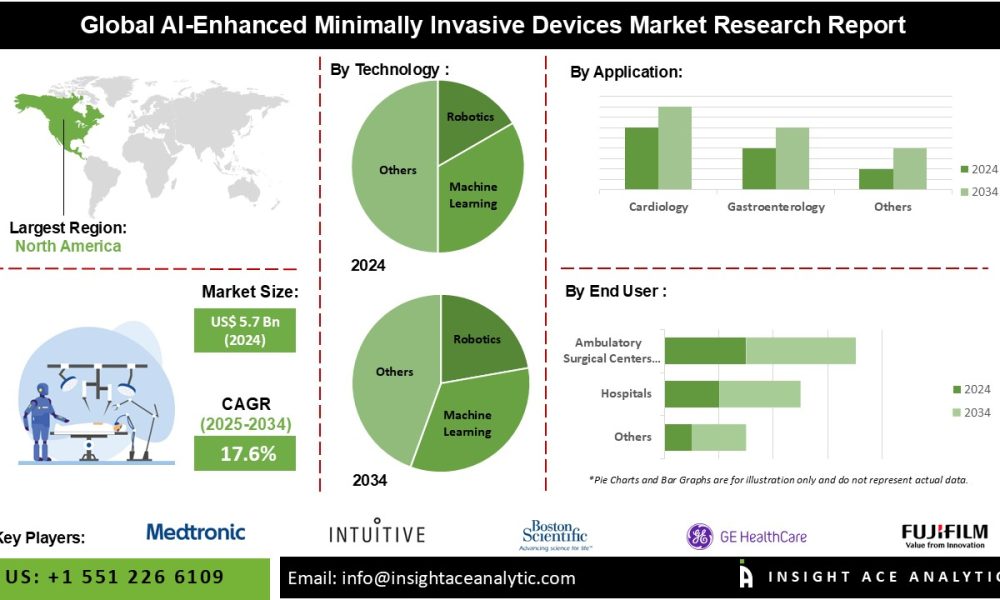
The Global AI-Enhanced Minimally Invasive Devices Market is valued at US$ 5.7 Bn in 2024 and it is expected to reach US$ 27.8 Bn by the year 2034, with a CAGR of 17.6 % during the forecast period of 2025-2034.
Check this Report Brochure : https://www.insightaceanalytic.com/request-sample/2962
The integration of artificial intelligence (AI) into minimally invasive medical devices is transforming the healthcare landscape by improving procedural precision, operational efficiency, and patient outcomes. AI-enabled technologies—such as robotic-assisted surgical platforms, smart catheters, and advanced imaging systems—leverage real-time data analysis, image recognition, and navigational intelligence to facilitate complex medical procedures with minimal physical intrusion.
The global market for AI-powered minimally invasive devices is experiencing strong growth, driven by ongoing technological advancements, increasing patient preference for less invasive treatment options, and the growing role of AI in delivering personalized medical care. These systems offer a range of benefits, including enhanced surgical accuracy, shorter recovery periods, more informed clinical decision-making, and reduced overall healthcare expenditures.
AI-based minimally invasive technologies are being adopted across a wide spectrum of medical disciplines. In cardiology, they assist with procedures such as stent placements; in gastroenterology, they enhance the effectiveness of advanced endoscopic diagnostics; in interventional radiology, they provide real-time guidance during complex interventions; in orthopedics, they are used in joint and spinal surgeries; and in urology and gynecology, robotic-assisted systems improve the precision of procedures such as prostatectomies and hysterectomies.
List of Prominent Players in the AI-Enhanced Minimally Invasive Devices Market:
- Medtronic Plc
- Intuitive Surgical, Inc.
- Boston Scientific Corporation
- GE HealthCare
- Fujifilm Holdings Corporation
- Stryker Corporation
- Siemens Healthineers
- Johnson & Johnson (Ethicon + Auris Health)
- Olympus Corporation
- Zimmer Biomet
- Asensus Surgical, Inc.
- CMR Surgical
- Auris Health (J&J Subsidiary)
Market Dynamics
Drivers:
The rapid evolution of artificial intelligence (AI) technologies—including machine learning and computer vision—has significantly enhanced the capabilities and precision of minimally invasive medical devices. These advancements have improved real-time imaging, intraoperative decision-making, and the overall safety and effectiveness of surgical procedures. AI-powered robotic-assisted systems offer superior dexterity and accuracy, particularly in complex interventions, thereby reducing procedural complications and improving patient outcomes.
These developments align with the growing global preference for minimally invasive procedures, which are associated with shorter recovery periods, reduced risk of complications, and less trauma for patients. Additionally, the increasing prevalence of chronic diseases—including cardiovascular disorders, cancer, and diabetes, which affect approximately 129 million individuals in the United States—continues to drive demand for innovative, AI-enabled diagnostic and therapeutic solutions.
Challenges:
Despite the significant potential of AI-integrated minimally invasive technologies, several challenges hinder broader market adoption. Regulatory frameworks have struggled to keep pace with the rapid development of AI, and inconsistencies across international approval processes present further barriers. Technical issues such as algorithmic bias, limited system transparency, and unpredictable behavior raise concerns about safety and reliability. Ethical challenges related to data privacy and the lack of robust model validation also affect stakeholder confidence. Operationally, high implementation costs, difficulties in system integration, the need for ongoing maintenance, and the requirement for continuous training of healthcare personnel present additional hurdles. Moreover, the need for consistent performance monitoring and regulatory compliance introduces added complexity and resource demands for healthcare providers and manufacturers alike.
Regional Trends:
North America currently leads the market for AI-enabled minimally invasive medical devices, supported by a mature regulatory environment, high levels of healthcare expenditure, and advanced technological capabilities in robotic and AI-assisted surgery. The region is home to major industry players—including Medtronic, Johnson & Johnson, and Stryker—that continue to invest heavily in research and development to deliver next-generation medical technologies. Furthermore, the growing demand for minimally invasive procedures, driven by their clinical advantages and cost-efficiency, is accelerating the integration and adoption of AI-driven solutions across healthcare facilities throughout the region.
Recent Developments:
- In March 2025, FUJIFILM Healthcare Americas and Us2.ai partnered to integrate AI-driven echocardiography into the LISENDO 880 cardiovascular ultrasound system. The collaboration enables full automation of echocardiogram analysis and reporting, delivering comprehensive cardiac measurements. This advancement streamlines clinical workflows and enhances diagnostic accuracy in heart disease detection.
- In March 2025, At the 2025 American College of Cardiology meeting, GE HealthCare unveiled the Revolution™ Vibe CT system, featuring Unlimited One-Beat Cardiac imaging for high-quality scans, even in complex cases like atrial fibrillation. Integrated with AI-powered tools like ECG-less Cardiac, TrueFidelity DL, and Effortless Workflow, the system enhances diagnostic speed, accuracy, patient comfort, and clinical efficiency.
Segmentation of Trusted Platform Module Market-
By Product Type:
- AI-Enhanced Catheters
- AI-Powered Endoscopy Systems
- Robotic-Assisted Surgical Systems
- Imaging and Visualization Devices
- Other Devices
By Application:
- Cardiology
- Gastroenterology
- Interventional Radiology
- Orthopedics
- Urology and Gynecology
- Others
By End User:
- Hospitals
- Ambulatory Surgical Centers (ASCs)
- Specialty Clinics
By Technology:
- Machine Learning
- Computer Vision
- Natural Language Processing (NLP)
- Robotics
By Region-
North America-
- The US
- Canada
Europe-
- Germany
- The UK
- France
- Italy
- Spain
- Rest of Europe
Asia-Pacific-
- China
- Japan
- India
- South Korea
- South East Asia
- Rest of Asia Pacific
Latin America-
- Brazil
- Argentina
- Mexico
- Rest of Latin America
Middle East & Africa-
- GCC Countries
- South Africa
- Rest of Middle East and Africa
About Us:
InsightAce Analytic is a market research and consulting firm that enables clients to make strategic decisions. Our qualitative and quantitative market intelligence solutions inform the need for market and competitive intelligence to expand businesses. We help clients gain competitive advantage by identifying untapped markets, exploring new and competing technologies, segmenting potential markets and repositioning products. Our expertise is in providing syndicated and custom market intelligence reports with an in-depth analysis with key market insights in a timely and cost-effective manner.




