
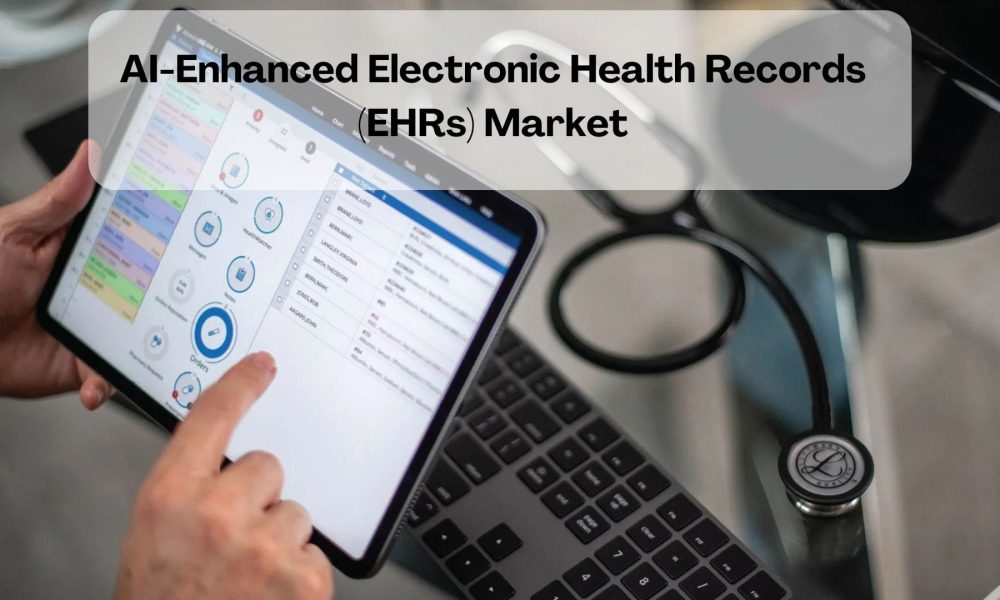
Global AI-Enhanced Electronic Health Records (EHRs) Market reached US$ 5.3 billion in 2023 and is expected to reach US$ 37.5 billion by 2031, growing at a CAGR of 28.8% during the forecast period 2024-2031.
AI-enhanced Electronic Health Records (EHRs) refer to digital patient records that integrate artificial intelligence (AI) capabilities to improve healthcare efficiency, accuracy, and decision-making. These systems utilize machine learning, natural language processing (NLP), and predictive analytics to streamline administrative tasks, enhance clinical decision support, and personalize patient care. AI-powered EHRs help automate documentation, detect patterns in patient data, and provide actionable insights for healthcare professionals.
The global AI-enhanced EHR market is experiencing significant growth due to the increasing adoption of digital healthcare solutions, rising demand for workflow automation, and advancements in AI technologies. The integration of AI in EHRs enhances data interoperability, reduces clinician burnout, and improves patient outcomes by offering predictive analytics and real-time decision support. Governments worldwide are encouraging the adoption of AI-driven healthcare solutions through regulatory frameworks and financial incentives. Key players in the market include Epic Systems, Cerner Corporation, Allscripts, and IBM Watson Health.
Download Free Sample PDF: https://www.datamintelligence.com/download-sample/ai-enhanced-electronic-health-records-market
Market Growth Drivers:
Growing Adoption of Advanced Data Analytics in AI-Enhanced EHRs
The integration of advanced data analytics into AI-enhanced Electronic Health Records (EHRs) is transforming the healthcare landscape by enabling more precise diagnoses, personalized treatment plans, and improved clinical decision-making. By leveraging AI-driven analytics, healthcare providers can efficiently assess vast amounts of patient data, identify disease trends, and detect potential health risks before they escalate. This capability empowers clinicians to make data-driven decisions that enhance patient care and treatment efficacy.
Predictive analytics, a key component of AI-enhanced EHRs, allows medical professionals to foresee patient outcomes based on historical health data. This early detection of high-risk individuals enables proactive intervention, timely medical attention, and customized treatment strategies, ultimately improving patient outcomes. Moreover, the ability to analyze large-scale health data across different populations aids in identifying disease outbreaks, monitoring public health trends, and optimizing resource allocation. This strengthens preventive care efforts, reduces hospital readmissions, and enhances overall healthcare efficiency.
Challenges of Data Privacy and Security in AI-Enhanced EHRs
As AI-powered EHRs process vast volumes of sensitive patient data, concerns over privacy and security remain significant challenges. High-profile data breaches have raised alarms about potential risks, including unauthorized access, identity theft, and regulatory penalties. Healthcare organizations must implement robust encryption, compliance protocols, and stringent access controls to ensure the safety of patient information and maintain trust among users.
Additionally, increasing patient awareness about data privacy has led to growing concerns over how their personal health information is collected, stored, and shared. Regulatory frameworks such as the Health Insurance Portability and Accountability Act (HIPAA) in the U.S. and the General Data Protection Regulation (GDPR) in Europe mandate strict compliance with data protection policies. To address these concerns, AI-driven EHR systems must incorporate advanced cybersecurity measures, including blockchain technology, multi-factor authentication, and real-time threat monitoring, ensuring secure and ethical handling of patient records.
Market Segments:
By EHR Type: On-Premise EHR Software, SaaS EHRs, Custom-Built EHR.
By Technology: Machine Learning, Deep Learning, Natural Language Processing (NLP).
By Application: Data Management and Organization, Data Analysis and Insights, Predictive Analytics, Virtual Medical Assistance, Clinical Decision Support, Others.
By End-Users: Hospitals, Clinics, Ambulatory surgical centers.
Competitive Landscape
- Epic Systems Corporation
- Medical Information Technology, Inc.
- Microsoft
- eClinicalWorks
- Medical Information Technology, Inc.
- ScienceSoft USA Corporation
- Oracle
Customize Your Scope: https://www.datamintelligence.com/customize/ai-enhanced-electronic-health-records-market
Regional Growth
North America’s Leading Role in the AI-Enhanced EHRs Market
North America is projected to maintain a dominant position in the AI-enhanced Electronic Health Records (EHRs) market. The region benefits from vast healthcare data resources, which play a crucial role in training AI algorithms. Access to high-quality, structured medical data enhances the accuracy and efficiency of AI applications in EHR systems, driving innovation and adoption across healthcare facilities.
The market growth in North America is further supported by rapid technological advancements, a strong presence of key industry players, and a growing focus on improving patient outcomes while reducing healthcare costs. AI-powered EHRs contribute to these goals by offering advanced data analytics, predictive modeling, and personalized treatment recommendations. As healthcare providers increasingly prioritize efficiency and quality care, the demand for AI-driven EHR solutions in the region is expected to expand significantly.
For Detailed Report:https://www.datamintelligence.com/enquiry/ai-enhanced-electronic-health-records-market




