
FOR IMMEDIATE RELEASE
The Silent Business Disruption Fracture: Why Wall Street’s Mid-February Correction Signals the End of the AI Agent Honeymoon
NEW YORK, NY — Something just broke on Wall Street. If you aren’t watching the ticker tapes with a clinical eye, you’ll miss the single biggest Business Disruption shift in AI Agent technology investing since the dot-com bust of 2000.
For three years, artificial intelligence was the tide that lifted all boats. In February 2026, that tide turned into a rogue wave. According to recent Bloomberg reports, mentions of “AI Agent Business Disruption” in corporate earnings calls didn’t just rise; they nearly doubled quarter-over-quarter. This wasn’t the “gentle uptick” of an evolving market; it was a klaxon. For the first time, C-suite executives are no longer framing AI as a shiny new opportunity—they are categorizing it as an existential threat to their legacy business models.
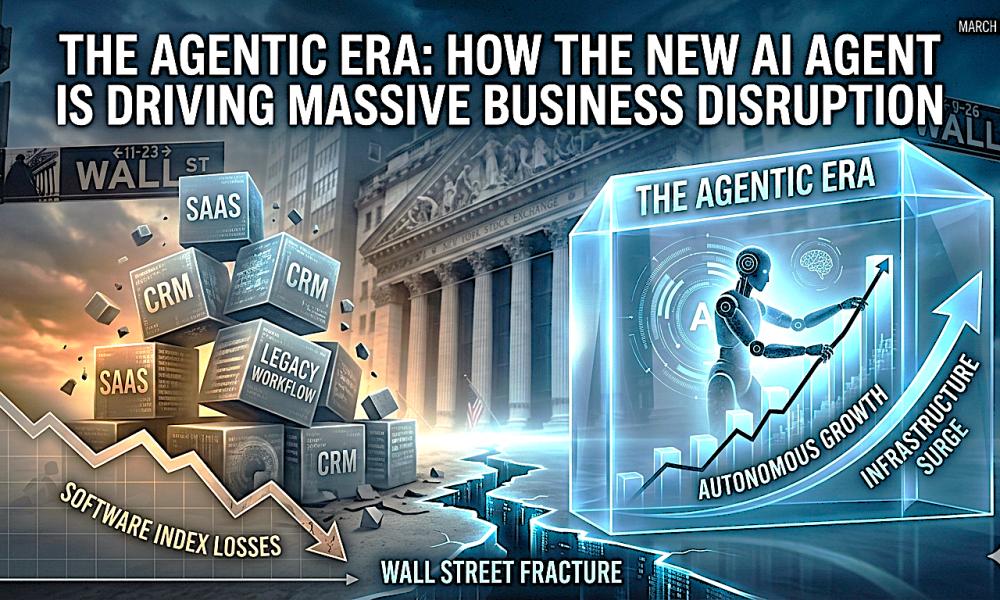
The market’s response in mid-February was swift and surgical. Tech-heavy indexes recorded significant losses as traders began the painful process of reassessing every assumption about AI-driven growth. This wasn’t a “panic sell” driven by emotion; it was something far more permanent. It was a rational recalculation of value in an economy that has suddenly moved past the era of the chatbot.
The Rise of the AI Agent: From Chatbots to Digital Workforces
The primary catalyst for this shift is the industry’s transition into what analysts are calling the “agentic era.” The era of asking a window to “write an email” is over. Models from Anthropic, Google, OpenAI, and Chinese labs like MiniMax have matured into something far more potent.
An AI agent is no longer a passive optional tool; it is an autonomous digital worker capable of executing long-term, multi-step tasks at a fraction of human cost. While early generative models were limited to content creation, today’s agents can navigate software interfaces, manage supply chains, and execute complex coding projects without human intervention.
Investor and AI founder Matt Shumer recently ignited a firestorm of debate by arguing that AI has officially crossed the threshold from “software tool” to “autonomous worker.” Shumer points to self-improving feedback loops and AI-written codebases as evidence that widespread white-collar disruption is no longer a decade away. It is a matter of one to five years—perhaps months.
When a company can deploy an AI agent to perform the duties of an entire department, the traditional per-seat licensing model of the software industry begins to crumble. We are moving from a world of “Software as a Service” (SaaS) to “Service as Software,” where the output is the product, not the tool used to create it.
The Architecture of Business Disruption: Winners, Losers, and the $1.5 Trillion Question
This shift has created a staggering paradox in the capital markets. While software stocks are reeling, infrastructure spending is hitting fever pitches. Nvidia and Foxconn have recently announced massive “AI factory” buildouts, and Amazon is moving forward with a $200 billion investment in AWS cloud infrastructure.
The disconnect is jarring: the foundations of AI are being built at a record pace, while the companies expected to sit on those foundations are facing a valuation crisis. This is the heart of the current business disruption.
Morgan Stanley recently released a sobering analysis flagging potential threats to the $1.5 trillion U.S. software credit space. Their logic is as cold as it is compelling: if an AI agent can automate the complex workflows that a specific software was designed to manage, that software becomes redundant.
This leads to a brutal new rubric for investors. If you are holding positions in software companies, you must ask one fundamental question: Can an AI agent do what this company’s product does?
- If the answer is “Yes,” the market will likely devalue the company immediately.
- If the answer is “Maybe,” the volatility will be relentless.
- If the answer is “Not yet,” the market will punish the stock anyway, simply at a slower cadence.
This business disruption isn’t suggesting that these multi-billion dollar entities will vanish overnight. Instead, it suggests that their growth narratives—the very thing Wall Street pays a premium for—have become indefensible. The “moats” of proprietary UI and user retention are being bridged by autonomous agents that don’t care about user interfaces; they only care about API calls and efficiency.
A Market Sorted by Reality
The February selloff was the “Great Sorting.” The transition from AI hype to AI reality means the market is finally identifying which companies will be worth dramatically more and which will be worth dramatically less.
We are witnessing the birth of a bifurcated economy. On one side are the “arms dealers”—the hardware and energy giants providing the compute and power. On the other side are the “Legacy Gatekeepers”—software firms whose value proposition relied on human-centric workflows that are now being automated out of existence.
In the middle are the few agile incumbents and “Agent-First” startups that are successfully pivoting to lead this new workforce. These are the entities that recognize an AI agent isn’t a feature to be added to a sidebar; it is the core of the new enterprise.
The Bottom Line
The “market wobble” of early 2026 was a warning shot. The era of speculative AI investing is dead, replaced by a cold, hard look at unit economics and autonomous capability. As digital workers begin to fill the seats of “department-level” tasks, the companies that fail to integrate—or are replaced by—this technology will find no shelter in the public markets.
Wall Street has stopped dreaming about what your own personal AI Agent might do. It has started pricing in what AI is doing. And for those on the wrong side of the Business Disruption, the silence of the “broke” market is the loudest sound in the world.
About the Report:
This editorial reflects the shifting sentiments of the Q1 2026 fiscal cycle, analyzing the convergence of “agentic AI” and its immediate impact on software valuations and global infrastructure investment.