
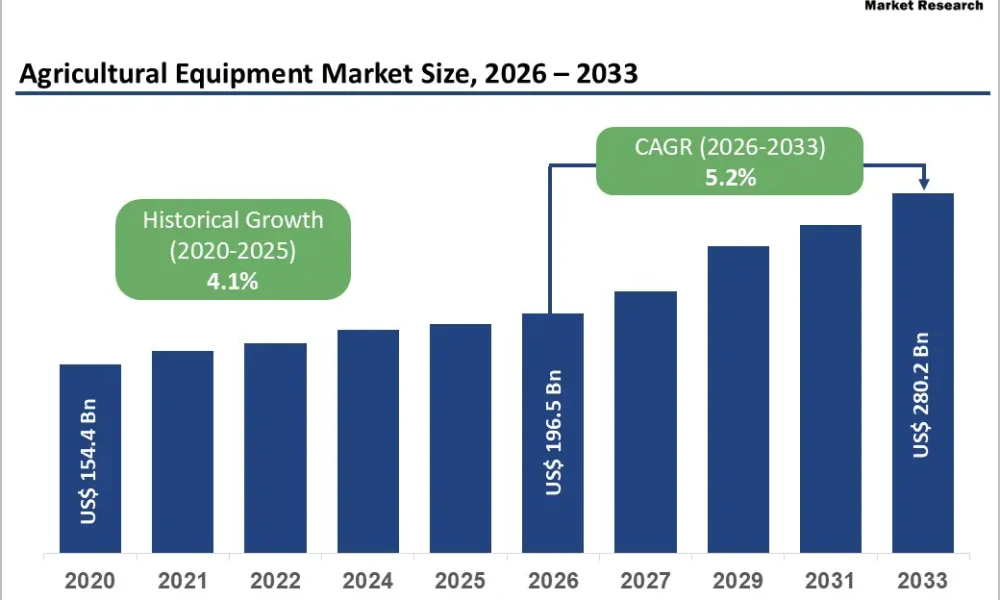
The global agricultural equipment market is witnessing robust growth as demand for mechanization rises in response to labor shortages, increasing food production needs, and modernization of farming practices worldwide. Agricultural equipment includes tractors, harvesters, seeders, planters, sprayers, and other machinery that streamline farming operations, reduce labor dependency, and improve productivity. The market is projected to reach US$ 196.5 billion in 2026 and expand to US$ 280.2 billion by 2033, growing at a CAGR of 5.2% between 2026 and 2033. Rising government support, technological innovations in precision agriculture, and adoption of smart farming solutions are key drivers that contribute to market expansion globally.
Among the various equipment segments, tractors remain the largest and most widely adopted, accounting for the majority of market revenue due to their versatility and essential role in mechanized farming. Geographically, Asia Pacific dominates the market, driven by large agricultural activities in countries like India and China. India’s Pradhan Mantri Kisan Samman Nidhi scheme and China’s agricultural modernization policies encourage equipment adoption, while rising awareness of sustainability and precision agriculture further fuels the demand for advanced machinery. North America and Europe also show steady growth, primarily supported by modern farm practices, automation, and technological upgrades in equipment.
Key Highlights from the Report
• The global agricultural equipment market is projected to grow at a CAGR of 5.2% from 2026 to 2033.
• Market size is expected to increase from US$ 196.5 billion in 2026 to US$ 280.2 billion by 2033.
• Tractors account for the leading product segment due to versatility and high adoption in mechanized farming.
• Asia Pacific leads the market, driven by India and China’s government initiatives supporting modernization.
• Technological advancements in precision agriculture are improving operational efficiency and sustainability.
• Growing global food demand and labor shortages are accelerating adoption of farm mechanization.
𝐆𝐞𝐭 𝐚 𝐒𝐧𝐞𝐚𝐤 𝐏𝐞𝐞𝐤, 𝐒𝐚𝐦𝐩𝐥𝐞 𝐏𝐃𝐅 𝐈𝐧𝐬𝐢𝐝𝐞: https://www.persistencemarketresearch.com/samples/3151
Market Segmentation
The agricultural equipment market can be segmented based on product type, end-user, and application. By product type, key categories include tractors, harvesters, seeders & planters, sprayers, tillers, and others. Tractors dominate due to their multifunctional applications in plowing, tilling, sowing, and hauling. Harvesters are widely used in grain and crop harvesting operations, improving efficiency and reducing labor dependency. Seeders and planters ensure precision planting, while sprayers and tillers enhance crop protection and soil management.
By end-user, the market serves small-scale farmers, large commercial farms, and government-supported agricultural initiatives. Large-scale farms lead demand as mechanization offers productivity gains and operational efficiency. Government initiatives promoting modern agriculture also drive adoption among smallholder farmers. Emerging farmers increasingly rely on affordable and compact machinery to enhance productivity and meet food supply needs.
By application, agricultural equipment is utilized in crop cultivation, harvesting, irrigation management, soil preparation, and crop protection. Precision agriculture technologies such as GPS-guided tractors, automated seeders, and smart sprayers help optimize yields while reducing labor requirements. Sustainable practices like reduced fertilizer and water usage are supported by modern machinery, further accelerating adoption across regions.
Regional Insights
Asia Pacific dominates the agricultural equipment market due to the region’s large agricultural base, population-driven food demand, and government policies supporting mechanization. India and China remain the primary contributors, with incentives for adopting modern farming equipment. Southeast Asian countries are also witnessing growth due to investments in mechanized farming and infrastructure development.
North America shows strong growth, driven by advanced farming practices, precision agriculture adoption, and high mechanization rates. The U.S. and Canada lead the region, focusing on smart machinery and efficient irrigation systems.
Europe maintains steady growth, supported by agricultural modernization programs, sustainability regulations, and automation adoption. Germany, France, and the UK are key contributors, prioritizing equipment that enhances efficiency while reducing labor costs.
Latin America sees moderate growth, driven by commercial farming in Brazil, Argentina, and Mexico. Expansion of mechanized farming and government initiatives support equipment adoption.
Middle East & Africa shows increasing adoption of modern agricultural equipment due to investments in agricultural infrastructure and initiatives to improve food security. Countries like Saudi Arabia, Egypt, and South Africa are implementing policies to boost mechanization and modern farming practices.
𝐆𝐞𝐭 𝐚 𝐂𝐮𝐬𝐭𝐨𝐦𝐢𝐳𝐞𝐝 𝐌𝐚𝐫𝐤𝐞𝐭 𝐕𝐢𝐞𝐰 𝐢𝐧 𝐎𝐧𝐞 𝐂𝐥𝐢𝐜𝐤 : https://www.persistencemarketresearch.com/request-customization/3151
Market Drivers
The market is primarily driven by rising global demand for food, labor shortages, and the need to enhance farming efficiency. Mechanization reduces dependency on manual labor, which is increasingly scarce in both developed and developing countries. Additionally, government initiatives and subsidies supporting equipment adoption are key growth drivers. Technological innovations in precision agriculture, GPS-enabled machinery, and IoT-enabled monitoring systems are further enhancing operational efficiency, reducing labor needs by up to 50% per acre, and improving crop yields.
Market Restraints
Despite strong growth, the market faces challenges such as high equipment costs, lack of financing options for small farmers, and maintenance requirements. Smallholder farmers in developing regions may struggle with the initial capital investment needed for modern machinery. Additionally, operation and maintenance costs, as well as a lack of skilled operators, may restrict widespread adoption in certain regions. Harsh environmental conditions and irregular terrain can also pose challenges for machinery longevity and performance.
Market Opportunities
Significant opportunities exist in precision agriculture, smart farming solutions, and emerging markets. Adoption of automated tractors, drones for crop monitoring, and AI-powered irrigation systems can improve efficiency and sustainability. Emerging economies in Asia, Africa, and Latin America present untapped markets, with rising mechanization rates supported by government policies and private investments. Additionally, developing compact, cost-effective equipment for small-scale farmers offers potential growth opportunities. Sustainable and energy-efficient machinery aligns with global environmental initiatives, further expanding market potential.
𝐁𝐮𝐲 𝐍𝐨𝐰 𝐭𝐡𝐞 𝐃𝐞𝐭𝐚𝐢𝐥𝐞𝐝 𝐑𝐞𝐩𝐨𝐫𝐭: https://www.persistencemarketresearch.com/checkout/3151
Company Insights
Leading companies in the agricultural equipment market focus on innovation, technology integration, and strategic partnerships to strengthen their market position.
• Deere & Company
• CNH Industrial N.V.
• AGCO Corporation
• Kubota Corporation
• Mahindra & Mahindra Ltd.
• Escorts Limited
• Claas KGaA mbH
• SDF Group
• Zoomlion Heavy Industry Science & Technology Co., Ltd.
• Yanmar Co., Ltd.
Recent Developments
Recent developments include the introduction of autonomous tractors and AI-enabled sprayers, enhancing productivity and precision in modern farms. Companies are also investing in electric and hybrid agricultural machinery, reducing fuel consumption and carbon footprint while promoting sustainable farming practices globally.
Conclusion
The agricultural equipment market is poised for sustained growth through 2033, driven by increasing mechanization, technological innovations, and rising global food demand. Asia Pacific dominates due to government initiatives and a large farming base, while North America and Europe maintain steady growth through precision agriculture and modernization of farms. Tractors remain the leading segment, supported by diverse applications across plowing, sowing, and harvesting. Technological advancements such as GPS-enabled machinery, autonomous tractors, and smart irrigation solutions are transforming operational efficiency, reducing labor dependency, and improving sustainability. With ongoing investments in mechanization and modern farming practices, the agricultural equipment market continues to be a critical enabler for global food security and efficient agricultural production.




