
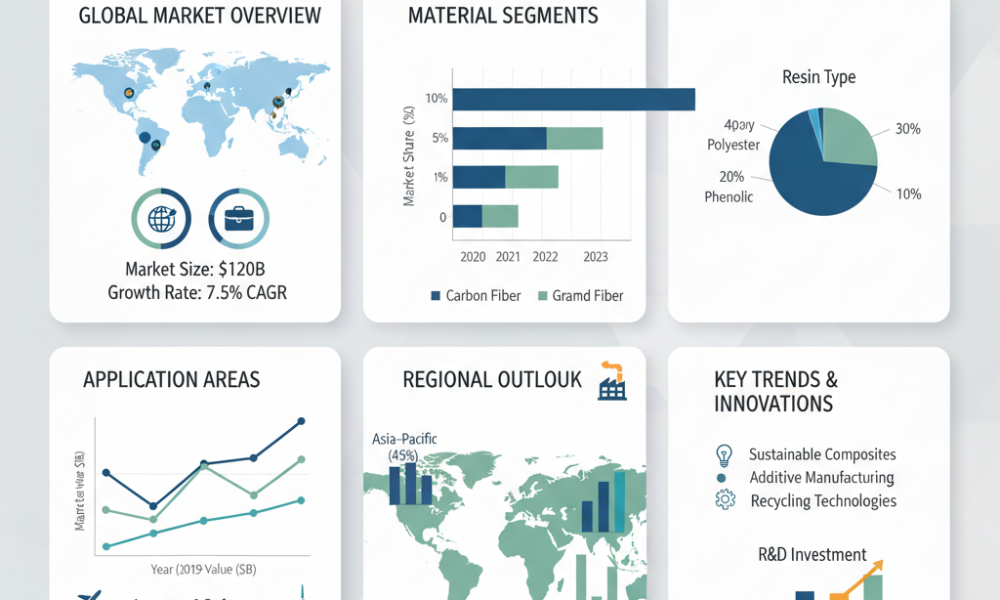
The global Advanced Composites Market is entering a dynamic growth phase, projected to surge from USD 52.4 billion in 2025 to USD 123.7 billion by 2035, reflecting a strong CAGR of 8.9%. Driven by innovation in aerospace, automotive, renewable energy, and infrastructure, advanced composites are redefining the global materials landscape with performance, durability, and sustainability at the core.
Key Market Insights at a Glance
- The market value in 2025 is projected to reach USD 52.4 billion, signaling robust demand across high-performance industries.
- Carbon fiber composites are set to dominate, holding approximately 54.7% of the total market share.
- Tier 1 players collectively account for 19% of global revenue, with mid-tier and emerging companies actively expanding capacity.
- Continuous R&D investments and bio-based material innovations are reshaping the competitive landscape.
- Industrial automation, lightweighting, and sustainability mandates are the primary growth accelerators for the coming decade.
Regional Value Snapshot
North America remains the innovation nucleus of the advanced composites industry, fueled by sustained demand from aerospace, defense, and high-value automotive applications. The Asia-Pacific region is witnessing exponential growth, led by China and India, where expanding automotive production, renewable-energy infrastructure, and large-scale construction projects are spurring composite consumption. Europe continues to lead in sustainability-driven initiatives, emphasizing recyclable, high-strength composite materials. Meanwhile, emerging economies in the Middle East, Africa, and Latin America are investing heavily in next-generation infrastructure and defense technologies, creating long-term opportunities for market expansion.
Segment Overview
By Product Type:
Carbon fiber composites dominate the market for their high strength-to-weight ratio and corrosion resistance, followed by glass and aramid fiber composites that serve cost-efficient, large-scale applications in wind energy, marine, and civil infrastructure.
By End-Use Industry:
- Aerospace & Defense: Expected to command over 38% of the market share in 2025, driven by the need for fuel efficiency and lightweight aircraft structures.
- Automotive & Transportation: Rapid adoption of composites for electric vehicles (EVs) and next-gen lightweight designs.
- Renewable Energy: Increasing use in wind turbine blades and structural reinforcements.
- Construction & Infrastructure: Rising demand for corrosion-resistant materials in smart and green building solutions.
- Sporting Goods & Leisure: Specialty composites used for high-performance recreational equipment.
Regional Overview
- North America: Strong R&D base and early adoption across aerospace and defense segments.
- Europe: Advanced environmental regulations are pushing sustainable composite development, especially in Germany and the UK.
- Asia-Pacific: Fastest-growing region with a double-digit CAGR, driven by automotive, renewable energy, and infrastructure sectors.
- Latin America & Middle East: Increasing focus on composites for military, energy, and civil engineering projects.
Competitive Landscape
The market features a blend of established leaders and emerging innovators. Tier 1 companies such as Hexcel Corporation, Toray Industries, and Solvay S.A. maintain global leadership through high-volume production and proprietary technology platforms. Tier 2 participants including SGL Carbon, Mitsubishi Chemical, and Teijin Limited focus on sustainable innovations and high-temperature-resistant composites. Numerous Tier 3 and regional firms are entering the field with customized, value-added solutions tailored to specific industries. Consolidation trends and strategic mergers are further enhancing global competitiveness.
Market Outlook: Powering the Next Decade
Over the next decade, advanced composites will be central to the industrial revolution of lightweighting and carbon neutrality. From electric mobility to wind-energy blades and future aircraft, demand for multifunctional materials is surging. Automation in composite manufacturing, AI-driven process optimization, and adoption of bio-resins and recyclable composites will redefine production economics. By 2035, the market is expected to surpass USD 123.7 billion, as industries integrate composites for efficiency, sustainability, and performance enhancement.
Key Players in the Sustainable Composites Industry
Major players shaping the future include Hexcel Corporation, Toray Industries, Solvay S.A., SGL Carbon, Mitsubishi Chemical, Teijin Limited, Owens Corning, Gurit, Axiom Materials, and Victrex plc. These companies are leading innovation in smart, self-healing, and bio-based composites, aligning performance goals with global sustainability standards.
Recent Strategic Developments
- Hexcel expanded aerospace-grade carbon fiber capacity in 2024.
- Toray Industries launched next-generation thermoplastic composites.
- Solvay introduced low-emission epoxy resin systems for industrial use.
- SGL Carbon integrated AI for automated fiber placement technology.
- Mitsubishi Chemical commercialized bio-based fiber-reinforced materials.
- Teijin unveiled high-temperature-resistant composite lines for EV applications.
These advancements mark a clear shift toward eco-conscious innovation and digitally optimized production.
To access the complete data tables and in-depth insights, request a sample report here: https://www.futuremarketinsights.com/reports/sample/rep-gb-21476
Have a specific Requirements and Need Assistant on Report Pricing or Limited Budget please contact us – [email protected]
About Future Market Insights (FMI)
Future Market Insights, Inc. (ESOMAR certified, recipient of the Stevie Award, and a member of the Greater New York Chamber of Commerce) offers profound insights into the driving factors that are boosting demand in the market. With a vast team of over 400 analysts worldwide, FMI provides global, regional, and local expertise on diverse domains and industry trends across more than 110 countries.



