
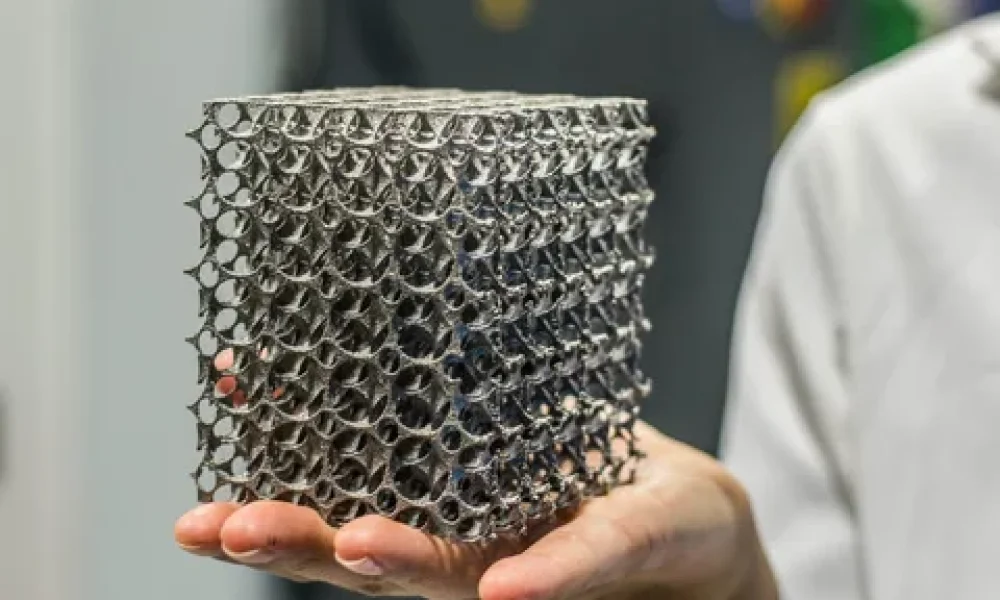
The Global Additive Manufacturing Market was valued USD 20.1 Billion in 2023 and projected to reach USD 74.6 Billion by 2030, growing at a CAGR of 20.6% during the forecast period of 2023-2030.
Download the Sample – https://www.marketdigits.com/request/sample/3611
TOC Covers in Depth & Breath on Additive Manufacturing Market
170 – Market Data Tables
65 – List of Figures
225 – Pages
Market Overview
The additive manufacturing sector has witnessed noteworthy growth and widespread adoption in recent times, with expectations of further substantial expansion and acceptance in the future. The key driver behind the increased adoption of additive manufacturing is the growing demand for automation and cost-effective technologies within the manufacturing industry. The integration of additive manufacturing technologies in production processes enables the efficient mass production of intricate parts, thereby reducing lead times. Its high precision and rapid production capabilities have led to the displacement of traditional methods. Additionally, additive manufacturing is revolutionizing production across various applications.
Major Vendors In The Global Additive Manufacturing Market:
- 3D Systems Inc.
- Autodesk Inc.
- Biomedical Modeling Inc.
- EnvisionTec, Inc.
- Eos GmbH Electro Optical Systems
- EXone Company
- General Electric Company
- Materialise NV
- Optomec Inc.
- Renishaw Plc
- Siemens AG
- Sirona Dental System
- SLM Solutions GmbH
- Stratasys Ltd.
- Voxeljet AG
- Wipro Limited
Request for Discount @ https://www.marketdigits.com/request/discount/3611
Ecological Advantages Provided By Additive Manufacturing
Companies aiming to enhance manufacturing sustainability benefit from the favorable environmental impact of additive manufacturing. In contrast to traditional production methods, additive manufacturing presents several environmental advantages, with energy and waste minimization being the most prominent. Additive manufacturing technologies prove more efficient, significantly reducing the environmental footprint of waste compared to traditional manufacturing processes. With additive manufacturing utilizing only the necessary materials for production, it boasts higher material efficiency. As manufacturers increasingly prioritize sustainability in their development strategies, the market is anticipated to experience acceleration, accompanied by environmental benefits.
Market Dynamics
Drivers:
- Rising demand for low-weight automobile components
- Higher development of prototypes for medical devices
- Increasing technological advancement in 3D printing
- Rapid product development at a low cost
Opportunities:
- Expansion of additive manufacturing into new industries
- Growing demand for personalized products
- Development of new materials
Rise Of Power Bed Fusion
Powder bed fusion is commonly employed for the 3D printing of individual parts such as machine components, jigs, and fixtures, particularly for low-volume functional parts spanning various industries. The mechanical properties of components produced through powder bed fusion closely resemble those achieved through casting and machining. This method supports a diverse range of materials and allows for the simultaneous production of multiple pieces. The three primary powder bed fusion techniques frequently utilized are selective laser sintering (SLS), electron beam melting, and selective laser melting. The field has seen advancements in powder purity and size dispersion, contributing to improved powder qualities. While hardware innovations significantly enhance the speed of powder bed fusion applications, the development of low-cost 3D printing materials by entrepreneurs is making this technique more accessible. Consequently, the emergence of the power bed fusion technique presents lucrative opportunities for the market, expanding its potential use cases.
The Market For Additive Manufacturing Is Dominated By North America.
In 2022, the North American market dominated with the highest revenue share, attributed to the increasing adoption of 3D printing technologies. Additive Manufacturing (AM) technologies offer four potential sources of value compared to conventional production methods, providing designers the flexibility to create parts that outperform or are more cost-effective than traditional alternatives due to their ability to generate virtually any 3-D shape. For example, an Airbus titanium bracket produced using additive manufacturing is 30% lighter than the original without compromising strength or performance. AM has gained widespread acceptance in various industries as the fastest and most cost-effective way to create functional prototypes during product development and evaluation. Additionally, there is a growing utilization of ‘indirect’ applications of AM technologies, such as fixtures, spare parts, and tooling for conventional production equipment.
The Asia Pacific market is anticipated to register the highest revenue Compound Annual Growth Rate (CAGR) during the forecast period. The advancement of Radio Frequency (RF) design has been propelled by Direct Metal Printing (DMP). Industry leaders leverage the potential of additive manufacturing to fundamentally reconsider subsystems and produce them in highly unitized structures. Unitization brings several advantages, including fewer interfaces in the RF transmission chain, leading to reduced overall system losses. Lower part counts, lighter and smaller assemblies, reduced quality control costs, and a more efficient supply chain are additional benefits of unitization. In a specific instance, an inductive RF filter for on-orbit use was manufactured using the DMP process, requiring only one piece compared to the 39 parts of a conventional unit. The additively produced filter also weighed half as much as the traditional filter.
The Stereolithography Segment is Anticipated to Hold the Largest Market Share During the Forecast Period
Based on technology the additive manufacturing market is segmented into Stereolithography, Fuse Deposition Modeling, Selective Laser Sintering, Direct Metal Laser Sintering, Polyjet Printing, Inkjet Printing, Electron Beam Melting, Laser Metal Deposition, Digital Light Processing, Laminated Object Manufacturing and Others. In 2022, the market was dominated by the stereolithography segment, capturing a significant revenue share. Stereolithography stands out as one of the oldest and most traditional printing technologies. Beyond its user-friendly operations, stereolithography boasts various advantages that contribute to its increasing adoption. Nevertheless, ongoing technological advancements and proactive research and development efforts by industry experts and researchers are creating opportunities for the exploration of several other efficient and reliable technologies.
To directly buy this report @ https://www.marketdigits.com/checkout/3611?lic=s