

Global AC Electric Motor Market: Trends, Growth, and Forecast to 2032
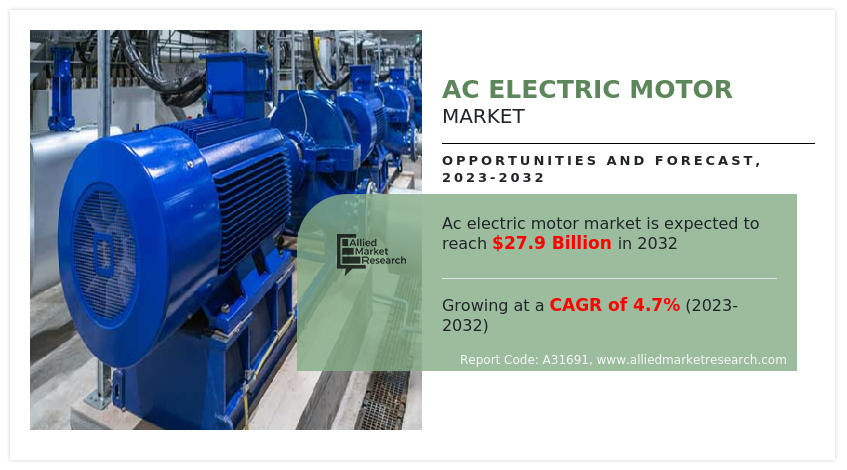
The global AC electric motor market size at $17.5 billion in 2022, is projected to reach $27.9 billion by 2032, growing at a compound annual growth rate (CAGR) of 4.7% from 2023 to 2032. AC electric motors, which convert electrical energy into mechanical energy, are integral to a wide range of applications, including industrial machinery, pumps, compressors, HVAC systems, electric vehicles, and robotics. Known for their efficiency, durability, high torque, and reliability, AC motors—particularly synchronous and induction types—are widely adopted across industrial and commercial sectors. The market’s growth is driven by increasing demand for energy-efficient motors, advancements in electric vehicle and robotics technologies, and supportive government policies promoting sustainable solutions.
𝐃𝐨𝐰𝐧𝐥𝐨𝐚𝐝 𝐏𝐃𝐅 𝐒𝐚𝐦𝐩𝐥𝐞@ https://www.alliedmarketresearch.com/request-sample/A31691
Market Dynamics
AC electric motors are essential components in various applications, including compressors, pumps, automobiles, machine tools, power tools, home appliances, and electric vehicles. These motors offer significant advantages over traditional motors, such as longer operational lifespans, lower energy consumption, reduced maintenance needs, and higher tolerance to voltage fluctuations. The growing emphasis on energy efficiency and productivity has fueled demand for high-efficiency AC motors, which consume less power while delivering superior performance. Additionally, key market players are focusing on product innovation to strengthen their portfolios and meet evolving industry needs.
For instance, in June 2023, ABB launched the AMI 5800 NEMA modular induction motor, designed for demanding applications such as pumps, compressors, fans, extruders, conveyors, and crushers. With a power output of up to 1750 HP, this motor offers exceptional modularity and customization, making it suitable for both new projects and upgrades in industries like chemical, oil, and gas. Such innovations highlight the industry’s commitment to delivering efficient and adaptable solutions, further driving market growth.
However, the high initial capital expenditure required for AC electric motors, including additional equipment like electronic switching controllers and speed controllers, poses a challenge to market expansion. These costs can deter adoption, particularly in cost-sensitive markets. Despite this, opportunities abound, particularly in the robotics and electric vehicle sectors. The rising adoption of automated robot technologies and supportive government incentives, such as France’s up to $6,300 subsidy for electric vehicle owners based on emission levels, are expected to create lucrative growth prospects.
Market Segmentation by Output Power
The AC electric motor market is segmented by output power into three categories: 1000 HP to 10,000 HP, 10,000 HP to 20,000 HP, and 20,000 HP to 30,000 HP. In 2022, the 1000 HP to 10,000 HP segment held the largest market share due to its widespread use in industrial applications. However, the 10,000 HP to 20,000 HP segment is expected to exhibit the highest CAGR from 2022 to 2032, driven by increasing demand for high-output, efficient motors in heavy industrial settings.
Market Segmentation by End-User Industry
By end-user industry, the market is divided into industrial machinery, transportation, HVAC, and others. In 2022, the industrial machinery segment accounted for the largest share, reflecting the critical role of AC motors in powering equipment like pumps, compressors, and conveyors. Meanwhile, the transportation segment is projected to register the highest CAGR, fueled by the growing adoption of electric vehicles and the need for motors that reduce carbon emissions. This shift aligns with global efforts to combat climate change and promote sustainable transportation solutions.
𝐄𝐧𝐪𝐮𝐢𝐫𝐞 𝐁𝐞𝐟𝐨𝐫𝐞 𝐁𝐮𝐲𝐢𝐧𝐠@ https://www.alliedmarketresearch.com/purchase-enquiry/A31691
Market Segmentation by Sales Type
The market is also segmented by sales type into new sales and aftermarket. In 2022, new sales dominated in terms of revenue, driven by the demand for advanced, energy-efficient motors in new installations. However, the aftermarket segment is expected to grow at the highest CAGR during the forecast period, as industries increasingly seek replacement and upgrade solutions to enhance efficiency and extend equipment lifespans.
Regional Analysis
Regionally, the AC electric motor market is analyzed across North America (U.S., Canada, Mexico), Europe (UK, France, Germany, Italy, rest of Europe), Asia-Pacific (China, Japan, India, South Korea, rest of Asia-Pacific), and LAMEA (Latin America, Middle East, Africa). In 2022, Asia-Pacific was the largest contributor to the market, driven by rapid industrialization, urbanization, and the growing adoption of electric vehicles in countries like China and India. Meanwhile, LAMEA is expected to lead in growth during the forecast period, supported by increasing investments in infrastructure and industrial development.
Competitive Landscape
The AC electric motor market is highly competitive, with major players including ABB Ltd., Cantoni Group, General Electric, Hitachi, Nidec Corporation, SEC Electric Machinery Co., Ltd., Siemens, Teco, Toshiba, and WEG. These companies are adopting strategies such as product launches, acquisitions, and partnerships to strengthen their market positions. For example, in July 2023, Nidec Corporation acquired Houma Armature Works, a U.S.-based company specializing in motor and generator remanufacturing, to expand its presence in the oil and gas sector. Similarly, in September 2023, WEG S.A. acquired Regal Rexnord Corporation’s industrial electric motors and generators business for $400 million, enhancing its global footprint.
In March 2023, Siemens introduced Innomotics, a new subsidiary focused on motors and large drives, offering a comprehensive range of low- to high-voltage motors, geared motors, and medium-voltage converters. This move underscores the industry’s focus on innovation and specialization. Additionally, in June 2022, Nidec launched the SynRA motor, the world’s first synchronous reluctance motor with an aluminum cage rotor, combining the efficiency of synchronous reluctance motors with the simplicity of induction motors. Such developments are poised to drive market growth by addressing the demand for high-performance, energy-efficient solutions.
𝐔𝐩𝐝𝐚𝐭𝐞 𝐎𝐧 𝐃𝐞𝐦𝐚𝐧𝐝@ https://www.alliedmarketresearch.com/request-for-customization/A31691
Key Benefits for Stakeholders
This market analysis provides valuable insights for stakeholders, including quantitative data on market segments, current trends, and growth dynamics from 2022 to 2032. Porter’s five forces analysis highlights the bargaining power of buyers and suppliers, enabling informed business decisions. The report also maps major countries by revenue contribution, offering a clear understanding of regional market dynamics. In-depth segmentation analysis identifies prevailing opportunities, while competitive benchmarking clarifies the positioning of key players.
The global AC electric motor market is poised for steady growth through 2032, driven by the increasing demand for energy-efficient motors, advancements in electric vehicle and robotics technologies, and supportive government policies. Despite challenges such as high initial costs, innovations like ABB’s AMI 5800 and Nidec’s SynRA motor, coupled with strategic acquisitions and partnerships, are expected to propel the market forward. With Asia-Pacific leading in market share and LAMEA emerging as a high-growth region, stakeholders have significant opportunities to capitalize on the evolving demand for AC electric motors across diverse industries.




