
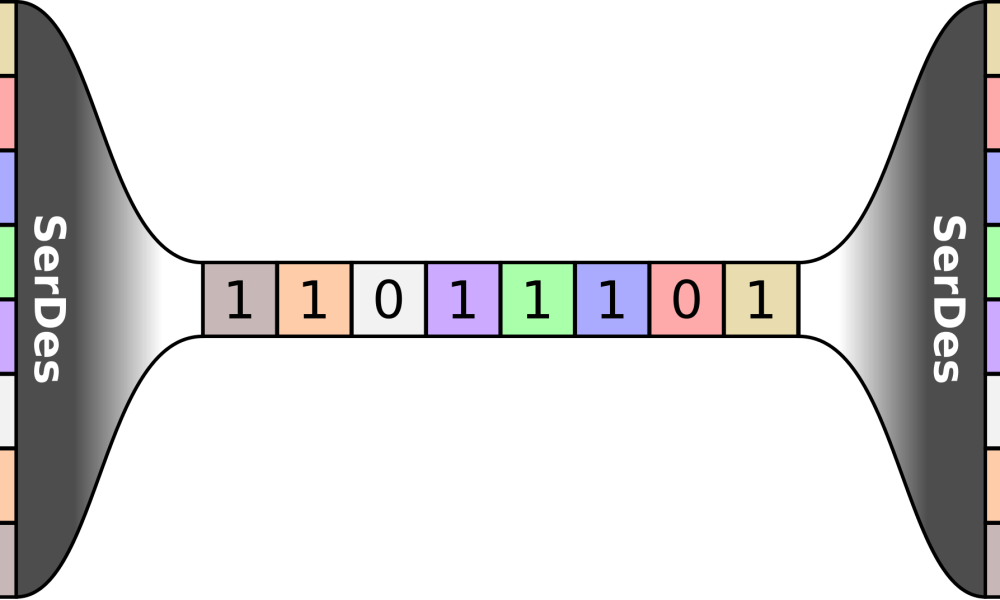
The SerDes market, with a value of USD 0.5 billion in 2022, is projected to grow at a compound annual growth rate (CAGR) of 15.2% from USD 0.57 billion in 2023 to reach USD 1.3 billion by 2030. The need to move large volumes of data between various components and systems efficiently and reliably has led to the development of advanced technologies, and one of the most significant innovations in this field is SerDes, short for Serializer/Deserializer. SerDes technology has revolutionized the way data is transmitted in a wide range of applications, from consumer electronics to data centers and beyond.
Understanding SerDes
SerDes is a key building block of modern digital communication systems. At its core, SerDes is a pair of integrated circuits that perform the task of converting parallel data streams into serial data streams on the transmitter side and then back into parallel data on the receiver side. This conversion allows for efficient data transfer between different parts of an electronic system while minimizing the number of physical connections required.
Request Free Sample Report @ https://www.marketdigits.com/request/sample/845
The leading players in the global SerDes industry are expected to optimize their operational costs to increase profit margins. Key market players such as Rambus (U.S.), Texas Instruments Inc. (U.S.), ON Semiconductor Corporation (U.S.), STMicroelectronics NV (Switzerland), ROHM Semiconductor (Japan), and others are actively working towards expanding market demand through research and development investments.
Challenges and Advancements
As technology evolves, the demands placed on SerDes systems continue to increase. These systems must keep pace with ever-higher data rates and more stringent signal integrity requirements. This has led to ongoing research and development efforts in the field.
One significant advancement in SerDes technology is the transition to higher data rates, often referred to as 56Gbps and beyond. Achieving these speeds requires innovations in circuit design, signal processing techniques, and materials science to minimize signal degradation and ensure reliable data transmission.
Another challenge is power efficiency. As electronic devices become more power-conscious, SerDes designers are constantly working to reduce the power consumption of these systems while maintaining performance. This involves optimizing the design of both the transmitter and receiver circuits and implementing advanced power management techniques.
Furthermore, SerDes technology is becoming increasingly flexible and adaptable. Modern SerDes chips often support multiple communication standards and can be reconfigured on-the-fly to adapt to changing system requirements. This versatility is essential in today’s rapidly evolving technological landscape.
In conclusion, SerDes technology has emerged as a cornerstone of modern electronics, enabling efficient and high-speed data transmission across a wide range of applications. Its ability to bridge the digital divide between parallel and serial data streams while addressing the challenges of increasing data rates and power efficiency ensures that SerDes will continue to play a pivotal role in shaping the future of electronic communication systems. As technology continues to advance, we can expect SerDes to evolve alongside it, enabling even more exciting and capable electronic devices and systems.
Request For Discount @ https://www.marketdigits.com/request/discount/845
SerDes Market Segmentation:
SerDes Application Outlook (USD Billion, 2023-2030)
• Optical Fibre Communication
• Datacenter and Cloud Computing
• 5G Wireless Infrastructures
• ADAS
• Vehicle Infotainment
• Others
SerDes Components Outlook (USD Billion, 2023-2030)
• Clock Multiplier Unit
• Lanes
• Physical Coding Sub-Block
SerDes Product Outlook (USD Billion, 2023-2030)
• Stand-Alone SerDes
• SerDes IP Core
SerDes Industry Outlook (USD Billion, 2023-2030)
• Automotive
• Consumer Electronics
• Telecom & IT
• Aerospace
• Military and Defense
• Manufacturing
• Others
Enquire about the report @ https://www.marketdigits.com/request/enquiry-before-buying/845
The SerDes (Serializer/Deserializer) market is influenced by several key drivers that propel its growth and adoption in various industries. These drivers highlight the importance of SerDes technology in modern electronics and communication systems. Some of the key drivers for the SerDes market include:
Rising Data Consumption: With the exponential growth in data consumption driven by applications such as streaming media, cloud computing, and the Internet of Things (IoT), there is an increasing need for high-speed data transfer within and between devices. SerDes technology enables efficient data transmission at multi-gigabit-per-second rates, making it essential for handling the surge in data traffic.
High-Performance Computing: The demand for high-performance computing (HPC) and data-intensive applications continues to grow, especially in fields like artificial intelligence, scientific research, and finance. SerDes plays a crucial role in connecting the various components of HPC systems, including processors, memory, and accelerators, to ensure seamless data exchange and system performance.
Data Center Expansion: Data centers are the backbone of modern digital infrastructure. SerDes technology is vital for data centers to maintain the high-speed and low-latency data connections required for data storage, processing, and networking. As data centers expand to meet increasing demand, the SerDes market benefits from the need for advanced data transmission solutions.
5G Network Deployment: The rollout of 5G networks is driving the demand for high-speed and low-latency communication links. SerDes technology is employed in 5G infrastructure, base stations, and networking equipment to support the high data rates and reliability needed for 5G services, including ultra-fast internet and real-time IoT applications.
Automotive Advancements: The automotive industry is adopting SerDes technology to meet the requirements of advanced driver-assistance systems (ADAS), autonomous vehicles, and in-car entertainment systems. SerDes enables the transmission of data between sensors, cameras, processors, and displays, enhancing vehicle safety and connectivity.