
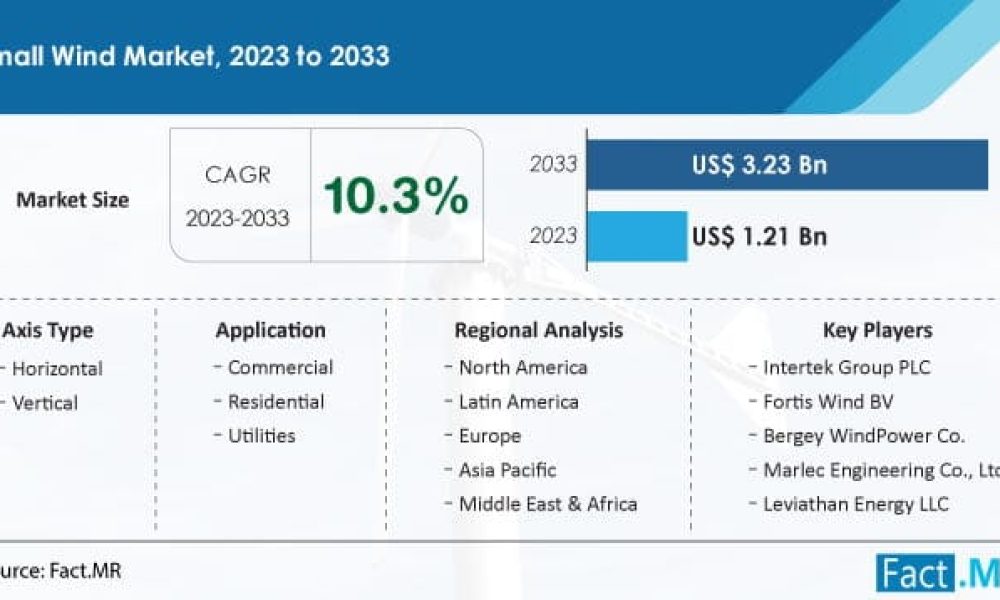
The global small wind market is valued at US$ 1.21 billion in 2023. The market is projected to expand at a stellar CAGR of 10.3% and reach a size of US$ 3.23 billion by 2033-end, according to the latest study by Fact.MR The increasing global energy crisis and the depletion of non-renewable resources to generate electricity are predicted to contribute to the growing demand for small wind systems. Various government regulations are also implemented to restrict carbon footprints to attain the objective of sustainability, which is also predicted to lead to increased adoption of small wind systems.
The Small Wind Market is gaining momentum as a crucial player in the global renewable energy landscape, offering decentralized and sustainable solutions for power generation. Defined by wind turbines with capacities typically ranging from a few kilowatts to 100 kilowatts, small wind systems cater to diverse applications, including residential, agricultural, and commercial settings. The market’s growth is propelled by increasing awareness of clean energy, advancements in turbine technology, and supportive government initiatives promoting distributed energy generation.
Download a Sample Copy of This Report:
https://www.factmr.com/connectus/sample?flag=S&rep_id=8812?PJ
Key Market Drivers:
- Growing Demand for Clean Energy: The primary driver for the Small Wind Market is the increasing demand for clean and renewable energy sources. As concerns about climate change and environmental sustainability rise, there is a heightened emphasis on transitioning to low-carbon energy solutions. Small wind turbines, with their ability to harness wind energy at the local level, align with the global shift toward cleaner power generation.
- Advancements in Turbine Technology: Technological advancements in small wind turbine design and efficiency contribute significantly to market growth. Innovations in materials, aerodynamics, and control systems enhance the performance and reliability of small wind systems. Improved turbine designs maximize energy capture, making small wind energy an increasingly viable and cost-effective option for distributed power generation.
- Supportive Government Incentives: Supportive government policies and incentives play a pivotal role in fostering the small wind market. Many governments around the world offer financial incentives, tax credits, and feed-in tariffs to promote the installation of small wind systems. These initiatives aim to accelerate the adoption of renewable energy and create a favorable environment for investment in small-scale wind projects.
Key Takeaways from Market Study
- The global small wind market was valued at US$ 1.11 billion in 2022.
- The market is estimated to be valued at US$ 1.21 billion in 2023.
- Worldwide demand for small wind systems is projected to rise at a substantial CAGR of 10.3% through 2033.
- The industry is set to reach a valuation of US$ 3.23 billion by the end of 2033.
- Demand for horizontal small wind systems is forecasted to increase at a CAGR of 9.4% and reach a market valuation of US$ 1.7 billion by 2033-end.
“Increasing shift towards renewable energy sources for electricity generation are proving lucrative for suppliers of small wind systems,” says a Fact.MR analyst.
Growing Adoption of Small Wind Systems in Developing Countries
Small wind electric systems are well-liked as cost-effective renewable energy solutions for homes. They are environmentally friendly, emitting zero pollution. Developed countries are increasingly embracing these systems to potentially reduce electricity bills by 50% to 90% and address the need for costly utility power lines in remote areas.
Small wind systems provide uninterrupted power during extended utility outages, ensuring a reliable electricity supply. They find use in various other applications, such as pumping water in ranches and farms.
Growing Energy Consumption in United States
Demand for small wind systems is valued at US$ 164 million in the United States in 2023. Demand for these systems is rising significantly due to the growing energy consumption.
- According to a report by the United States Energy Information Administration in 2021, wind energy is utilized to generate approximately 9.21% of utility-scale electricity annually in the United States.
Challenges and Restraints:
- High Initial Costs: The high initial costs associated with the installation of small wind systems pose a challenge to market growth. While the long-term operational and maintenance costs are relatively low, the upfront investment can be a barrier for individuals and businesses considering the adoption of small wind technology. Efforts to reduce installation costs and enhance financing options are essential to address this challenge.
- Site-Specific Challenges: Small wind systems are sensitive to the local wind conditions and site characteristics. Suboptimal wind resources, turbulent wind patterns, or constrained spaces can affect the performance of small wind turbines. Conducting thorough site assessments and addressing specific challenges related to installation locations are critical to maximizing the efficiency and viability of small wind projects.
Key Market Players
Prominent companies manufacturing small wind systems include Intertek Group PLC, Fortis Wind BV, Jacobs Wind Electric Company, Orchid International, Kliux Energies International Inc., Nerfey WindPower Company, Marlec Engineering Co., Ltd., Leviathan Energy LLC, Foshan Ouyad Electronic Co., Ltd., Energy Technology Centre Ltd., Guangzhou HY Energy Technology Limited Corp., Northern Power Systems, Inc., MOWEA GmbH, Halo Energy, and Braun Windturbinen GmbH.
Wind Energy Expansion in the UK and Germany Fuels European Market Growth
The United Kingdom and Germany are anticipated to maintain a substantial presence in the European market throughout the forecast period. These countries have secured substantial government funding to bolster their wind energy production infrastructure, thereby fostering growth opportunities in the market. Prominent industry players are strategically leveraging these prospects by setting up regional offices and manufacturing facilities in the region.
Get Customization on this Report for Specific Research Solutions:
https://www.factmr.com/connectus/sample?flag=RC&rep_id=8812
Current Industry News (2023):
several trends and developments may have shaped the Small Wind Market in 2023.
- Emergence of Hybrid Systems: The industry may have witnessed an increased interest in hybrid energy systems that combine small wind turbines with other renewable sources, such as solar photovoltaics. Hybrid systems offer a more reliable and consistent power output, leveraging the complementary nature of wind and solar resources. This trend aligns with the broader goal of creating resilient and sustainable energy solutions.
- Focus on Energy Storage Solutions: Small wind projects may have seen a growing focus on integrating energy storage solutions. Battery storage technologies help address the intermittent nature of wind energy, enabling the storage of excess energy during periods of high wind and delivering it when the wind is less favorable. The integration of energy storage enhances the reliability and stability of small wind power systems.
- Community-Based Wind Projects: The industry may have experienced a rise in community-based small wind projects. Collaborative efforts among communities, local governments, and renewable energy developers could lead to the establishment of small wind farms that serve localized energy needs. Community engagement and shared ownership models contribute to the democratization of renewable energy.
- Advancements in Turbine Monitoring: Technological advancements in turbine monitoring and control systems may have gained prominence. Enhanced sensors, data analytics, and real-time monitoring capabilities contribute to proactive maintenance, optimized performance, and extended lifespan of small wind turbines. These advancements support the industry’s efforts to improve overall reliability and reduce operational costs.
More Valuable Insights on Offer
Fact.MR, in its new offering, presents an unbiased analysis of the small wind market, presenting historical demand data for 2018 to 2022 and forecast statistics for 2023 to 2033.
The study divulges essential insights into the market based on axis type (horizontal, vertical), installation (off-grid, on-grid), and application (commercial, residential, utilities), across five major regions of the world (North America, Europe, Asia Pacific, Latin America, and the MEA).
Contact:
US Sales Office:
11140 Rockville Pike
Suite 400
Rockville, MD 20852
United States
Tel: +1 (628) 251-1583
E Mail : [email protected]




