
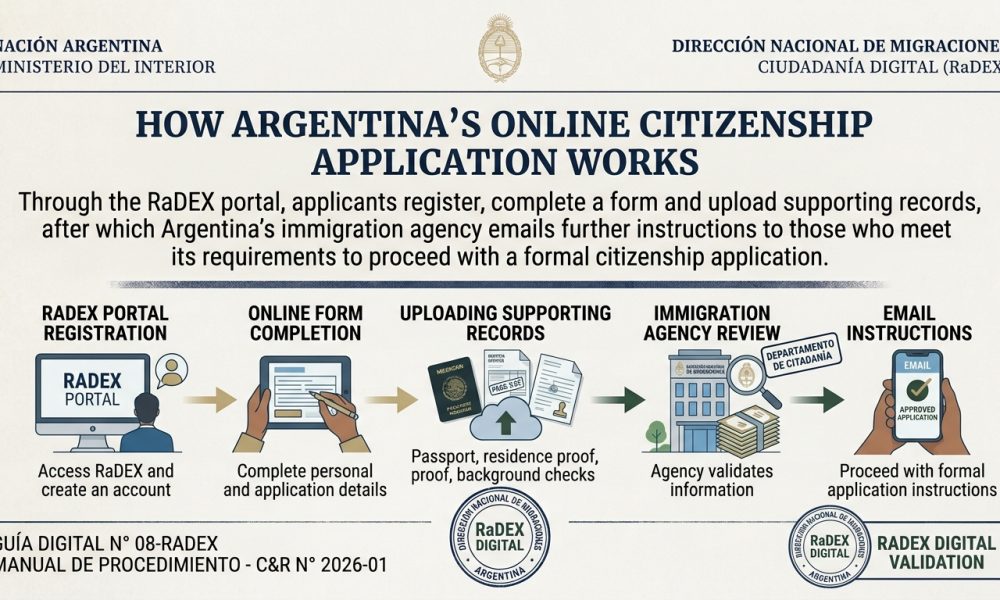
Argentina’s RaDEX platform allows eligible residents to register, upload citizenship documents, and receive instructions by email. Still, electronic preloading does not guarantee approval, and litigation continues over which institution may legally decide naturalization applications.
WASHINGTON, D.C., November 26, 2026
Argentina’s online citizenship application begins with a government registration and document submission process, giving Mexican residents a digital starting point for naturalization while preserving key eligibility checks, subsequent administrative steps, and uncertainty over which authority makes the final decision.
The National Directorate of Migration, known as DNM, uses its RaDEX system to collect applicant information and supporting records. Still, the system’s availability should not be confused with an approved citizenship certificate or a completed naturalization proceeding.
The RaDEX Portal Opens the Process
Argentina introduced the digital naturalization channel in October 2025, following a presidential decree transferring citizenship decisions from the federal judiciary to immigration officials, a controversial institutional reform subsequently challenged before Argentina’s courts, a distinction applicants should understand before relying on the procedure.
The government’s published instructions direct applicants to create an online account, complete the citizenship form, and attach required records; qualified applicants then receive an email explaining how to proceed toward formalizing the request, an important consideration when preparing the official case record.
Applicants Must Be Inside Argentina
Residents should avoid scheduling an application around a planned holiday outside the country, since the portal explicitly requires physical presence when applying online and checks immigration status against official agency records during the preliminary assessment.
The immigration agency’s dedicated citizenship registration page states that anyone using this online procedure must be physically in Argentina, because the system checks existing residence authorization and the period spent in the country.
A Mexican citizen staying in Mexico City cannot safely assume that opening a website from abroad substitutes for residence in Argentina, especially when the agency’s system verifies facts that a foreign internet connection cannot establish.
First Step: Register a Personal Account
The initial registration screen requests names, an email address, identity-document type and number, date of birth, nationality, and contact details, creating the credentials needed to access the subsequent preloading stage, particularly when the applicant must later verify information personally.
Applicants should enter their official details exactly as shown on authentic Identification records, because discrepancies between the account profile, residence history,, and uploaded documents can complicate verification before substantive nationality eligibilityis assessedn,andh accuracyremainsg essential throughout the review process.
The Registered Email Becomes Essential
Because the government may send deadlines or requests to the registered address, applicants should protect account access, check unwanted-message folders, and avoid using an email service controlled exclusively by an adviser or temporary employer, especially when the uploaded evidence supports a later government determination.
Once registration is submitted, the applicant receives a username and password through the designated email account, making continued access to that inbox essential throughout processing and possible requests for further evidence, rather than relying exclusively on informal advice from private intermediaries.
The immigration authority specifically warns users to monitor the address regularly because additional document requests and notice of an in-person appointment may arrive there, rather than exclusively through postal correspondence or a telephone call, a practical safeguard when different official records are subsequently compared.
Second Step: Preload the Citizenship Application
Using the credentials issued after registration, applicants move to RaDEX’s citizenship preloading interface and supply the requested personal information, residence details and electronic versions of supporting documentation relevant to their individual circumstances, making independent verification of the applicant’s circumstances particularly important.
The dedicated interface allows you to upload scans or readable smartphone photos. Still, applicants should ensure pages are complete, official seals are present, and identifying information is legible before sending anything to the agency, without replacing the substantive requirements governing the citizenship request.
Uploaded Documents Do Not Mean Approval
The official portal explains that the process is not fully initiated until the applicant completes the necessary steps and receives confirmations with an assigned expediente, or administrative case number, distinguishing account creation from formal proceedings.
A person who merely receives login credentials should therefore avoid announcing that a citizenship application has been officially accepted, because successful registration only enables later submission and does not establish that legal requirements are satisfied.
The Agency Screens Residence Eligibility
Argentina’s current naturalization guidance addresses foreign-born applicants aged at least eighteen who obtained temporary or permanent residence more than two years earlier, subject to the contested rules governing continuous lawful residence before filing, an administrative detail that applicants should verify before completing submission.
A Mexican applicant who first entered Buenos Aires as a tourist must distinguish that visit from qualifying residence recognized by immigration officials, because the agency’s published calculation does not automatically begin with the first airport arrival.
Travel Records Can Affect the Timeline
Under the 2025 decree’s strict published interpretation, the two qualifying years must occur without international departures, a potentially difficult condition for Mexican residents who visit relatives or supervise business activities outside Argentina, since government authorities may request clarification during later examination.
A brief weekend in Mexico may therefore prompt an eligibility objection under the agency’s instructions. However, litigation concerning the decree means applicants should obtain current advice before treating that restriction as conclusively settled by the courts.
Identity Documents Must Match
An applicant who discovers errors in a civil record should use established correction or certification channels rather than alter an uploaded image, since authorities may compare electronic copies with source documents during later verification.
Argentina’s government requirements call for a national identity document and an authenticated birth record, so names, dates, and personal identifiers should match the applicant’s residence records or be supported by lawful correction documents, especially when delays could disrupt an intended naturalization timeline.
For Mexican residents who have changed surnames through marriage or another legitimate process, maintaining a documentary connection between former and current identities can reduce confusion during the agency’s preliminary screening and subsequent in-person verification, a distinction applicants should understand before relying on the procedure.
Criminal Records Require Careful Preparation
The published naturalization requirements include an Argentine criminal-record certificate and a qualifying certificate from the country of origin concerning previous convictions or pending criminal proceedings, with appropriate legalization where applicable, an important consideration during preparation of the official case record.
Applicants with multiple nationalities or residence in other jurisdictions should seek individualized instructions rather than assume a single Mexican certificate resolves every verification question raised by earlier immigration or court records.
Financial Support Must Be Documented
The distinction between showing financial ability and proving lawful income sources is particularly important for international freelancers, landlords and investors, whose bank balances may be substantial while the underlying business records still require explanation, particularly when the applicant must later verify information personally.
The agency expects proof of lawful employment or legitimate means of subsistence, potentially including recent payslips, tax registration and invoices, tax payments or other documents establishing how the applicant supports themselves, with accuracy remaining essential throughout the subsequent review process.
A self-employed Mexican resident should organize business and payment records before submission, because a convincing explanation of lawful income depends on the underlying economic activity rather than the size of a particular bank account balance.
Tax Registration Can Be Relevant
Argentina’s online instructions list CUIT or CUIL Identification among supporting materials, linking the naturalization review to the records used for employment, taxpayer registration, or social security administration within the country, especially when the uploaded evidence supports a later government determination.
Applicants should verify which identifier applies to their circumstances and ensure supporting income records match it, rather than invent registration details or provide a number belonging to another person, and should not rely exclusively on informal advice from private intermediaries.
Emails May Request Additional Evidence
Timely responses can prevent unnecessary procedural friction, but applicants should confirm that unexpected messages genuinely originate from the immigration authority before disclosing passwords, transferring funds, or sending sensitive Identification documents to unfamiliar accounts, a practical safeguard when different official records are subsequently compared.
After initial upload, the immigration authority may communicate that documents need correction, additional clarification or another filing step, meaning a digital application can still require significant work before the substantive review advances, making independent verification of the applicant’s circumstances particularly important.
Applicants should retain correspondence and copies of every uploaded file, particularly if a later message identifies a missing page, an illegible photograph,o r an inconsistency between the electronic application and an original civil document, without replacing the substantive requirements governing the citizenship request.
In-Person Attendance May Still Be Required
The government website describes both electronic initiation and personal administrative follow-through, so applicants should budget for travel within Argentina, potential translation assistance, and sufficient flexibility if the appointment is assigned after initial document review, an administrative detail that applicants should verify before completing submission.
The agency describes its service as semipresential and explains that successful preliminary processing can lead to an appointment at the migration office, so applicants should not interpret online submission as a promise of entirely remote naturalization.
A Mexican professional planning frequent overseas travel should keep availability for required appointments and maintain accessible originals of significant documents, because electronic copies may not eliminate the need for personal identity verification, since government authorities may request clarification during later examination.
Fees and Instructions Must Be Verified
Applicants should follow the official government payment and procedural instructions shown for their case, and avoid unauthorized intermediaries who promise to expedite naturalization through private access or unofficial administrative charges, especially when delays could disrupt an intended naturalization timeline.
A payment receipt, like an account password or preliminary eligibility email, is a piece of procedural evidence rather than proof of nationality, making careful attention to official status notifications more important than marketing assurances, a distinction applicants should understand before relying on the procedure.
The Constitutional Challenge Is Significant
In June 2026, Argentina’s National Electoral Chamber invalidated the executive decree transferring naturalization authority to DNM, raising constitutional concerns because citizenship involves political rights and the presidency used emergency decree powers, an important consideration during preparation of the official case record.
A La Nación report on the court ruling described the chamber’s reasoning and the dispute over federal judges’ traditional role, illustrating why an active online portal does not by itself settle the underlying jurisdictional controversy.
An Appeal Does Not Equal a Final Judgment
The government challenged the electoral ruling, and an extraordinary appeal advanced toward the Supreme Court during 2026, leaving applicants to distinguish the agency’s currently published administrative instructions from the unresolved constitutional question concerning authority, particularly when the applicant must later verify information personally.
As of November 26, 2026, the verified procedural developments do not establish a conclusive Supreme Court resolution, so an applicant should seek current legal guidance before assuming that online filing conclusively determines which institution will grant citizenship.
Digital Submission Is Not a Passport
Even when a citizenship application advances, a completed electronic form does not establish Argentine nationality, and any eventual approval must be followed by the legally required identity registration and passport procedures administered by competent institutions.
Families should separate the dates of residence eligibility, case initiation, substantive determination, and passport issuance, because buying tickets or ending existing immigration arrangements based on a preliminary RaDEX message can create avoidable risks, and accuracy remains essential throughout the subsequent review process.
Mexican Citizenship Adds Another Legal Question
Mexicans by birth benefit from constitutional Protection against deprivation of Mexican nationality, whereas people who became Mexican through naturalization face different provisions concerning voluntary acquisition of foreign nationality and extended residence abroad, especially where the uploaded evidence supports a later government determination.
A naturalized Mexican should seek appropriate legal advice before acquiring Argentine citizenship, because approval through RaDEX or another lawful procedure does not automatically guarantee retention of Mexican nationality under Article 37, and relying solely on informal advice from private intermediaries is risky.
Other Passports Can Create Separate Duties
Mexican American dual nationals should remember that naturalization abroad does not automatically terminate American citizenship obligations, including the U.S. State Department’s requirements for dual nationals concerning travel documents when entering or departing the United States.
A foreign passport also cannot erase earlier immigration violations or criminal proceedings, making truthful declarations and authentic personal records essential regardless of how efficiently an online government system accepts initial data, a practical safeguard when different official records are subsequently compared.
Identity Privacy Cannot Replace Disclosure.
Individuals exploring Amicus International Consulting’s new identity services should distinguish lawful record updates and privacy planning from using an inaccurate identity to conceal past citizenship, travel, or legal history from immigration authorities, making independent verification of the applicant’s circumstances particularly important.
Where a legal name change has occurred, the safer approach is to preserve authenticated records connecting identities and explain discrepancies honestly, allowing the agency to assess the same applicant consistently across databases and uploaded files.
Second Passport Planning Requires Patience
Families considering Amicus International Consulting’s second passport services may include Argentina in a broader lawful mobility strategy. Still, no consultant can guarantee a Supreme Court outcome, government approval, or a specific naturalization timeline without changing the substantive requirements governing the citizenship request.
A practical plan begins by confirming lawful residence, assembling genuine supporting evidence and understanding the online filing stages, while retaining sufficient flexibility for appointments, administrative corrections and changing judicial instructions, an administrative detail that applicants should verify before completing submission.
The Case Number Marks a Real Milestone
An assigned file number provides a useful reference for lawful follow-up and for subsequent official correspondence about additional supporting records. However, it does not resolve any outstanding identity question, determine the final citizenship outcome, or replace government confirmation when a later procedure requires proof of nationality.
The most useful distinction for prospective applicants is between receiving account credentials, completing electronic preloading, and obtaining confirmation that the citizenship file has formally begun with its own administrative case number, since government authorities may request clarification during later examination.
For Mexican residents using Argentina’s online procedure, RaDEX can simplify initial documentation and communication. However, a successful application still depends on substantive eligibility, procedural follow-through, and the legal authority ultimately responsible for nationality decisions, particularly where delays could disrupt an intended naturalization timeline.




