
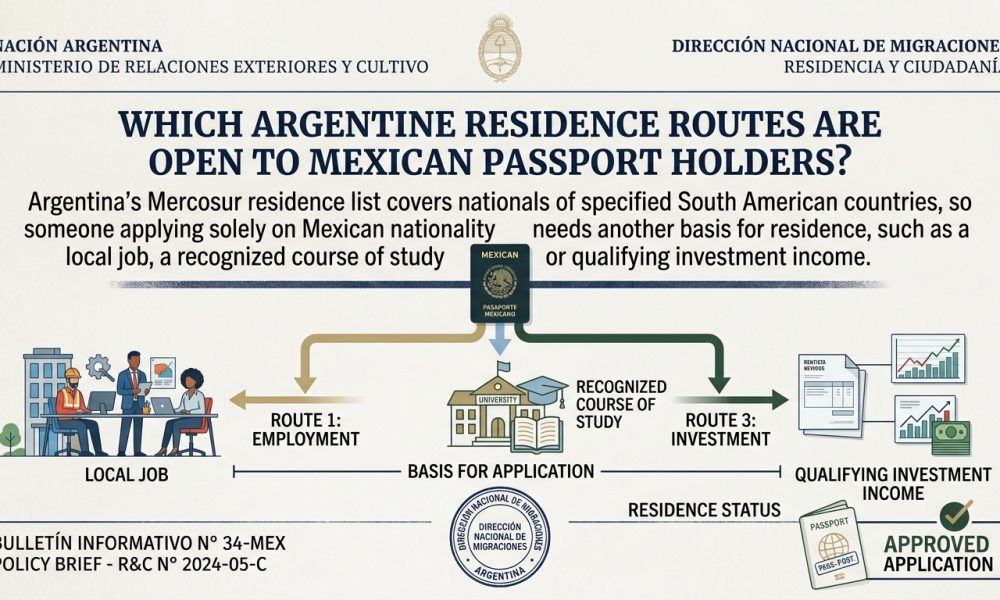
Mexican passport holders cannot use Argentina’s Mercosur residence pathway solely because of Mexican nationality. Still, qualifying employment, education, passive income, retirement benefits, family relationships, and certain investments may support other lawful immigration applications.
WASHINGTON, D.C., November 26, 2026
Mexican citizens considering a new home in Argentina face several potential immigration routes. Still, the regional Mercosur residence program does not automatically include them, so individual circumstances matter more than geographic proximity or shared Latin American heritage.
A legitimate job offer, admission to a recognized university, documented income from owned assets, or qualifying family connections can provide alternative bases. However, each category has separate requirements and still requires government approval.
Mexico Is Not on the Mercosur Residence List
Argentina’s National Directorate of Migration publishes an expedited residence category for specified native nationals of Uruguay, Brazil, Paraguay, Bolivia, Chile, Peru, Ecuador, Colombia, Venezuela, Guyana and Suriname. Still, Mexico does not appear among those qualifying birth nationalities.
The framework generally allows eligible regional nationals to obtain temporary residence for two years, with potential extensions and multiple entries, offering a nationality-based route that is materially different from applications involving employment contracts or demonstrated personal income.
Certain Naturalized Regional Citizens May Qualify
Argentina’s instructions also recognize individuals born outside Mercosur countries who have held citizenship through naturalization for at least five years in specified participating countries, creating a narrower exception that applicants should not confuse with ordinary Mexican nationality.
For a person applying solely as Mexican, however, the practical starting point remains identifying another legal reason for residence rather than assuming that residence somewhere in Latin America produces a regional immigration entitlement.
Salaried Employment Offers a Defined Route
Argentina’s migration legislation recognizes a temporary worker category for foreigners performing lawful remunerated activities under an employment relationship, allowing Mexican professionals to pursue residence when an Argentine employer is prepared to support the required documentation.
The published process calls for a preliminary employment contract describing the employer, duties, location, working hours, and remuneration, along with the employer’s tax Identification and appropriate registration with the immigration authority’s sponsoring-entity system when filing with the National Directorate of Migration today.
Employer Registration Is More Than a Formality
Argentina requires sponsoring employers to comply with applicable registration requirements, including tax authority records and the National Registry of Foreign Requesters (RENURE), when the specific worker procedure requires it.
Recognized University Study Can Support Residence
Another route allows qualifying international students enrolled in educational institutions recognized by Argentina, particularly those in degree programs within the official education system and able to provide the required institutional enrollment documentation under the official student enrollment documentation framework.
A Mexican student accepted into a Buenos Aires engineering program might qualify for temporary student residence. At the same time, certain short courses, exchanges, and informal educational activities may instead fall into categories that do not provide equivalent status.
The currently published student procedure describes an initial renewable one-year authorization. However, the underlying regulatory framework recognizes different periods for certain programs, so the actual residence decision must establish the student’s effective dates.
Academic Enrollment Does Not Replace Immigration Approval
A university admission letter shows an academic opportunity. Still, it does not independently authorize permanent settlement, so the distinction between acceptance, temporary residence approval, and subsequent renewals matters for anyone planning a multiyear degree.
Rentista Residence Depends on Asset Income
Argentina’s rentista category serves people who support themselves with qualifying income from owned assets, including rental property, financial investments, and certain company interests, rather than income earned by personally performing ongoing services within the investment income classifications used by immigration authorities.
A Mexican landlord receiving documented payments from an apartment in Guadalajara may have a relevant financial foundation, provided the applicant establishes genuine ownership, consistent rental receipts, and required transfers through authorized financial institutions.
By contrast, overseas consulting fees and remote employment salaries remain compensation for personal work, even when deposited in foreign currency, and should not be misrepresented as passive income to qualify as rentista income.
The Rentista Threshold Changes Over Time
The published rentista test requires qualifying income equivalent to at least five Argentine minimum monthly wages, so the benchmark moves whenever the national wage floor changes and can also fluctuate when Mexican receipts are converted into Argentine pesos.
A property owner should build in a meaningful safety margin rather than rely on a single favorable exchange rate, because changes between planning and filing may affect whether the documented monthly amount remains sufficient.
The current domestic service procedure describes an initial renewable one-year residence permit, so continuing income documentation matters when an applicant later seeks an extension, not just when meeting the documentary rules for nonregional immigrant applicants.
Pensionado Residence Has a Separate Basis
Retirees receiving qualifying pension payments may investigate Argentina’s pensionado residence category, which has its own documentary standards and should be distinguished from rentista applications based on property returns or other investment income subject to the evidence standards for foreign pension holders.
Pension income does not eliminate ordinary identity and criminal-history screening, and retirees should separately consider medical coverage, financial transfers, and any taxation arising from a permanent move abroad under the documentary screening rules applicable to pension applicants.
Family Reunification May Provide Residence
Argentina recognizes family-based residence possibilities for qualifying spouses, parents and children of Argentine citizens or qualifying residents, subject to the legal relationship, sponsor status and specific provisions currently governing the proposed application under the agency’s current requirements for qualifying family sponsors.
A Mexican citizen married to an Argentine national may consequently have a route unavailable to an unrelated visitor. Still, the marriage must be authentic and documented through records accepted by the responsible immigration authority.
Other family relationships may require proof of dependency, age, or the sponsor’s authorized residence, so it’s unwise to assume every cousin, sibling, or adult relative qualifies through the same reunification procedure when relying on the specific reunification categories available domestically.
Investing Capital Requires Its Own Assessment
Argentina’s migration framework identifies an investor category for foreigners contributing their own assets to activities considered of interest to the country. Still, a portfolio purchase or apartment acquisition should not automatically meet that definition.
Applicants contemplating a business venture should verify the required project, capital evidence, and competent approval mechanism before transferring funds, particularly because immigration residence and investment-related citizenship proposals are distinct legal subjects before relying on investment criteria for a residence application.
Remote Workers Have a Different Temporary Option
Argentina also offers a transitory digital-nomad arrangement for eligible foreign nationals performing qualifying remote services for overseas clients or companies, addressing situations that are not normally suitable for the passive-income rentista category under the separate transitory residence provisions for digital nomads.
That permission generally covers a shorter stay of up to 180 days,s with a possible extension for an equivalent period, rather than an ordinary renewable temporary residence permit for long-term settlement, which cannot automatically replace the requirements for long-term residence.
Mexican freelancers should verify the nationality and work conditions. They should not assume that a digital-nomad authorization necessarily starts the legally qualifying residence period for any future Argentine naturalization application under immigration rules for qualifying remote work arrangements.
Tourists Need a Residence Basis Before Settling
Mexican visitors may explore Argentina under applicable short-stay entry rules. Still, tourist entry permission does not, by itself, establish temporary residence or authorization to undertake paid employment in the country.
Repeated tourist entries or ownership of a local apartment do not substitute for an approved immigration status, and future citizenship calculations should not automatically count every day spent sightseeing before residence was granted.
Applications Require Reliable Criminal Records
Most ordinary residence categories require Identification, lawful entry, proof of address, and appropriate Argentine criminal-background information, along with foreign certificates covering qualifying earlier periods of residence where the current instructions request those documents as determined by the specific immigration category being requested.
Mexican applicants with previous homes in Canada, the United States, or another country may need more than one foreign certificate, particularly when the governing rules examine residence history during the previous three years.
Apostilles, legalization, and accepted Spanish translations may also be necessary, making document preparation a key scheduling task rather than an administrative detail that can always be completed after arrival before filing the residence application with the migration authorities.
RaDEX Handles Many Residence Applications
Argentina’s RaDEX system lets applicants initiate many residence procedures electronically, upload supporting files, and pay the required fees before receiving instructions for any required in-person attendance or document verification, depending on the residency application and filing instructions.
An application receipt or provisional document should be distinguished from final residence approval, because each document’s legal significance can differ for work authorization, Identification, and subsequent naturalization calculations, particularly for applicants who eventually pursue permanent residence or citizenship.
Renewal Dates Affect a Long-Term Plan
Temporary residence authorizations have stated validity periods and renewal conditions, so it’s essential to track expiration dates, continued employment or student enrollment, qualifying income, and any changes to family sponsorship circumstances well before the expiry of their existing migration authorization.
Households should preserve every approval and renewal record, since an unexplained gap in authorized status may matter when seeking permanent residence or assessing the legal requirements for eventual citizenship when immigration authorities later review evidence of continuous lawful residence.
Permanent Residence Is a Separate Milestone
Argentina’s published residence guidance generally identifies three years of qualifying temporary residence as a route toward permanent residence for nationals outside the relevant Mercosur framework, subject to conditions including actual presence and the applicable administrative rules.
Mexican applicants should not confuse that potential progression with the ordinary two-year Mercosur temporary permit available to specified regional nationalities, because the starting categories and qualifying periods serve different legal purposes under the distinct criteria governing nonregional temporary residence applicants.
The government also recognizes particular family circumstances that can support permanent residence under separate provisions, making a personalized analysis more reliable than assuming everyone must follow one identical three-year timeline under the alternative statutory routes for qualifying family members.
Naturalization Requires Another Legal Review
Argentine citizenship is not automatically granted after gaining temporary or permanent residence because naturalization involves separate substantive conditions and an institutional dispute over executive immigration authority and judicial decision-making powers as courts review the validity of contested nationality procedures.
A 2025 Associated Press report on Argentina’s immigration restrictions described government reforms affecting foreign residents, providing context for why prospective applicants should verify current procedures rather than rely on older descriptions of the country’s migration system.
The 2025 decree introduced particularly strict continuous-residence language for naturalization, while later court litigation challenged key provisions, so prospective citizens should seek qualified legal advice on the rules that apply to their specific history.
Mexican Nationality Also Requires Attention
Mexican citizens by birth generally enjoy constitutional Protection against loss of their nationality. In contrast, naturalized Mexican citizens face separate Article 37 risks when voluntarily acquiring another nationality or remaining continuously abroad for a specified period.
A Mexican national considering an Argentine passport should therefore examine whether their original Mexican nationality arose by birth or naturalization, because the consequences of eventual foreign naturalization can differ substantially between those categories.
The United States State Department’s dual-nationality guidance further illustrates how governments maintain independent obligations for their own citizens, particularly where a Mexican applicant also possesses American nationality and plans to travel with multiple passports.
Tax and Healthcare Need Independent Planning
Legal residence does not automatically determine every tax obligation or guarantee universal public healthcare, because foreign-source income, family arrangements, residence history, and insurance status can each engage rules separate from immigration admission under the independent statutory frameworks for taxation and public insurance.
Identity Records Must Remain Consistent
Readers investigating Amicus International Consulting’s new identity services should distinguish legitimate civil-record changes from fabricated residence or employment histories, because Argentine immigration authorities require truthful information and reliable evidence connecting each applicant with their actual circumstances.
A lawful name change should be supported by official documentation linking previous passports and certificates, rather than treated as a way to conceal earlier citizenship, criminal proceedings, or inconsistent financial information when resolving discrepancies in applications submitted to immigration authorities.
A Second Passport Comes Later
Families considering Amicus International Consulting’s second passport services can compare Argentine residence options with longer-term nationality goals. Still, no private adviser can guarantee immigration approval or replace the government’s determination of the correct legal category.
The practical starting point is to choose an authentic residence basis, gather the required supporting evidence, and understand renewal obligations before calculating when permanent residence or a separate citizenship application becomes realistic.
The Right Route Depends on the Applicant
For Mexican-only passport holders, Argentina’s Mercosur nationality route is generally unavailable. Still, genuine employment, recognized education, passive asset income, qualifying pensions, family relationships, and certain investment arrangements can offer alternative lawful possibilities.
The strongest relocation plan distinguishes temporary permission from permanent settlement and citizenship, preserves authentic records, and addresses the individual’s financial circumstances, rather than assuming that a Mexican passport automatically opens every Argentine immigration pathway without meeting independently applicable legal, documentary, and administrative requirements.




