
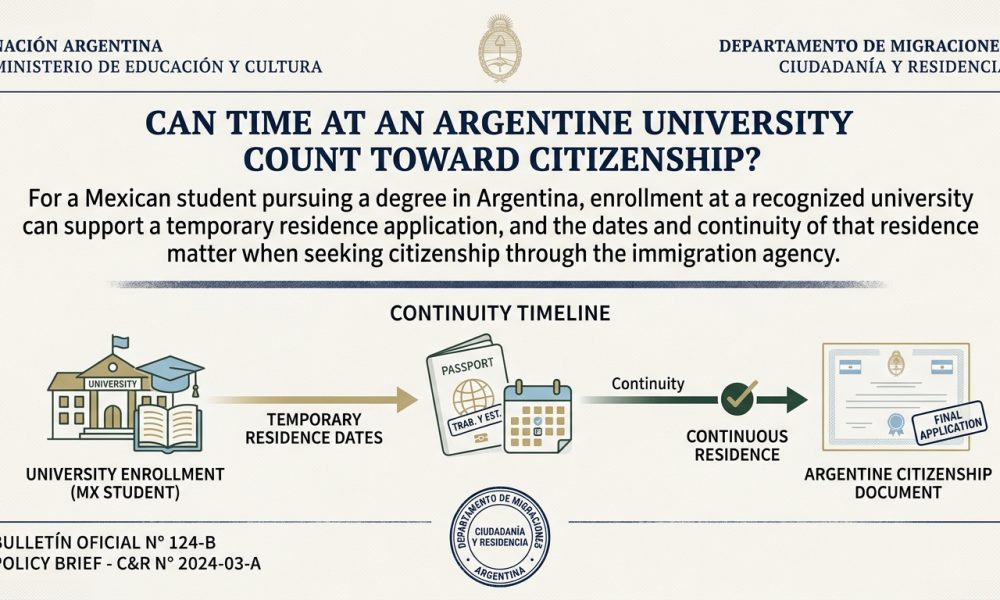
Mexican students enrolled at recognized Argentine universities may obtain temporary residence that can support a later naturalization application. Still, the legal status granted, its effective dates, and uninterrupted residence matter more than academic attendance alone.
WASHINGTON, D.C., November 26, 2026
A Mexican student completing a degree in Buenos Aires may find that university education opens a legitimate pathway to Argentine residence and potentially future citizenship. However, enrollment alone does not start a guaranteed naturalization countdown or eliminate separate immigration requirements.
Argentina’s current immigration rules recognize temporary residence for students in qualifying programs. At the same time, a contested 2025 citizenship reform requires two years of continuous legal residence immediately before applying, so applicants must pay close attention to permits, international travel, and administrative records.
University Enrollment Can Support Temporary Residence
Argentina’s Migration Law 25,871 recognizes students as a temporary residence category when they attend officially recognized educational institutions and follow qualifying courses, providing a possible lawful foundation for a Mexican national undertaking a full university degree rather than a brief tourist visit.
The National Directorate of Migration’s student residence procedure identifies appropriate educational enrollment, government Identification,, and supporting records. It specifies that applications proceed through the country’s electronic RaDEX system and then require an appointment with migration officials.
Recognized Courses Matter More Than Marketing
Verify a university’s formal recognition and course classification before relocating, because Argentina distinguishes full degree programs within the official educational system from informal training courses, short exchanges, and other academic activities with different immigration consequences.
A Mexican student entering a recognized engineering degree can fall under a different migration category than someone purchasing a short private language course, even if both institutions describe their programs as opportunities to study in Buenos Aires.
Not Every Student Permit Is Temporary Residence
Argentina’s 2023 student regulation distinguishes full programs within the official education system, which can qualify for temporary residence, from certain nonofficial courses and international mobility programs that generally receive transitory authorization rather than the same residential classification.
This distinction matters because the currently published naturalization procedure refers specifically to temporary or permanent residence, making transitory study permission an unreliable basis for assuming that two years of citizenship-qualifying residence have begun.
The Student Permit Has Its Own Validity Period
A prospective student should distinguish an academic offer from the immigration authority’s subsequent residence decision, because acceptance by even a prestigious public university cannot determine how long a foreign national will legally be authorized to remain in the country.
Although the underlying student regulation allows qualifying residence grants of up to two years in some circumstances, the current government service page describes an initial one-year temporary student authorization that may be extended following the applicable procedures.
Students should rely on the actual dates printed in their authorization and official immigration record, rather than assume a university’s four-year academic program automatically produces a four-year residence permit without renewals or additional government review.
The Starting Date Is an Immigration Question
A Mexican citizen might arrive as a tourist in February, begin university classes in March, and receive an approved temporary student residence permit in June, creating three different dates that should not be casually treated as equivalent for citizenship eligibility.
Under the immigration agency’s current administrative interpretation, the legally recognized period of temporary or permanent residence matters, and the applicant should confirm its effective start date rather than automatically counting earlier tourist days.
A Pending Application Is Not Always Enough
An online submission receipt, residence appointment, or provisional document can demonstrate that a student initiated immigration procedure. Still, the 2025 reform expressly distinguishes provisional residence from the recognized status used to establish settlement or naturalization eligibility.
Administrative delays deserve individual legal assessment, especially where a student remains lawfully present while awaiting a final decision, because assuming that every pending month counts could lead to an incorrectly timed citizenship filing.
Two Years Must Precede the Citizenship Application
Argentina’s published citizenship instructions require adult foreign applicants to have obtained temporary or permanent residence more than two years earlier and to demonstrate continuous legal residence during the two years immediately preceding their naturalization application.
Completing two academic years does not automatically satisfy this rule if the student obtained qualifying immigration status later, allowed a residence authorization to lapse, or spent substantial time outside Argentina under the contested administrative interpretation.
A Summer Trip to Mexico Raises Questions
The presidential decree introduced in May 2025 defines continuous naturalization residence strictly under its contested framework, and the immigration agency’s current instructions say applicants must not have made any international departure during the relevant two-year period.
A student who visits family in Guadalajara during the university summer break may therefore encounter a citizenship-continuity objection even while maintaining enrollment and an otherwise valid student permit, demonstrating why academic calendars and naturalization requirements must be planned separately.
Residence Permission and Citizenship Continuity Differ
A temporary student permit can remain valid under its own entry and absence rules. At the same time, a separate naturalization application may face objections about continuous physical presence, since immigration authorization and nationality procedures answer legally different questions.
Students should not assume that the ability to reenter Argentina after vacation preserves their entire two-year naturalization period, particularly while the validity of the relevant decree remains contested in court.
The Courts Challenged the 2025 Reform
Argentina’s National Electoral Chamber ruled against Decree 366/2025 in June 2026, questioning the government’s transfer of naturalization decisions from federal judges to immigration officials and the constitutional use of emergency decree powers.
A La Nación report on the June court decision explained the judicial challenge, which the government appealed, meaning applicants should distinguish the agency’s still-published requirements from a final Supreme Court resolution that has not been verified.
The Appeal Does Not Guarantee Eligibility
The constitutional litigation creates uncertainty concerning which institution may adjudicate naturalization and what legal residence conditions are enforceable. Still, an individual student should not treat an unresolved appeal as permission to disregard official instructions entirely.
Qualified Argentine legal counsel can review relevant court developments and the applicant’s permit history, especially when a proposed filing depends on counting provisional periods, foreign travel, or a residence classification authorities might dispute.
The RaDEX Process Requires Documentation
Students who expect their citizenship eligibility to mature while they finish their degree should maintain their immigration records year by year, rather than attempt to reconstruct effective dates and disputed periods from scattered correspondence after graduation.
The immigration agency directs applicants to register through RaDEX, complete the application, pay the appropriate fees, and upload supporting documents; after that, eligible students receive instructions for a required in-person appointment and verification.
A Mexican student’s submission should therefore include Identification and evidence issued or certified by the educational institution, ensuring the university’s confirmation matches the exact program and enrollment status shown in the application.
Educational Institutions Have Registration Duties
The university or other qualifying establishment must be registered with the immigration authority and issue the relevant electronic enrollment confirmation, because personal acceptance letters alone may not satisfy every document required for the student-residence procedure.
Prospective students should contact the institution’s international admissions office before travel to confirm that it can provide the recognized immigration enrollment certificate and that the chosen program falls within the appropriate legal category.
Criminal Records and Translations Matter
Depending on age and previous residence, applicants may need Argentine and foreign criminal-history certificates, along with officially accepted translations, apostilles, or legalization, creating preparation requirements independent of whether a university has accepted their academic qualifications.
Mexican students with earlier residence in another country should disclose that history accurately and determine which authorities must issue certificates, rather than assume that a clean record from Mexico alone covers every background requirement.
Students Must Maintain Genuine Enrollment
Renewal may require evidence that the applicant remains a regular student in an eligible academic program, so continuing enrollment, university records, and timely submission of the next immigration application matter throughout the residence period.
A student who withdraws, is dismissed, or transfers to an unrecognized course should reassess the immigration implications before assuming that the original permission continues indefinitely despite changes to the facts supporting its issuance.
Switching Universities Requires Administrative Care
Changing universities or degree programs may be academically sensible. Still, a student should confirm whether new enrollment documentation and immigration updates are necessary, particularly if the replacement program differs in recognition, duration, or residence classification.
Maintaining complete copies of approval letters, enrollment certificates, grades, and permit renewals helps establish a reliable chronological record if officials later review whether the student continuously qualified for the claimed immigration residence status throughout the period.
Graduation Does Not Grant Citizenship
The safest transition from study to work or another authorized status is one planned before the current permission expires, with written confirmation of application deadlines and any effects that a category change might have on residence continuity.
A completed university degree demonstrates academic achievement rather than Argentine nationality, and a graduate who wishes to remain should identify a qualifying immigration route before the student authorization expires or no longer fits their circumstances.
Professional employment, eligible family connections, or another lawful residence category may offer further options. Still, changing categories can require fresh evidence and does not retroactively repair earlier gaps in a naturalization residence history.
Students Need a Financial Plan
Tuition, housing, and daily living costs require separate evaluation, because an immigration residence application does not guarantee admission to every university, access to public funding, or a stable supply of financial assistance throughout a multiyear course.
Argentina’s 2025 reforms also address whether public universities can charge certain international students, making current institutional fee policies more important than older descriptions suggesting every overseas applicant receives identical tuition treatment.
Working During Studies Needs Verification
Students considering part-time employment should check the specific employment rights tied to their authorized status and any separate payroll or professional requirements, rather than assume all educational residence permissions allow unrestricted local work.
A university internship, paid placement, or remote foreign contract may create additional labor and tax questions, especially when the activity changes the reason for residence or affects the documentation submitted in a later citizenship application.
Tax Residence Is a Separate Legal Concept
Spending a substantial portion of the year in Argentina can create tax consequences under domestic financial rules. Still, an income-tax residence determination is not automatically interchangeable with qualifying immigration residence for naturalization purposes.
Mexican students receiving family support, investment earnings, or freelance income should review relevant reporting obligations in both countries, especially when their living arrangements and employment activities become more substantial than a temporary academic exchange.
Families Should Preserve Accurate Records
Parents helping a student finance education abroad should keep authentic transfer records, birth records, and legal identity documents, since the university and immigration authority may require different evidence of family relationships, financial support, and personal history.
Readers reviewing Amicus International Consulting’s new identity services should distinguish lawful documentation changes from disguising past immigration or educational records, because government decisions require truthful information and a reliable connection between previous and current identities.
A Mexican Passport Does Not Confer Citizenship
Mexican citizenship may allow the applicant to visit Argentina under applicable entry rules. Still, it does not automatically waive the country’s student-residence application or guarantee a shorter Argentine naturalization period than for other qualifying foreign applicants.
Naturalized Mexican citizens should separately examine Article 37 of Mexico’s Constitution before acquiring Argentine citizenship, since voluntary foreign naturalization can expose that category of Mexican nationality to legal risks not faced by Mexicans by birth.
American Dual Nationals Have Other Duties
Students who also hold American citizenship should remember that studying abroad does not automatically terminate their obligations to the United States, and travel documents and government assistance remain subject to applicable American rules.
The United States State Department’s study-abroad guidance emphasizes passport preparation, destination-country requirements, and emergency planning, essential considerations that remain relevant when an international student is also navigating Mexican and Argentine identity documentation.
A Future Passport Needs Its Own Approval
Families exploring Amicus International Consulting’s second passport services can consider Argentine university residence as one option for lawful international mobility. Still, private advisers cannot guarantee that study periods will meet citizenship requirements or overcome contested legal provisions.
An effective plan identifies the recognized university, secures the correct temporary residence, preserves renewal and travel records, and evaluates naturalization eligibility only after confirming how the prevailing Argentine rules apply to the student’s actual history.
The Answer Depends on Recognized Residence
For families comparing Argentina with other destinations, the most meaningful planning milestone is not simply the university graduation date but the legally recognized residence anniversary, followed by a separate eligibility review and a decision from the competent citizenship authority.
University time can matter in an Argentine citizenship application when it is supported by qualifying, valid temporary residence and the applicant meets the separate naturalization requirements, rather than merely having attended classes or held an academic Identification card.
For a Mexican student planning to spend two years in Buenos Aires, the key questions are when lawful residence began, whether it continued, and which naturalization rules remain enforceable after the pending constitutional litigation is resolved.