
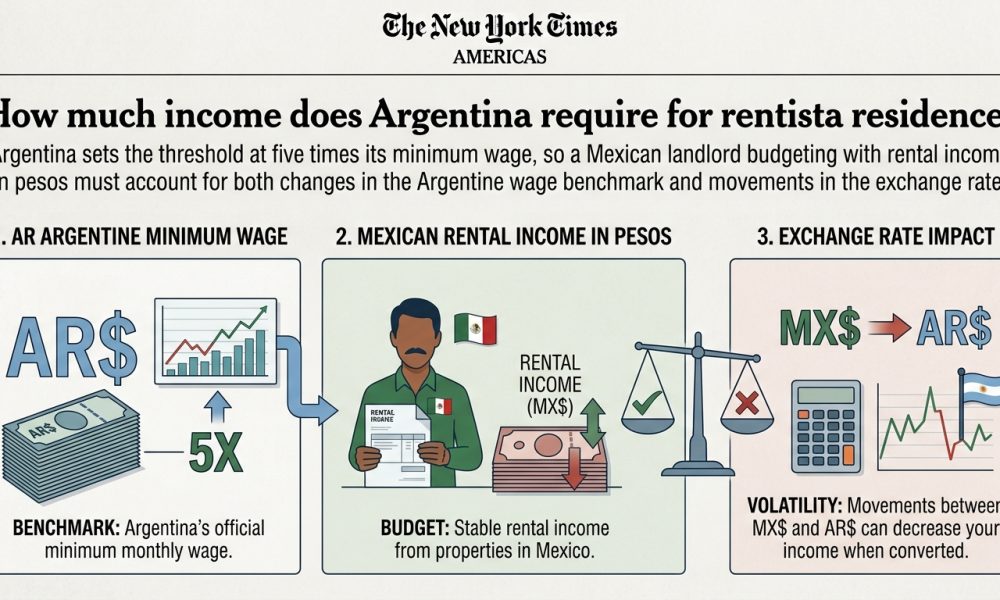
Argentina requires qualifying asset-derived income of at least five national minimum monthly wages, making exchange-rate changes, rental documentation, and future wage increases important for Mexican property owners planning to reside in Buenos Aires.
WASHINGTON, D.C., November 26, 2026
Mexican landlords considering Argentina’s rentista residence permit must demonstrate more than ownership of valuable property, because immigration authorities require qualifying income that meets a threshold tied directly to the country’s minimum monthly wage.
The benchmark changes as Argentina adjusts its national wage floor, while rents collected in Mexican pesos introduce another variable, meaning an applicant who appears comfortably eligible today could face a different financial calculation when filing or renewing.
The November 2026 Threshold Is ARS 1,994,000
Argentina’s minimum monthly wage for November 2026 is ARS 398,800 under Resolution 4/2026, and multiplying that amount by the five-wage rentista requirement produces a qualifying monthly income benchmark of ARS 1,994,000.
This income threshold is expressed in Argentine pesos, not a fixed annual property valuation or a permanently established United States dollar amount, so applicants should not treat older migration advice as a reliable current quotation.
The regulation sets a minimum, not an approval guarantee, and officials can independently assess whether the revenue comes from eligible assets, can be properly documented, and enters Argentina through authorized financial channels.
December Brings a Higher Published Benchmark
Resolution 4/2026 already schedules the monthly minimum wage to increase to ARS 406,400 in December 2026, which would lift the corresponding five-wage rentista benchmark to ARS 2,032,000 if the current formula remains applicable.
The scheduled increase demonstrates why the precise assessment date matters, because the peso amount needed to qualify can change between an initial consultation, collection of foreign documents, and the immigration office’s review of a completed application.
A Mexican owner receiving a fixed monthly rental payment should calculate a margin above the applicable requirement, rather than assume that an amount barely sufficient in November will necessarily remain sufficient in a later filing month.
The Government Defines Rentista Income Narrowly
Argentina’s National Directorate of Migration describes rentista residence as available to foreigners who support themselves through benefits derived from assets incorporated into their personal estate, including real property, financial instruments, and qualifying company ownership interests.
The official instructions exclude remuneration obtained through personal work, so a consultant receiving monthly retainers cannot establish rentista eligibility merely by describing foreign clients’ payments as passive income or routing them through an investment account.
For Mexican landlords, authentic lease payments may provide the relevant foundation. At the same time, the fees earned managing other people’s properties require separate treatment because those receipts typically compensate active services rather than returns from owned assets.
Mexican Rental Income Requires Currency Planning
For planning purposes, a landlord should model both a modest weakening of the Mexican peso and another Argentine wage increase, since those changes could occur together and reduce eligibility even while the original lease continues performing exactly as promised.
Suppose a landlord receives rent in Mexican pesos but must demonstrate an Argentine-peso equivalent, because the economic value of those receipts can shift when the currencies move against one another between collection and immigration assessment.
If the Mexican peso weakens relative to the Argentine peso, a constant contractual payment may translate into fewer Argentine pesos, potentially reducing the applicant’s margin above the immigration threshold even without any change in the tenant’s rent.
Conversely, a favorable exchange-rate movement may increase the converted value of the same payment. However, applicants should not depend on temporary currency appreciation to compensate for an otherwise insufficient or poorly documented recurring income stream.
Exchange Rates Need a Reliable Reference
Confirm the relevant exchange rate and valuation date with the receiving immigration authority or competent adviser, because commercial currency-conversion quotations, bank settlement rates, and government reference rates do not always produce identical figures.
Landlords should distinguish the rent contract’s gross amount from income actually received, considering withholding, property expenses, payment interruptions, and transfer charges when applicable documentation or an agency assessment makes those distinctions relevant to demonstrated disposable income.
Label any peso conversion quoted during preliminary planning with its date and source, rather than presenting it as a permanent threshold that will remain accurate throughout a multi-month immigration application and eventual renewal.
A Published Wage Schedule Helps Applicants Budget
Argentina’s September 2026 wage resolution established monthly increases extending beyond November, and a September report by Todo Noticias described the sequence as part of the government’s published national minimum-wage adjustments affecting worker compensation.
That reporting provides useful context for the moving benchmark. Still, applicants should treat the official resolution and the National Directorate of Migration’s current instructions as controlling references when calculating their own eligibility under the rentista residence category.
The five-wage formula is more durable than any single peso amount, making periodic recalculation a necessary part of budgeting rather than a one-time exercise performed when a family first considers moving abroad and estimates future costs.
Asset Ownership Must Be Demonstrable
A residential lease is more useful when supported by a property title, authentic tenant agreement, and consistent bank deposits, because immigration officials may reasonably examine both the applicant’s ownership interest and the lawful source of payments.
Where the property is jointly owned, the applicant should determine which portion of rental proceeds legally belongs to them, instead of reporting all property revenue as personal income without accounting for other owners’ entitlements.
Applicants using properties held through companies or trusts require individualized assessment of the economic and legal arrangements, because a company statement does not automatically establish that every underlying receipt is personally available to the residence applicant.
Stable Income Matters Beyond One Good Month
Argentina’s related entry-permit guidance describes rentista income as stable and expected for at least two years, reinforcing the importance of evidence demonstrating ongoing capacity rather than an isolated high-value bank transfer shortly before filing.
A landlord whose tenant recently departed should avoid presenting an unsigned replacement lease as guaranteed income. At the same time, le someone with several occupied properties may be better positioned to document continuity through normal tenant turnover.
Historical deposits, valid leases, and credible supporting records help explain expected payment. Still, immigration approval remains a government decision, not a mathematical entitlement created whenever an applicant shows a sufficient total in their recent accounts.
Funds Must Enter Through Authorized Institutions
Argentina’s implementing migration rules require applicants to document the origin of funds and their entry through banks or financial institutions authorized by the Central Bank, making transparent transfers integral to the rentista category.
An individual receiving rent in a Mexican account should therefore plan how to establish the transfer trail into Argentina, keeping statements and receipts rather than assuming that owning overseas assets alone satisfies the financial documentation requirement.
Informal cash couriers or transactions lacking reliable records can undermine an otherwise strong application, particularly where immigration officials need to reconcile rent agreements, account ownership and the actual funds transferred internationally through authorized financial providers.
The Threshold May Apply to Each Applicant
A family intending to submit several applications should request confirmation about whose income may be counted and how each requirement is documented, because assuming one rental stream covers everyone could create unexpected shortfalls after fees and translations have already been paid.
The migration disposition establishing five minimum wages states that applicants in a family group must demonstrate the required income for each residence, which can materially change the budget for couples or households applying together.
A Mexican landlord planning residence with a spouse should therefore verify the actual amount required for each application and whether any family-specific procedure changes the documentation, rather than automatically treating one threshold as sufficient for everyone.
Dependent children, accompanying relatives and the precise residence category can raise additional questions, making early review of family composition essential before calculating the financial resources needed to support an international household over the full residence period.
Rental Income Is Different From Salary
A Mexican professional earning a stable salary from a foreign company may have more regular monthly receipts than a landlord, but payments for personal work are specifically excluded from the published rentista income definition.
Freelancers and remote employees should explore other suitable immigration categories rather than relabeling service invoices as asset distributions, because mischaracterizing income can create document inconsistencies and potentially serious problems during government review of the immigration application and supporting evidence.
A landlord who also performs consulting work should keep those revenue streams separate, counting only qualifying asset-derived receipts toward the rentista requirement rather than assuming every foreign transfer contributes to the five-wage threshold.
Rentista Residence Is Not the Same as Pensioner Residence
Argentina maintains a separate pensionado residence category for eligible people receiving qualifying pensions from governments, international organizations, or private institutions, with its own documentary criteria even though a five-wage financial benchmark also appears.
Mexican retirees receiving public or private pension benefits should compare the appropriate categories before deciding how to file, because legitimate retirement payments and rental-property returns have different legal origins and may require different official certificates. Identical numerical benchmarks do not eliminate the need to choose the correct residence classification, and applicants should not assume a pension statement substitutes for evidence of rentista income from personally owned assets.
Initial Permission and Renewal Require Planning
The distinction between statutory maximums and the residence period actually issued is especially important for families signing multiyear housing leases, because a one-year initial permit can still require affirmative renewal supported by current financial evidence before it expires.
Argentina’s current domestic rentista instructions generally describe temporary residence granted initially for one year with possible extension. At the same time, other entry-permit provisions use broader statutory periods that should not be confused with the current filing procedure.
Renewal can involve fresh evidence that qualifying income still reaches the applicable wage multiple, meaning an increase in the minimum wage or a fall in foreign rental receipts may matter after the original permit is approved.
Applicants should retain updated contracts and financial statements throughout residence, rather than assemble records only once and assume later renewals cannot revisit the origin, consistency, or sufficiency of supporting income despite later changes in financial circumstances.
Mexican Tax Obligations Remain Separate
Rental proceeds from Mexican real estate may remain subject to Mexican tax obligations, while establishing residence in Argentina can trigger separate reporting questions, so a migration income threshold should never be mistaken for a complete tax analysis.
Applicants should consult advisers qualified in both jurisdictions about rental taxation, foreign tax credits,s and any applicable agreements before changing financial arrangements, particularly when long-term residence will coincide with continued property ownership in Mexico.
For Mexican American landlords, the Internal Revenue Service’s guidance on citizens abroad explains ongoing American tax responsibilities, adding another reason to coordinate immigration decisions with existing financial obligations rather than treating a new residence permit as a tax exemption.
Citizenship Plans Need Another Legal Review
Temporary residence as a rentista does not itself grant Argentine nationality, because naturalization requires separate legal conditions and government procedures that have also been affected by reforms and constitutional litigation during 2025 and 2026.
Mexican nationals considering eventual Argentine citizenship should distinguish ordinary residence authorization from the contested continuous-residence rules, particularly where travel to inspect rental properties or visit relatives may create complications under the agency’s published naturalization instructions.
Naturalized Mexican citizens also face distinct constitutional nationality-loss risks when voluntarily acquiring another citizenship, so a long-term Argentine plan should review Mexico’s Article 37 before any eventual naturalization, not just the initial residence application.
Identity and Asset Records Must Remain Authentic
Families exploring Amicus International Consulting’s new identity services should distinguish lawful identity documentation from concealing property ownership or fabricating rental contracts, because immigration officials require truthful records connecting the applicant to the actual income-producing assets.
A legal name change does not erase previous tax obligations or turn wages into rent, so a documented connection between earlier and current identities is essential when banks and government agencies assess international transfers.
A Second Passport Is Not a Guaranteed Outcome
Readers considering Amicus International Consulting’s second passport services should understand that qualifying for Argentine rentista residence is separate from future citizenship, and no private adviser can guarantee approval, even if the applicant meets the income threshold.
The practical starting point is to verify authentic asset income, calculate the current five-wage amount, document currency conversion and authorized transfers, then assess whether the family’s financial resources comfortably exceed the threshold during the intended residence period.
The Five-Wage Formula Is the Essential Number
Applicants should distinguish the mathematically calculated threshold from the amount ultimately accepted by immigration officials, because documentary quality, income stability, authorized transfers, and any additional family-member requirements can remain decisive even when the peso figure appears sufficient.
As of November 26, 2026, Argentina’s five-wage rentista benchmark is ARS 1,994,000 per month, with the already scheduled December adjustment increasing the corresponding figure to ARS 2,032,000 under the published wage resolution.
For a Mexican landlord paid in pesos, long-term eligibility planning therefore depends on two moving measures: Argentina’s minimum wage and the relevant currency exchange rate, along with reliable documentation showing that qualifying rental income continues to arrive.