
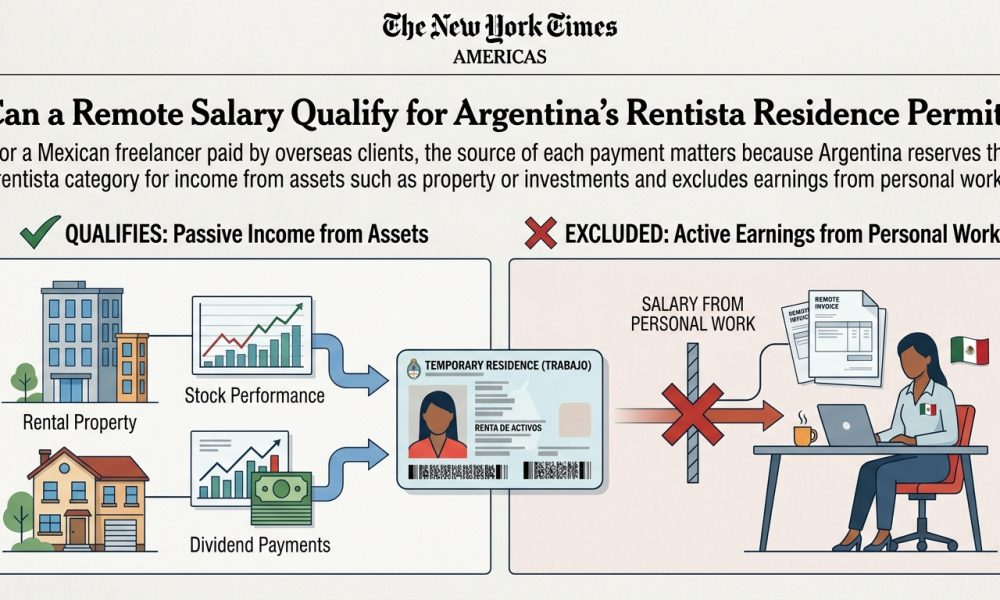
Mexican freelancers paid by overseas clients must distinguish compensation for personal services from returns on owned assets, because Argentina excludes employment and consulting income from its rentista category despite the foreign location of the payer.
WASHINGTON, D.C., November 26, 2026
Mexican professionals contemplating a move to Buenos Aires often ask whether salaries, consulting fees, or freelance payments from overseas clients can support Argentina’s rentista residence permit. Still, the government’s published conditions clearly distinguish between earned compensation and qualifying passive income.
Although an applicant may receive substantial monthly deposits from businesses in Mexico, the United States, or Europe, the customer’s origin does not turn payment for active work into income generated by investments or other owned assets.
Rentista Residence Is Designed Around Assets
Argentina’s National Directorate of Migration describes rentista residence as a category for foreigners who maintain themselves from benefits produced by assets in their personal estate, including financial instruments, real property, and qualifying interests in companies.
Its published instructions expressly exclude compensation obtained through personal work, meaning applicants should examine what produces each payment rather than rely on the fact that the money crosses a border before reaching their account.
Foreign Clients Do Not Make Income Passive
The key question is not whether customers are based outside Argentina, but whether the applicant receives returns from owned property or financial interests without providing ongoing services that generate ordinary earned income.
A graphic designer living in Mexico City might earn a dependable monthly income creating advertising materials for clients based in California. Yet, those invoices compensate ongoing professional services rather than the ownership of an income-producing asset.
The same analysis ordinarily applies to software development contracts, online teaching, marketing consultancy and bookkeeping services, because the professional must perform productive work to receive payment even when the client never enters Argentina.
A Remote Employee Faces the Same Distinction
A Mexican programmer employed by an American technology company may collect a regular salary in dollars and retain a foreign employment contract. Still, those circumstances do not change the fundamental character of the payments as remuneration for labor.
Neither foreign payroll administration nor payment through an international bank establishes the passive-income foundation required for rentista, so the employment relationship should be evaluated under an immigration category appropriate to remote or local work.
Rental Property Can Produce Qualifying Returns
A Mexican homeowner receiving documented rent from property outside Argentina presents a different case, because lease payments may derive from an asset already owned by the applicant rather than from services performed for a customer.
Authorities can still examine complete, authentic title documents, lease agreements, bank deposits, and the economic substance of the arrangement, particularly where a supposed rental structure disguises remuneration for active management or professional services.
Investment Income May Also Qualify
A family living on diversified securities or income-producing real estate should prepare records covering an extended period, because a stable pattern of lawful distributions provides a more persuasive financial explanation than one unusually large deposit.
Dividends, interest, and other benefits from qualifying financial investments can fall within the asset-income framework, provided the applicant establishes ownership, legitimate origin, consistency, and the ability to bring the necessary funds into Argentina through recognized channels.
An occasional investment sale should not automatically be treated as a recurring income stream, because officials may distinguish ordinary proceeds from capital disposal and focus on demonstrable investment returns that can support continued residence.
Company Ownership Requires More Than Labels
A shareholder receiving genuine distributions from an overseas business may have qualifying investment returns. Still, amounts described as dividends deserve scrutiny when they actually compensate the shareholder’s daily consulting, administrative, or operational work.
Incorporating a freelance business abroad and transferring its receipts to a personal account does not necessarily create passive income, because immigration authorities may consider the economic nature of the underlying services and distributions.
The Minimum Amount Changes With Wages
Argentina’s current instructions require qualifying rentista income equal to at least five times the national minimum monthly wage, making the required amount variable rather than a permanently fixed figure denominated in Argentine pesos or American dollars.
Applicants should calculate the threshold using the official minimum wage for their filing period and allow for exchange-rate movements, documentation expenses, and ordinary living costs instead of relying on figures advertised months earlier.
Bank Transfers Need a Traceable Path
Currency conversion and international transfer fees matter when calculating available resources, and applicants should avoid informal arrangements that make it hard to show where the money came from or which authorized institution processed the transfer.
The immigration agency requires evidence that qualifying funds enter Argentina through Central Bank-authorized banking or financial institutions, making traceability an important part of the application beyond proving that the applicant owns valuable assets.
Account statements, distribution records, and transfer documentation should show a complete, consistent financial history, since unexplained transfers between unrelated parties can raise questions even when the total deposited exceeds the monetary threshold.
A Large Savings Balance May Not Settle Eligibility
Someone with substantial savings but no identifiable investment income should not assume a single account balance automatically meets the rentista requirements, because the published guidance focuses on resources and benefits arising from assets.
Where large capital balances or unusual investment structures are involved, applicants should request a specific, individualized assessment from the competent immigration authority rather than characterize every available dollar as acceptable recurring income.
Digital Nomad Status Addresses Remote Services
Argentina maintains a separate transitory residence option for qualifying digital nomads who provide services remotely through electronic communications for individuals or companies domiciled abroad, making that route more directly relevant to many freelancers.
The program was introduced in 2022, when an Associated Press report on Argentina’s remote-worker initiative described efforts to attract international professionals whose occupations could be performed online while they temporarily lived in the country.
The Nomad Category Has Nationality Conditions
Argentina limits its digital-nomad category to nationals of countries whose citizens do not require tourist visas to enter, so applicants should verify eligibility using their passport and applicable entry rules before proceeding.
A Mexican applicant should also distinguish visa-free tourist entry from permission to perform remote services, because the digital-nomad category provides a defined immigration framework rather than turning every vacation into employment authorization.
The Nomad Permit Is Shorter Term
A remote designer who needs only several months in Buenos Aires might find a transitory authorization aligned with that limited objective. In contrast, a household seeking years of settlement must explore a residence category that supports its intended duration.
The official digital-nomad procedure provides transitory residence for up to 180 days, with the possibility of extension for an equivalent period, rather than the ordinary one-year renewable rentista residence currently described on the migration agency’s service page.
This difference matters for anyone hoping to establish a durable household, because authorization for a temporary remote-work stay should not be treated as automatically interchangeable with the legal residence required for future permanent residence or naturalization.
Application Procedures Also Differ
The rentista process begins through Argentina’s RaDEX electronic application system and proceeds toward an in-person appointment after initial review. At the same time, the current domestic digital-nomad instructions describe an in-person procedure rather than filing through RaDEX.
Applicants should confirm the route appropriate to their location and status, since submitting remote-work invoices through a rentista application simply because its online forms appear convenient can create a substantive eligibility problem.
Nomad Applications Need Work Evidence
The digital-nomad procedure requires a detailed description of independent professional activity, a brief curriculum vitae, and evidence such as contracts, employer attestations, or professional-fee receipts, along with at least one relevant occupational reference.
Those same documents can demonstrate precisely why an applicant does not fit rentista, because invoices and service contracts clearly show ongoing active professional remuneration rather than investment income generated without performing new work.
Salaried Employment in Argentina Is Different
A foreign professional hired by an Argentine employer may instead qualify for temporary residence as a migrant worker, subject to a genuine employment relationship, a preliminary contract, and the employer’s required immigration and tax registrations.
An overseas company’s remote salary should not be casually relabeled as local employment either, because the worker category involves specific employer sponsorship and labor conditions that must match the actual working arrangement.
Criminal and Identity Records Remain Necessary
Rentista applicants must demonstrate valid Identification, lawful entry, and an Argentine address. In contrast,e older applicants generally need the specified Argentine and foreign criminal-record documentation covering relevant previous residences and the applicable screening period.
Mexican certificates or documents issued elsewhere may require apostilles, formal legalization, and properly certified Spanish translations, so applicants should coordinate document preparation rather than assume financial eligibility replaces standard personal background-verification requirements.
Tax Residence Is a Separate Question
An immigration classification that allows foreign income does not determine whether a person becomes an Argentine tax resident, because domestic tax laws may consider physical presence, residence status, and other factual connections independently of the visa description.
Freelancers should investigate how foreign business receipts are treated, which social security contributions apply, and any remaining Mexican tax obligations before moving, especially when continuing client relationships could create additional compliance questions across jurisdictions.
American Connections Add Their Own Responsibilities
Mexican American dual nationals planning remote work from Argentina must also account for continuing United States obligations, and the U.S. State Department’s business travel guidance advises travelers to verify that their destination-country immigration status permits the activities they intend to undertake.
An American employer’s willingness to permit work from abroad does not itself establish Argentine authorization or resolve taxation, payroll, professional licensing and employer compliance questions that may arise when services are performed in another jurisdiction.
Mixed Income Requires Separate Classification
For instance, monthly rent from an independently owned Mexican apartment should be documented apart from payments for managing other owners’ properties, because the latter generally reflects services even when both revenue streams appear in the same banking account.
A Mexican entrepreneur might receive commercial rents, portfolio dividends, and consulting fees in the same month, so it’s essential to classify each source separately rather than submit the combined bank deposit as if every component were passive.
If qualifying asset income independently meets the required financial threshold, the applicant may be in a different position than someone whose total income reaches that level only after including payment for personal services.
Documentation Should Establish Economic Substance
Reviewers may need to understand who owns the assets, how distributions are calculated, and whether payments are expected to continue, so a coherent documentary record is more useful than a spreadsheet containing attractive but unsupported revenue projections.
Applicants should also disclose material changes in income where required during renewal, because a residence permission grounded in passive returns may become difficult to support if the underlying property is sold or distributions stop.
Families Need Their Own Residence Planning
A freelancer relocating with a spouse or children should assess each family member’s legal status, including separate applications, schooling arrangements, and healthcare coverage, rather than assume the principal applicant’s income automatically establishes unrestricted rights for every dependent.
Households should also budget for residential rent, emergencies, and transfer costs in Argentina, recognizing that meeting an immigration income threshold does not guarantee affordable housing or comprehensive medical insurance for an entire family.
Another Passport Does Not Change Income Character
People considering Amicus International Consulting’s new identity services should distinguish lawful identity documentation from disguising the source of remuneration, because a new legal name or additional passport cannot transform professional fees into investment returns.
Authorities may examine previous identities, tax records,s and the legal origins of funds, making authentic documents and truthful explanations more important than any promotional assurance that foreign earnings automatically qualify for passive-income residence.
Citizenship Plans Require Realistic Timelines
Applicants interested in eventual Argentine citizenship should distinguish temporary digital-nomad permission from qualifying legal residence for naturalization, especially after the country’s 2025 reforms and subsequent judicial challenges concerning residence requirements and decision-making authority.
Anyone planning a two-year citizenship pathway should get current Argentine legal advice before choosing a short-term immigration category, because neither remote-work income nor a transitory permit guarantees that the required naturalization period has begun.
A Second Passport Is Not an Income Exemption
Families reviewing Amicus International Consulting’s second passport services can compare Argentina with other lawful mobility options. Still, private intermediaries cannot waive statutory income classifications, alter immigration decisions, or guarantee future nationality merely because substantial money arrives from overseas.
A responsible application strategy identifies genuinely passive receipts, verifies the prevailing financial threshold,d and evaluates the correct residence category before major relocation commitments, rather than trying to fit a convenient legal label to an incompatible employment arrangement.
The Source of Payment Determines the Answer
For a Mexican freelancer paid by foreign clients, the basic answer is that ordinary salary and professional-service fees do not satisfy Argentina’s published rentista income test merely because the payments originate abroad or arrive in foreign currency.
Qualifying returns from owned assets may support a rentista application, while remote-work earnings point toward separate immigration possibilities, making transparent financial records and category-specific legal review essential to a sustainable Argentine relocation plan.




