
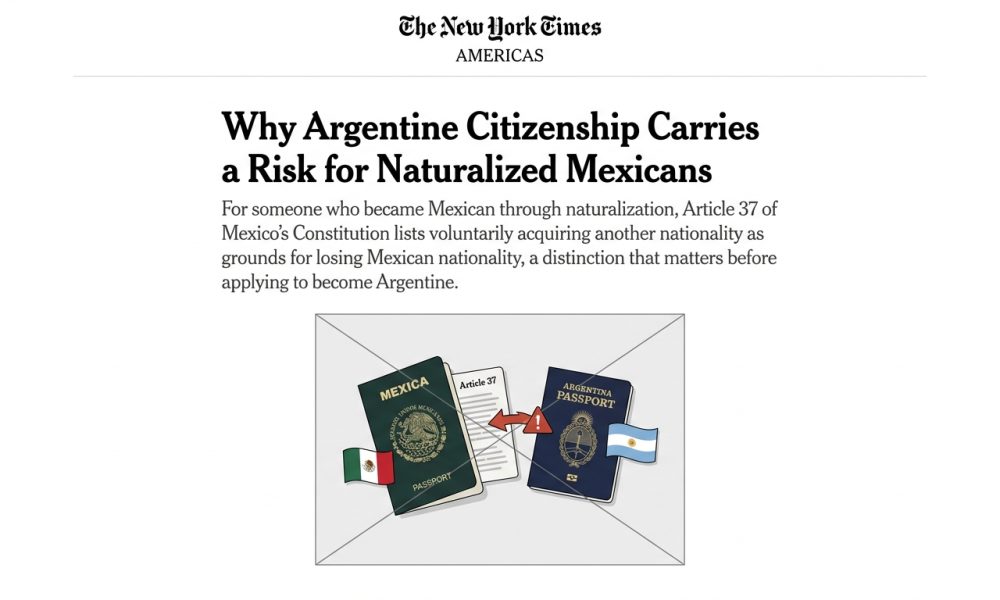
Mexico’s Constitution protects nationality acquired by birth against deprivation. Still, Article 37 establishes different rules for naturalized Mexicans, making voluntary Argentine naturalization, foreign passport use, and prolonged residence abroad potentially serious legal concerns.
WASHINGTON, D.C., November 25, 2026
Mexican citizens considering Argentine naturalization face an important constitutional distinction that can determine whether acquiring another passport strengthens their international options or puts their existing nationality at risk, particularly when they originally obtained Mexican citizenship through naturalization.
Although Mexico recognizes multiple nationality in certain circumstances, Article 37 of its Constitution sets specific grounds for losing nationality acquired through naturalization, creating complications for foreign-born residents who later seek Argentine citizenship through residence.
Mexican Citizenship Has Two Different Legal Foundations
Mexico distinguishes nationality acquired by birth from nationality obtained through naturalization, and this distinction has lasting consequences when individuals subsequently acquire other citizenships, obtain foreign passports, or establish permanent residence outside Mexican territory.
A person born abroad to a qualifying Mexican parent can possess Mexican nationality by birth, while a foreign national granted a Mexican naturalization certificate occupies a different constitutional category despite holding similar ordinary Identification documents.
Article 37 Protects Mexicans by Birth
Article 37 establishes that Mexican nationality acquired by birth cannot be taken away, providing important Protection for individuals who subsequently naturalize elsewhere while preserving the nationality they originally acquired under Mexican constitutional law.
A Mexican citizen by birth who lawfully acquires Argentine nationality can therefore generally retain Mexican nationality. However, separate questions involving public office, travel documentation, taxation and other obligations still require appropriate legal consideration.
Naturalized Mexicans Face Different Restrictions
The same constitutional article identifies voluntary acquisition of another nationality as a ground for losing Mexican nationality obtained through naturalization, making an Argentine citizenship application potentially consequential for someone who originally became Mexican as a foreign national.
This is not merely a question of whether Argentina permits multiple citizenships, because Mexico independently determines the conditions under which its own naturalization status can be retained, challenged, or lost.
Voluntary Acquisition Is the Central Concern
When a naturalized Mexican deliberately applies for Argentine citizenship through an ordinary naturalization procedure, the resulting acquisition may fall within the constitutional provision addressing voluntary acceptance of a foreign nationality after becoming Mexican.
The applicant should therefore obtain a legal assessment before completing Argentine naturalization, rather than assume that Argentina’s willingness to recognize another citizenship obliges Mexico to disregard its own nationality-loss provisions.
A Practical Example Illustrates the Risk
Consider a Philippine-born individual who became Mexican through naturalization, established a household in Mexico City, and later moved to Buenos Aires after deciding that Argentine nationality would provide additional residence and travel opportunities.
If that person later voluntarily acquires Argentine citizenship, Mexican authorities may have grounds to initiate the nationality-loss process under Article 37, even though the applicant previously held a valid Mexican naturalization certificate.
A Mexican Passport Does Not Resolve the Distinction
Possession of a ten-year Mexican passport does not, by itself, establish whether the holder is Mexican by birth or by naturalization, because both categories can hold valid government-issued travel documents despite their differing constitutional protections.
Applicants should examine the legal basis of their citizenship, including birth registration records or the original naturalization certificate, before relying on general statements that Mexican nationals can always retain multiple citizenships.
Foreign Passport Use Is a Separate Constitutional Ground
Article 37 also lists using a foreign passport as a ground affecting Mexican nationality by naturalization, meaning applicants must consider more than the formal act of acquiring Argentine citizenship when planning international travel.
The constitutional wording further addresses presenting oneself as a foreigner in a public instrument, making accurate legal advice particularly important where an individual already holds another nationality or frequently uses different passports.
Earlier Citizenship Histories Require Individual Analysis
A naturalized Mexican who previously held Philippine, American, or another nationality should not assume that the constitutional treatment of an existing nationality is identical to the voluntary acquisition of a new nationality after Mexican naturalization.
The timing and legal character of each citizenship, together with any use of foreign passports, require careful examination because different circumstances may engage separate statutory or constitutional provisions.
Five Continuous Years Abroad Create Another Risk
Article 37 separately identifies continuous residence outside Mexico for five years as a ground for losing Mexican nationality by naturalization, making extended Argentine settlement potentially significant even without completing an Argentine naturalization application.
An individual considering Argentina as a permanent retirement or business destination should therefore examine both the proposed acquisition of another citizenship and the independent consequences of prolonged residence away from Mexico.
Short Trips Should Not Become a Compliance Strategy
Naturalized Mexicans should not assume that occasional travel to Mexico automatically resolves every residence-related concern, because the legal meaning of continuous foreign residence requires assessment under the governing provisions and the individual’s actual circumstances.
A reliable plan should document where the person genuinely lives and obtain qualified Mexican advice about relevant residence evidence, rather than manufacture travel patterns intended to disguise a permanent foreign household.
Loss of Nationality Requires a Legal Procedure
A constitutional ground for loss does not mean every person instantly loses Mexican nationality without an official process, because Mexico’s Nationality Law requires procedural protections and administrative action by the competent authorities.
Article 27 provides for a hearing before loss of nationality by naturalization. At the same time, Article 32 requires the Foreign Ministry to revoke the naturalization certificate following the applicable legal process when the statutory conditions are established.
The Foreign Ministry Has a Central Role
Mexico’s Secretariat of Foreign Affairs administers nationality matters, including naturalization certificates and procedures addressing possible nationality loss, making the agency’s formal determinations more important than assumptions expressed by private intermediaries or foreign immigration authorities.
Article 28 also requires designated authorities and public officials to report circumstances that may fall within Article 37, showing that nationality-loss proceedings can arise from official information rather than only an individual’s voluntary disclosure.
The Individual Has a Right to Be Heard
The Nationality Law’s requirement for a prior hearing matters because a person facing possible revocation should have an opportunity to address the relevant allegations, submit evidence, and pursue any available legal remedies.
Applicants should nevertheless avoid confusing procedural safeguards with substantive immunity, since a hearing does not eliminate constitutional grounds for loss or guarantee a favorable determination after officials review the evidence.
Nationality Loss Does Not Automatically Affect Relatives
Article 29 of Mexico’s Nationality Law provides that a decision concerning loss of nationality by naturalization affects the individual subject to the resolution, an important limitation for households containing spouses and children.
Children who independently possess Mexican nationality by birth may therefore occupy a different legal position from a parent whose naturalization certificate is challenged, making separate documentation and family-specific analysis essential.
Argentina’s Naturalization Requirements Add Complexity
Argentina’s ordinary citizenship framework has traditionally centered on a two-year residence requirement, while reforms introduced during 2025 attempted to impose stricter conditions concerning lawful residence and uninterrupted physical presence immediately before application.
For a naturalized Mexican, the decision to pursue Argentine citizenship consequently involves two separate legal questions: whether Argentina will approve the application and whether eventual approval creates consequences under Mexican constitutional law.
Argentina’s 2025 Immigration Reform Remains Significant
A May 2025 Associated Press report on Argentina’s immigration crackdown described the government’s effort to tighten naturalization requirements, illustrating how the Argentine process can change independently of Mexico’s longstanding constitutional distinction between nationality by birth and naturalization.
Subsequent Argentine litigation challenged the government’s authority to transfer naturalization decisions from federal courts to immigration officials, adding procedural uncertainty without changing the need for applicants to examine Mexico’s separate nationality-loss provisions.
A Pending Argentine Application Is Not Citizenship
Merely considering Argentine naturalization or submitting preliminary documents should not automatically be equated with actually acquiring foreign nationality, because Article 37 identifies legally significant conduct that must be evaluated according to its precise circumstances.
Nevertheless, applicants should obtain advice before filing rather than waiting until approval, since completing the naturalization process may leave fewer opportunities to reconsider decisions that affect existing Mexican nationality.
A Mexican by Birth Faces a Different Calculation
A Mexican citizen born in Guadalajara who later establishes residence in Buenos Aires can generally consider Argentine naturalization without encountering the same constitutional ground for loss of Mexican nationality through voluntary foreign naturalization.
By contrast, a person born in the Philippines who later became Mexican through naturalization must assess whether acquiring Argentine citizenship would affect the legal status previously obtained from Mexico.
U.S. Dual-Nationality Rules Are Not Mexican Rules
The U.S. Embassy’s guidance on dual nationality in Mexico explains important aspects of holding American and Mexican citizenship. Still, American nationality principles should never be assumed to determine whether Mexico permits a naturalized Mexican to acquire another nationality.
Someone holding American, Mexican, and potentially Argentine citizenship must examine the laws of all three countries, because the Protection afforded by one nationality system cannot override another government’s constitutional requirements.
Different Governments Can Reach Different Conclusions
Argentina may recognize an individual as a citizen following lawful naturalization even when Mexican authorities subsequently determine that the same person’s Mexican naturalization status has become vulnerable under Article 37.
This possibility illustrates why international nationality planning requires coordinated legal analysis rather than separate applications pursued without considering the interaction among citizenship acquisition, passport use, foreign residence and potential nationality loss.
Losing Mexican Nationality Has Practical Consequences
A formal loss determination can affect a person’s ability to rely on Mexican citizenship for residence, documentation and other rights, creating potentially substantial disruption where the individual continues to own property or maintain family relationships in Mexico.
Former naturalized citizens should not assume an Argentine passport automatically replaces all practical benefits of Mexican nationality, particularly where future employment, banking arrangements, or family relocation depend on their existing legal status.
Property and Banking Should Be Reviewed Separately
International households should assess how a nationality change might affect financial accounts, investment structures and property ownership, since banks and other institutions can request updated Identification and evidence of current legal status.
A Mexican naturalization certificate under review may create administrative complications involving compliance records, making accurate information and early consultation more valuable than attempting to conceal a later citizenship acquisition from regulated institutions.
Tax Residency Does Not Follow the Same Formula
Mexican tax residence, Argentine tax residence, and nationality are separate legal concepts, meaning a person can face tax obligations in one country without holding its citizenship or satisfying another country’s naturalization requirements.
The decision to relocate should therefore consider income reporting, foreign assets,s and applicable tax agreements independently of nationality retention, especially where employment or investments remain connected to Mexico after a move.
Authentic Identity Records Remain Essential
Individuals exploring Amicus International Consulting’s new identity services should distinguish legitimate identity documentation and privacy planning from any attempt to conceal previous nationalities, because government citizenship decisions depend on authentic records and truthful disclosures.
A lawful name change or newly issued passport does not erase an earlier Mexican naturalization, subsequent Argentine citizenship, or relevant residence history, making reliable documentary continuity essential for cross-border compliance and future official verification.
Second Passport Planning Must Consider Existing Rights
Families reviewing Amicus International Consulting’s second passport services should evaluate the durability of every existing nationality before pursuing another, particularly when one citizenship was acquired through naturalization and remains subject to constitutional loss provisions.
Assess the value of an Argentine passport alongside any potential loss of Mexican nationality, rather than treating the acquisition of another document as an uncomplicated improvement in mobility and personal security.
Qualified Advice Should Precede Argentine Naturalization
A naturalized Mexican considering relocation to Argentina should obtain advice from appropriately qualified practitioners in both jurisdictions, with particular attention to Article 37, the Nationality Law and the individual’s complete nationality history.
That review should address the intended naturalization, foreign passport use, and extended residence abroad before irreversible commitments are made, while confirming that any administrative determination concerning Mexican nationality follows the applicable legal procedures.
The Central Distinction Is Nationality by Birth
For Mexicans by birth, Argentina can represent an additional lawful citizenship opportunit. At the same time,e naturalized Mexicans face constitutional risks that may outweigh the expected benefits unless their circumstances have been carefully reviewed under Mexican law.
The key lesson is that multiple passports do not necessarily provide stronger legal security, because acquiring Argentine nationality can create an unexpected vulnerability when existing Mexican citizenship was obtained through naturalization rather than birth.




