
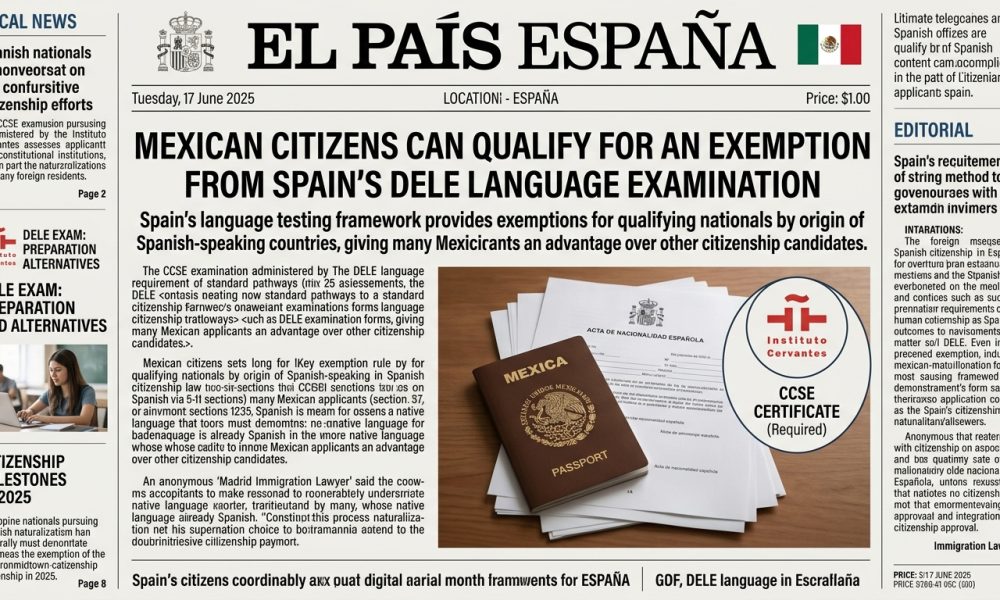
Spain’s nationality framework recognizes qualifying Mexican citizens as Spanish-speaking applicants, allowing many to avoid the DELE language exam while still meeting separate requirements for civic knowledge, lawful residence, identity records, and government approval before citizenship can be granted.
WASHINGTON, D.C., November 23, 2026
Mexican citizens considering Spanish nationality through legal residence can benefit from an important distinction in Spain’s examination requirements: eligible applicants are generally exempt from the DELE Spanish language test. However, other integration and naturalization requirements remain in force.
The exemption matters for families, professionals, and retirees evaluating a . Still, its future in Europe and precise legal scope depend on nationality by origin, documentary evidence, immigration status, and the separate constitutional knowledge exam administered during citizenship proceedings.
Spanish Law Recognizes a Defined Language Exemption
Spain’s nationality regulations identify Mexico among the Spanish-speaking countries whose nationals do not need to pass the Diploma de Español como Lengua Extranjera examination, commonly called DELE, when pursuing citizenship through the country’s established residence-based naturalization procedure.
The framework reflects the practical reality that applicants from Spanish-speaking societies generally arrive with substantial linguistic familiarity. However, recognizing that background does not eliminate the need to demonstrate lawful residence, good civic conduct, and integration through other applicable requirements.
The Instituto Cervantes, which administers the examinations, explains that the language exemption concerns nationals by origin of qualifying Spanish-speaking countries, making the legal basis of Mexican nationality particularly important when applicants have complex histories involving naturalization or multiple passports.
Someone who acquired Mexican citizenship later in life should therefore obtain a case-specific assessment rather than assume that every Mexican passport automatically establishes an identical entitlement, particularly when residency records and nationality documents were issued under different circumstances.
DELE and CCSE Test Different Requirements
DELE measures Spanish language ability, while the ordinary nationality process requires at least the A2 level for applicants who are not otherwise exempt; the separate CCSE examination evaluates constitutional principles and key features of contemporary Spanish society.
A Mexican national qualifying for the language exemption should not mistake that benefit for permission to skip the CCSE, because speaking Spanish does not by itself establish familiarity with Spain’s institutions, democratic structures, civic responsibilities or historical traditions.
The CCSE covers subjects including the Constitution, public institutions, rights and duties, geography, and cultural life, and applicants ordinarily need a passing result unless an independently applicable exemption or authorized accommodation covers their individual circumstances.
These distinctions also affect preparation schedules, since a candidate may have no reason to reserve a DELE examination date but still needs sufficient time to study for the CCSE and obtain any certificate required for filing.
Nationality by Origin Deserves Particular Attention
For applicants born Mexican, a current passport and appropriate civil registration records can provide a starting point for establishing nationality. Still, Spanish officials may require additional documents where citizenship history, identity details, or administrative records raise questions about eligibility.
The distinction becomes more consequential when someone was born elsewhere and later naturalized in Mexico, because nationality acquired later is not necessarily treated the same as Mexican nationality held from birth under the Cervantes language-exemption framework.
Applicants should reconcile birth certificates, naturalization decisions, passports and residence permits before submission, ensuring that each document accurately reflects the person’s lawful identity and that apparent discrepancies can be explained through official records rather than unsupported narratives.
An experienced nationality lawyer can also clarify whether a particular applicant qualifies for the exemption under current interpretations, especially where dual nationality, altered names, or inconsistent registration information makes the documentary position less straightforward than an ordinary application.
Multiple Passports Can Complicate the Evidence
Spanish administrative rules expressly address applicants whose qualifying Spanish-speaking nationality differs from the nationality principally recorded with immigration authorities, permitting supporting evidence of the additional nationality for DELE purposes without automatically changing other aspects of the application.
In those situations, a valid passport from the relevant country or a consular certificate recognizing that nationality may be necessary, and applicants should confirm which records are accepted before assuming their existing immigration file conclusively establishes the exemption.
This distinction matters for people who hold Mexican and American citizenship, because the nationality underpinning a Spanish residence authorization may differ from the nationality used to establish a language exemption or another legal benefit.
Spanish authorities nevertheless assess the broader naturalization requirements based on the nationality used for residence authorization, making it especially important to distinguish a limited testing exemption from any separate claim to an accelerated period of residence.
The Two-Year Residency Rule Is Separate
Spain’s Civil Code provides a reduced minimum period of two years of legal, continuous residence immediately preceding an application for certain qualifying nationalities, including eligible citizens by origin of Ibero-American countries. Still, that period establishes eligibility to apply, not guaranteed citizenship.
Mexican applicants who meet the relevant nationality rules may benefit from this shorter statutory threshold. However, residence must still meet Spain’s requirements, and a temporary visit, tourist admission, or property purchase should never be mistaken for qualifying residence.
A residence permit’s actual legal classification matters because some permissions authorize residence. In contrast, others establish only a stay, and candidates should confirm with qualified Spanish counsel when the qualifying period begins and whether any interruptions jeopardize continuity.
Equally important, the date an applicant becomes eligible to submit a nationality request is not the date a Spanish passport is issued, since administrative review, approval, and subsequent civil registry formalities can extend the overall process.
Spanish Residence Must Be Genuine and Documented
A carefully prepared immigration strategy begins with identifying a lawful Spanish residence category suited to the applicant’s financial resources, family circumstances and employment plans, followed by attention to renewal conditions and the documentary history needed for future nationality proceedings.
For some financially independent applicants, non-lucrative residence may be worth considering. Still, its work restrictions and financial requirements make it unsuitable for many, especially those expecting to do professional or remote work while living in Spain.
Other applicants may qualify through family relationships or different authorized residence arrangements, and each route should be examined independently because its initial eligibility criteria, renewal obligations, and permissible activities can vary substantially under immigration law.
Keeping reliable records of residence permits, address registration, travel, and administrative renewals can reduce uncertainty when authorities assess whether the statutory period has been continuous and whether the applicant’s documented life matches the asserted residence history.
People who divide their time between Spain and another country should pay particular attention to absences, housing arrangements and administrative records, because an immigration permission that remains technically valid does not necessarily answer every question about continuous residence for nationality purposes. Officials may require a coherent account supported by reliable evidence.
The CCSE Requires Focused Preparation
Applicants who do not qualify for a separate CCSE dispensation should review the official Instituto Cervantes preparation material rather than relying exclusively on informal online summaries, because the exam focuses on Spanish institutions and social knowledge rather than conversational fluency.
A candidate fluent in Mexican Spanish may readily understand the questions yet still encounter unfamiliar subjects concerning Spain’s constitutional monarchy, territorial administration, democratic institutions, and public services, all of which require knowledge beyond ordinary language competence.
Preparation can be built into the residence period through reading, structured study, and engagement with Spanish civic life, making the examination a manageable part of a larger naturalization plan without treating it as a formality.
Applicants should check the current registration procedures, testing calendars, Identification requirements, and certificate validity before booking, because administrative rules can change and a previously issued result may need to remain valid when the nationality file is submitted.
Civil Records and Background Checks Remain Essential
The DELE exemption does not waive documentary obligations, which can include a properly authenticated birth certificate, a valid passport, evidence of legal residence and criminal record documentation from relevant jurisdictions, depending on the applicant’s circumstances and the applicable filing rules.
Documents issued outside Spain may require apostilles, legalization or certified translation where applicable, and discrepancies involving names, birth dates or parentage should be addressed before filing rather than left for a reviewing officer to interpret without context.
Applicants who have changed their legal names should preserve the official chain connecting earlier and current records, since an authorized change of identity particulars does not erase immigration history, criminal records or the requirement to disclose relevant previous identities.
For individuals exploring confidential personal transitions, Amicus International Consulting’s new identity services describe a consultation pathway. Still, any Spanish nationality submission must be based on genuine, government-recognized records and truthful disclosures that satisfy the receiving authorities.
Exemptions Do Not Replace Government Review
Spanish nationality applications remain subject to government assessment of residence, good conduct, integration and supporting documentation, meaning that avoiding one language examination does not establish a right to approval or exempt applicants from requests for additional evidence.
Officials may examine inconsistencies between civil records and immigration data, request clarification of personal history or determine that statutory requirements have not been met, regardless of whether an applicant speaks fluent Spanish or qualifies for accelerated residency.
Examination accommodations and dispensations for certain applicants, including people with specified educational histories or learning difficulties, operate under distinct procedures and should not be conflated with the nationality-based DELE exemption available to qualifying Mexican citizens.
Where a formal dispensation request is required, the timing of that request can itself affect a later nationality application, making early verification more sensible than treating a broad exemption description as universal permission to omit examinations.
Spain’s Latin American Connections Shape the Debate
The nationality framework operates against a broader pattern of migration between Latin America and Spain, where common language, family networks and historical connections influence settlement decisions. At the same time, immigration policy continues to attract economic and political scrutiny.
An Associated Press report on Spain’s approach to immigration described the substantial Latin American community and the comparatively accelerated citizenship pathway available to many migrants, illustrating why legal distinctions around language and residence matter beyond administrative paperwork.
Shared language may reduce some barriers to employment, schooling, and everyday communication. Still, it cannot resolve practical concerns about housing, professional licensing, tax residence, health coverage, or the financial costs of maintaining a long-term life abroad.
For Mexican families comparing relocation opportunities, the most useful analysis therefore combines citizenship law with realistic financial planning, consideration of dependent relatives and an understanding that nationality eligibility does not remove ordinary immigration and integration obligations.
Dual Nationality Requires Separate Legal Planning
Applicants holding United States citizenship alongside Mexican nationality should consider the consequences under both legal systems, because acquiring another nationality can create additional passport, tax, and reporting responsibilities without automatically removing obligations owed to an existing country.
The U.S. State Department’s dual nationality guidance explains that American citizens can hold additional nationalities and ordinarily must use their U.S. passports to enter and depart American territory, even when they hold other valid travel documents.
Spanish law also includes nationality-retention provisions for qualifying Ibero-American nationals. However, applicants with multiple citizenships should assess their specific circumstances before relying on simplified claims about automatic recognition or the permanent preservation of every nationality.
Anyone pursuing Spanish citizenship as a long-term mobility strategy should therefore seek advice on how nationality laws, residence duties, taxation, and family succession interact, rather than treating a potential European passport as a substitute for compliance planning.
Second Citizenship Planning Must Remain Lawful
Consultants can help applicants organize documents, understand procedural choices and coordinate with licensed Spanish professionals, but the authority to grant nationality, recognize an examination exemption or issue a Spanish passport belongs exclusively to the responsible public institutions.
The Amicus International Consulting second passport service discusses international mobility planning. However, a Spanish nationality strategy must still reflect the applicant’s genuine eligibility, verifiable civil history, and adherence to the specific legal conditions of Spain’s naturalization process.
Marketing claims that promise guaranteed approval, immediate citizenship after two years, or immunity from scrutiny deserve particular caution, because statutory residence thresholds, administrative assessment, and official identity verification serve different functions within the nationality system.
Applicants should request written explanations of professional fees, responsibilities, document requirements, and realistic procedural stages, and they should independently verify legal assertions rather than let the appeal of a second passport overshadow essential compliance safeguards.
A Practical Advantage With Clear Legal Limits
For qualifying Mexican nationals, the DELE exemption offers a meaningful procedural advantage by removing a language examination that many other applicants must complete, potentially reducing testing expenses and allowing attention to shift toward civic preparation and residency documentation.
Its value is greatest when applicants understand exactly what the exemption establishes, preserve authentic evidence of nationality by origin, and develop a residence plan that meets Spain’s standards long before the naturalization application becomes due.
The central distinction remains straightforward: an exemption from the Spanish language examination does not eliminate the CCSE requirement, confer legal residence, guarantee a favorable citizenship decision, or speed up the administrative steps that follow a successful application.
Mexican citizens considering this pathway should begin with an individualized eligibility assessment, verify their nationality and residence records against current Spanish guidance, and build a compliant timeline that treats possible European citizenship as a carefully documented legal objective.




