
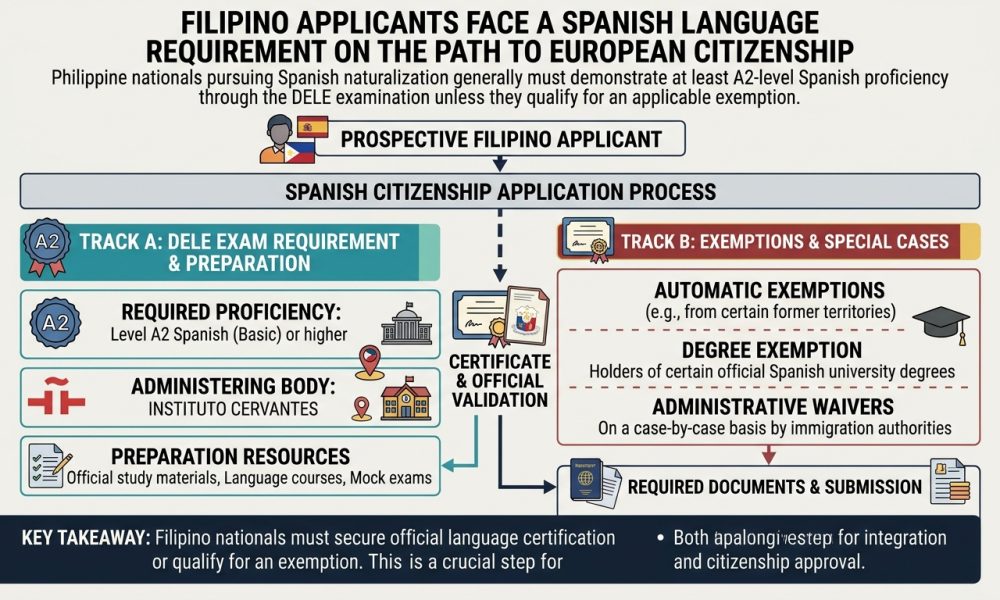
Philippine nationals pursuing Spanish naturalization generally must demonstrate at least A2-level Spanish proficiency through the DELE examination or another officially accepted qualification, unless they qualify for a recognized exemption, even when their nationality allows them to apply after two years of legal residence.
WASHINGTON, DC, November 23, 2026 — Filipino citizens seeking Spanish nationality must generally demonstrate basic Spanish-language proficiency before completing naturalization, a key requirement that distinguishes Philippine applicants from Mexican nationals, who ordinarily qualify for a language-examination exemption.
Although Spain’s Civil Code provides a reduced two-year citizenship residence requirement for qualifying nationals of the Philippines, this preferential treatment does not automatically excuse applicants from demonstrating sufficient knowledge of Spanish.
This distinction has practical consequences for Filipino professionals, students, and families considering relocation to Europe, because successful naturalization requires coordinating lawful residence, language preparation, civic examinations, background documentation, and a favorable government decision.
Spanish Citizenship Requires More Than Two Years of Residence
Article 22 of Spain’s Civil Code generally allows qualifying nationals of Philippine origin to apply for naturalization after two years of legal, continuous residence immediately preceding their application, rather than the ordinary 10-year period.
However, meeting the shortened residence threshold establishes eligibility to apply rather than an automatic right to citizenship, because Spanish authorities must also evaluate good civic conduct, integration, and other statutory conditions.
For Filipino applicants planning careers in Madrid, Barcelona, or Valencia, language preparation should begin alongside immigration planning rather than being postponed until the second anniversary of qualifying residence approaches.
The DELE A2 Examination Establishes Basic Language Proficiency
Spain’s naturalization regulations generally require qualifying adult applicants to demonstrate Spanish proficiency through a Diploma de Español como Lengua Extranjera, commonly called DELE, at level A2 or an accepted higher level.
The Instituto Cervantes administers the examination, which awards recognized Spanish-language qualifications under Spain’s established certification framework and publishes information on examinations, registration procedures, and available accommodations.
The A2 requirement measures practical communication rather than advanced academic fluency, but applicants must still demonstrate sufficient comprehension and expression to handle ordinary situations using basic Spanish vocabulary and grammatical structures.
The Philippines Does Not Receive an Automatic Language Exemption
Article 6 of Royal Decree 1004/2015 exempts nationals of countries or territories where Spanish is an official language from the ordinary DELE requirement, provided they meet the legally applicable nationality conditions.
The Philippines is not included in that exemption because Filipino and English are its official languages under the country’s current constitutional framework, despite Spanish’s historical role in earlier periods.
Consequently, a Filipino citizen who qualifies for Spain’s two-year naturalization residence provision will ordinarily still need accepted Spanish-language evidence, even though an applicant from Mexico may be excused from that particular examination.
Mexican and Filipino Applicants Follow Different Examination Rules
Mexican and Filipino nationals by origin can benefit from the same reduced naturalization residence period. Still, Spain’s nationality regulations distinguish between eligibility based upon historical national connections and exemptions based upon official language status.
A Mexican citizen qualifying for the language exemption may still need to pass Spain’s constitutional and sociocultural examination, while a Filipino applicant ordinarily faces both language and civic knowledge requirements.
This difference shows why comparing citizenship pathways solely by residence duration can create misleading expectations, especially when applicants from different countries assume preferential nationality treatment extends to every administrative requirement.
Spanish History Explains the Preferential Nationality Connection
The Philippines’ historical relationship with Spain helps explain its inclusion among countries benefiting from the reduced nationality residence period. However, the country’s modern linguistic and constitutional development produced a different official-language position.
Spanish influence remains visible in Filipino surnames, place names, legal traditions, and parts of the national vocabulary, but these historical connections do not establish that contemporary applicants have sufficient Spanish communication skills.
For prospective citizens, recognizing this distinction can make preparation more realistic by separating historical eligibility advantages from the present-day language abilities required during the Spanish naturalization process.
Recent Filipino Reporting Has Explained the Citizenship Opportunity
In a PhilSTAR Life report on Spanish citizenship opportunities for Filipinos, the publication described the documentation and integration requirements for obtaining nationality, including the DELE language exam and a separate constitutional knowledge assessment.
The reporting illustrates why Filipino applicants should distinguish citizenship through qualifying ancestry from ordinary naturalization through residence, since these pathways can involve different legal foundations and documentary requirements.
Applicants should nevertheless verify current examination obligations directly against Spanish government regulations, because explanatory reporting and individual success stories cannot replace the legislation governing their particular nationality applications.
A2 Spanish Is a Defined European Language Standard
The Common European Framework of Reference for Languages identifies A2 as an elementary level at which learners can understand frequently used expressions and communicate in routine situations involving familiar personal and everyday subjects.
For Filipino applicants, this generally involves practical abilities such as discussing work, family, shopping, transportation, and accommodation while understanding relatively simple spoken and written communications in Spanish.
Achieving the standard requires genuine preparation, especially for candidates with little prior exposure to Spanish despite living in communities where English and Filipino are widely spoken.
The DELE A2 Examination Assesses Several Language Skills
The ordinary DELE A2 examination evaluates reading comprehension, listening comprehension, written expression and interaction, and spoken expression and interaction, requiring candidates to demonstrate abilities across different forms of everyday communication.
Applicants should prepare for each component independently because conversational confidence does not necessarily establish sufficient reading or writing proficiency, especially when candidates have learned Spanish informally without completing structured language instruction.
Speaking Spanish at Home Does Not Automatically Establish Exemption
Some Filipino families preserve Spanish-language traditions or have relatives who speak Spanish, but family background and informal fluency do not automatically establish a legal exemption from the examination requirements.
A candidate who already speaks Spanish confidently may find preparation easier, yet the applicant must still provide recognized documentary evidence of proficiency unless an applicable exemption has been formally established.
Higher-Level DELE Diplomas Can Also Satisfy the Requirement
Applicants who already possess recognized DELE qualifications at level B1, B2, C1, or C2 generally do not need to obtain another diploma specifically at A2, because the regulations recognize higher proficiency levels.
A Filipino professional who previously completed an advanced Spanish-language examination should therefore verify the existing certificate’s recognition before registering unnecessarily for another test or paying additional examination fees.
Some Official Language-School Qualifications Are Recognized
Spain’s administrative rules also recognize specified official Spanish-language certificates issued through authorized educational institutions, including certain qualifications from the country’s official language schools at accepted proficiency levels.
However, certificates from private tutoring companies, commercial language applications, or informal training programs are not automatically equivalent to government-recognized qualifications, so certification status matters before selecting a course.
The Instituto Cervantes Provides Examination Preparation Resources
The Instituto Cervantes publishes information on DELE examinations, candidate guidance, and available examination sessions, allowing Filipino applicants to assess the required skills and choose preparation materials that match their proficiency level.
Structured preparation can combine classroom instruction, supervised speaking practice, listening exercises, and sample examination tasks, especially when an applicant’s biggest challenge is spontaneous conversation rather than reading familiar Spanish vocabulary.
Examination Registration Should Follow Official Procedures
Candidates ordinarily register for the DELE through recognized examination arrangements, selecting an appropriate location and session while providing the Identification details required by the Instituto Cervantes.
Because examination dates, registration deadlines, and fees can differ by country and testing center, applicants should confirm current arrangements before buying travel tickets or scheduling nationality submissions.
Spanish Examinations Can Be Taken Before Relocation
Filipino applicants do not necessarily need to wait until establishing residence in Spain before preparing for or taking a recognized DELE examination, since the Instituto Cervantes operates through an international examination network.
An applicant who intends to relocate for employment may therefore complete the language requirement earlier, provided the qualification is recognized, and the candidate retains the necessary certificate or verification information.
DELE Diplomas Generally Have Indefinite Validity
Recognized DELE diplomas generally do not expire, unlike some other examination certificates with limited validity periods, allowing successful candidates to keep their qualification for a later nationality application.
This feature can benefit Filipino professionals whose immigration plans change after completing the language assessment. However, candidates should maintain access to their official records and confirm their documentary acceptability when applying.
The CCSE Examination Is a Separate Citizenship Requirement
The CCSE examination, also administered by the Instituto Cervantes, evaluates knowledge of Spain’s Constitution, political institutions, culture, and society rather than measuring the applicant’s general Spanish-language proficiency.
Ordinary adult Filipino applicants generally must meet both requirements unless a recognized exemption applies, so it’s important to prepare separately for language competency and the civic knowledge expected of future Spanish citizens.
The CCSE Test Requires 15 Correct Answers
The CCSE examination includes 25 questions and ordinarily requires at least 15 correct responses to pass, covering constitutional principles, democratic institutions, and aspects of everyday life in Spain.
Candidates should study the official examination materials rather than assuming that passing DELE automatically demonstrates sufficient civic knowledge, because each examination measures different competencies under the naturalization framework.
The Two Examinations Have Different Validity Arrangements
A successful DELE diploma ordinarily has indefinite validity, while the CCSE certificate generally remains valid for four years, creating different considerations when applicants schedule examinations ahead of their citizenship applications.
Filipino residents should coordinate these qualifications with their expected immigration eligibility, especially if overseas travel, employment changes, or residence renewals could delay when they meet the two-year requirement.
Educational Qualifications May Support Examination Exemptions
Spain’s nationality procedures recognize certain educational circumstances in which applicants who completed qualifying studies within the Spanish education system may qualify for an exemption from examinations through specified official documentation.
Filipino graduates should verify whether their Spanish qualifications fall within the legally recognized categories, because completing any course taught in Spanish does not automatically establish exemption from both DELE and CCSE.
Secondary Education in Spain Has Particular Significance
Applicants who completed qualifying compulsory secondary education in Spain may receive special consideration under the nationality examination rules, provided accepted documentation establishes the relevant educational qualification.
The legal analysis differs from simply attending a Spanish university or completing a short professional course, so the specific educational credential matters when evaluating potential exemptions.
Disability and Learning Difficulties May Require Accommodations
Spanish examination and nationality procedures include provisions addressing certain disabilities, learning difficulties and other recognized circumstances that may justify adapted examinations or a formal dispensation under the applicable requirements.
Applicants should seek official guidance and provide appropriate supporting evidence before requesting an exemption, because difficulty learning Spanish alone does not establish that the government’s legal conditions have been met.
Minors Generally Face Different Examination Obligations
Spain’s nationality regulations generally exempt applicants younger than 18 from the ordinary DELE and CCSE examination requirements, although their nationality applications remain subject to other legal and documentary conditions.
Filipino families should therefore evaluate each child’s circumstances separately, particularly when parents and children have different ages, immigration histories, or possible claims to nationality through Spanish ancestry.
Language Testing Does Not Replace Qualifying Residence
A Filipino applicant who passes both DELE and CCSE cannot obtain Spanish nationality solely through examination success, because naturalization through residence also requires a qualifying legal immigration history.
The applicant must demonstrate continuous lawful residence immediately before the citizenship request, along with good civic conduct and compliance with the other requirements set out in Spain’s Civil Code.
Student Stay Authorization Usually Does Not Count
Ordinary authorization for studies is generally classified as estancia por estudios rather than qualifying residence for nationality purposes, meaning years spent attending Spanish universities do not automatically begin the two-year naturalization period.
A Filipino graduate may need to transition to employment residence or another appropriate category before accumulating the legal residence needed for a citizenship application, even if the student has already passed the language examination.
Employment Residence Can Establish the Necessary Foundation
Filipino professionals who obtain qualifying Spanish employment residence may begin building the immigration history relevant to naturalization, provided they maintain valid authorization and comply with the continuity conditions established under nationality law.
Employers, professional qualifications, employment contracts, and Social Security registration can matter during immigration processing, although these documents do not replace the separate language and integration evidence required for citizenship.
Highly Qualified Professional Residence Provides Another Possibility
Spain’s specialized international mobility framework offers residence arrangements for qualifying highly qualified professionals, including individuals recruited for eligible managerial, technical, or other specialized activities under applicable employment conditions.
For Filipino engineers, healthcare specialists, and technology professionals, these arrangements can provide a lawful residence pathway, though professional recognition, salary requirements, and government approval must be assessed before relocation.
Residence Cards and Municipal Registration Document: Different Facts
Spain’s TIE foreigner identity card documents an immigration classification, while municipal registration through empadronamiento establishes an administrative record of habitual residence within a particular municipality.
Filipino applicants should keep both documents with the original immigration authorization, because local address registration cannot, on its own, turn a student stay or tourist visit into qualifying citizenship residence.
Nationality by Origin Determines the Preferential Residence Period
Spain’s two-year naturalization provision generally applies to Philippine nationals by origin, so the applicant’s legal basis for Filipino citizenship matters when determining whether the shortened residence requirement applies.
An individual who later acquired Philippine nationality through naturalization should not assume that holding a Philippine passport automatically provides identical eligibility, especially when their original nationality and immigration history require review.
Previous Foreign Nationality Can Affect Application Documentation
Filipino applicants who previously held another nationality or later acquired additional citizenship may need to provide documents establishing the relevant dates, legal classifications,, andongoingg recognition of their nationality relationships.
These records can matter when determining eligibility for the reduced residence period, exemption from examinations, or the consequences of eventually acquiring Spanish citizenship under applicable laws.
Philippine Citizenship Can Have Separate Retention Rules
Spain generally provides favorable nationality treatment for qualifying Philippine nationals acquiring Spanish citizenship, including exceptions to the ordinary renunciation declaration required of certain applicants from other countries.
However, Spanish nationality rules do not determine every consequence under Philippine law, so applicants should distinguish the requirements of both governments before completing naturalization.
American-Filipino Applicants Face Additional Responsibilities
Some Filipino professionals also hold United States citizenship, creating circumstances in which Spanish immigration and nationality planning must be coordinated with separate American passport requirements and international financial responsibilities.
The U.S. Department of State’s guidance on dual nationality explains that Americans may hold additional citizenship while remaining subject to applicable U.S. legal obligations, including passport requirements for international travel.
Financial Planning Remains Separate From Citizenship Examinations
Filipino residents establishing homes in Spain should review income taxation, social security, and other obligations based on their circumstances, especially if employment or investments continue to generate income outside Spain.
Passing language and civic examinations does not exempt them from those obligations, just as paying Spanish taxes does not, on its own, establish eligibility for nationality without sufficient legal residence.
The Naturalization Application Requires Supporting Records
A complete citizenship application may require birth records, residence documentation, relevant criminal background certificates, examination results, and other evidence based on the applicant’s nationality and personal circumstances.
Documents originating in the Philippines may require authentication and sworn Spanish translations, so early preparation matters when administrative processing or inconsistencies could delay submission after the qualifying residence period.
The Government Must Approve Citizenship Independently
Even when a Filipino applicant completes two years of qualifying residence and obtains recognized DELE and CCSE results, the Ministry of Justice must independently determine whether the remaining statutory requirements are satisfied.
A successful examination therefore supports the application but does not guarantee approval, particularly when residence continuity, good civic conduct,t or Identification records raise matters requiring additional governmental review.
Spanish Citizenship Can Eventually Provide EU Mobility Rights
Successful naturalization gives qualifying Filipino applicants Spanish nationality and the associated European Union citizenship rights, potentially supporting residence, employment, and family mobility across participating member states under applicable legislation.
These opportunities begin with legally effective acquisition of nationality rather than holding a residence card or examination certificate, making the government’s final decision and required civil registration formalities essential.
Language Preparation Should Begin Before Citizenship Eligibility
Filipino residents pursuing the two-year pathway can benefit from starting DELE preparation early enough to complete the assessment without delaying an otherwise eligible nationality application.
Regular Spanish conversation, structured study, and practice with recognized examination materials may improve preparedness, particularly for applicants whose workplaces primarily use English or whose household language remains Filipino.
Amicus International Consulting and Second-Citizenship Planning
Amicus International Consulting examines broader international mobility considerations through its second-citizenship planning analysis, providing context for applicants comparing lawful residence-based nationality routes with other approaches to obtaining additional citizenship.
Its international relocation and citizenship advisory services also address cross-border planning. Meanwhile, the Instituto Cervantes administers the exam, and Spain’s competent government institutions handle nationality approval.
Accurate Expectations Can Prevent Avoidable Application Delays
Filipino applicants should establish a realistic sequence involving immigration authorization, continuous residence, language certification, civic examination results, and official documentary preparation before selecting a projected citizenship application date.
The most common planning risk is treating Spain’s preferential two-year provision as an unconditional passport timetable, rather than recognizing that lawful residence and successful completion of separate substantive requirements must coincide.
Conclusion: Filipino Applicants Must Plan for Both Language and Residence Requirements
Spain’s nationality system provides qualifying Philippine nationals by origin with an important two-year residence advantage. Still, the country’s DELE exemption for recognized Spanish-speaking nationalities does not ordinarily extend to Filipino applicants.
The A2 language requirement, together with the CCSE examination, qualifying legal residence, and good civic conduct, creates a structured naturalization process that applicants should prepare for before becoming eligible to submit their requests.
Ultimately, Filipino professionals and families seeking Spanish citizenship in 2026 should distinguish reduced residence requirements from examination exemptions, ensuring their European mobility plans reflect current legislation, recognition, qualifications,s and independent government approval.




